
We finished last week heading north up the Icefields Parkway from the Athabasca Glacier towards Jasper.
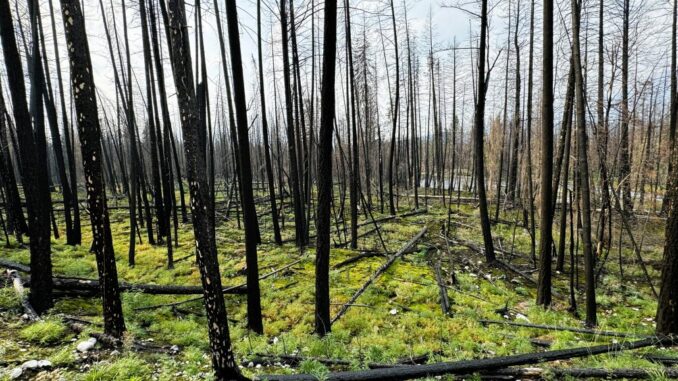
In Summer 2024 two large wildfires had swept through the area causing significant damage to the town and many miles of the surrounding forest. https://en.wikipedia.org/wiki/2024_Jasper_wildfire
By the time I had reached Sunwapta Falls there were already signs of burned trees alongside the road and as far as the eye could see. This continued, albeit with a few unaffected patches, as far as the Park Rangers’ toll booth just south of Jasper. This had previously been a nice little log cabin but had now been replaced with a fibreglass portacabin, a portent of things to come. Further along, the campgrounds alongside the road were closed to visitors and now occupied by even more portacabins, which looked like they were accommodating the workers clearing up the mess, as well as displaced locals.
© Snotsicle 2025
Heading into the central, touristy part of town things seemed a little better. The Nesters supermarket, bars and coffee shops were all intact, as were most of the low-rise hotel & motel complexes, however some of them looked rather newer than I remembered so it’s possible that they had been rebuilt over the previous year.
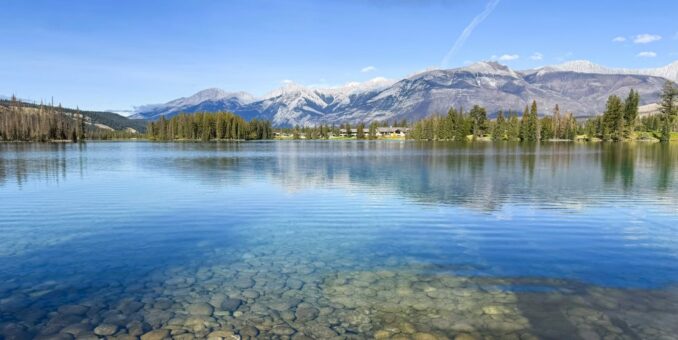
As I mentioned last week, my usual choice of accommodation hadn’t been accepting reservations earlier in the year, so I’d had to choose a lodge near Pyramid Lake, a couple of miles on the other side of town, where there was no fire damage at all. Driving around to my favourite hotel the following day, though, I was very pleased to see that it was open for business again, the buildings, golf course and most of the trees having been saved by the complex’s own private fire department!
© Snotsicle 2025
Likewise, the local ski hill at Marmot Basin had also escaped mostly unharmed, although it was closed and boarded-up when I went to have a look at it, with no summer activities on offer.
As for the burned part of the park, much of it will take many decades to return to its former glory, although shrubs, grasses and deciduous bushes were already starting to appear in areas where little sunlight formerly reached. Two of the “Red Chairs” trails that I had intended hiking were cordoned off due to risk of falling trees, so I was somewhat limited to areas around the lakes, which had already been made safe.
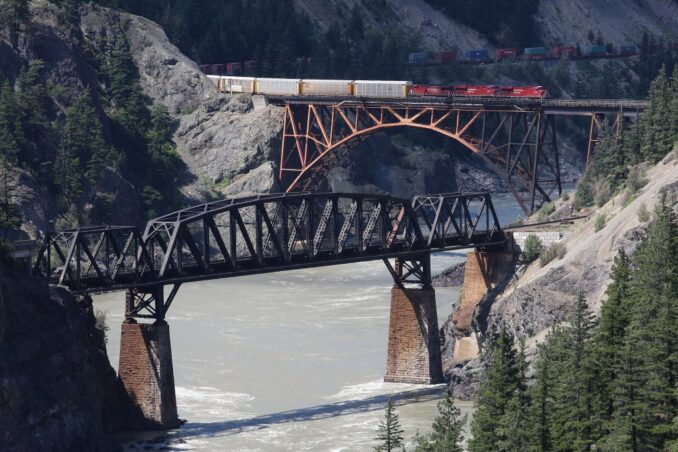
After three days seeing the sorry state of Jasper, it was time to start heading west again in the general direction of my final goal. Vancouver would be a long journey to attempt in a day, and battling with the city traffic after an eight hour drive down the Yellowhead Pass was probably not a good idea, so I decided to overnight at another favourite skiing haunt of mine, Whistler, situated on the Coast Range just inland from the Strait of Georgia – 462 miles plus a brief detour to have lunch at Sun Peaks. It’s a very pretty drive across the western Rockies and along the Fraser River valley. On the north side runs the Canadian National railroad between Kamloops and Vancouver, on the south side their rivals Canadian Pacific duplicate the same route, although they apparently now share each other’s tracks for the sake of efficiency with one being used for westbound traffic while the other is used for eastbound.
Michael Frei, CC BY-SA 4.0, via Wikimedia Commons
Rolling into Whistler in late afternoon, it’s a novelty to see other visitors walking around wearing trainers, shorts & sun hats rather than ski boots, Gore-Tex and helmets as has been the case during all of my previous visits. It was very much the shoulder season with the summer mountain-biking having recently closed and all the village services transitioning into winter mode. The hotel concierge staff were already wheeling racks of rental skis into the store room ready for the snow season opening day at the end of November and the “gear” shops were doing likewise – sandals and lycra out, puffer jackets and snowboard boots in.
After a comfortable night, I was ready to hit the road the rest of the way down the “racetrack” (highway 99 was improved and partially twinned in advance of the 2010 Winter Olympics) to Vancouver Airport, known locally as YVR. I’m not heading back home yet, but the rental car company from whom I collected the RAV4 in Toronto would only let me keep it for a maximum of 30 days and wouldn’t allow me to drop it off any further than YVR, for some reason. My plan was to hand it back, check into the hotel inside the terminal for a night and then spend the day in Vancouver before picking up a new rental car the following morning. Crossing Vancouver wasn’t too bad for someone used to London traffic, but it was a good decision not to attempt it while tired.
Heading straight into the National Rent-a-Car return lane, a very pleasant lady checked for damage (there wasn’t any) and scanned the barcode on the car with her little iPad thing, which reported the mileage covered – a surprising 8,033 km or 5,000 miles in 24 days. She was very interested to know about my journey so far and suggested some places to visit in my next destination.
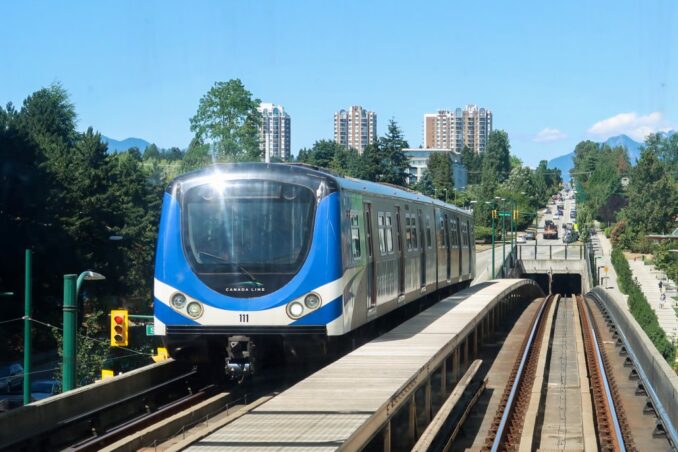
With luggage wheeled into the lift, up to the hotel and dumped in my room, there was plenty of time to take the “Skytrain” into the downtown area to do some shopping and have a wander around the city. For those wondering, the Skytrain is a small light-rail system, similar to the Docklands Light Railway, which runs on elevated tracks through the outskirts of the city before diving underground in the central area. The Canada Line conveniently offers a direct service between the airport and Waterfront Station, which is within walking distance of most of the interesting parts of the city, taking about 25 minutes from end to end.
Wpcpey, CC BY-SA 4.0, via Wikimedia Commons
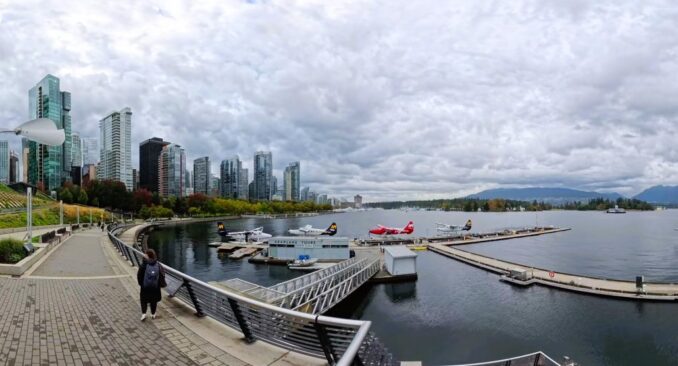
Vancouver is as close to being a perfect city as you are likely to find anywhere – coastal, fairly temperate (it rarely snows despite being within sight of three local ski hills) and very modern, but with some historic buildings in the downtown area.
© Snotsicle 2025
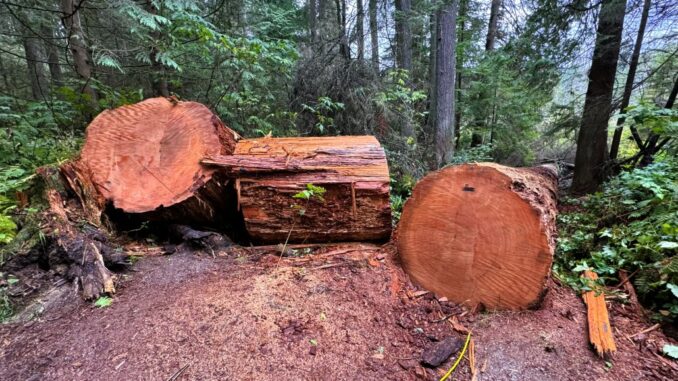
Walking from Waterfront Station a pedestrianised route passes the cruise terminal, the seaplane base (Harbour Air’s much-publicised battery aeroplane was notably absent), around Coal Harbour and eventually ends up in Stanley Park. It is a lovely urban park named after Lord Frederick Stanley, a former Governor General and creator of the Stanley Cup ice hockey championship. It is apparently the largest urban park in North America, most of it densely covered with large old-growth trees but also has a few formal gardens, some sports facilities and two lakes.
© Snotsicle 2025
A quick stop at another Amazon locker to collect an extra micro-SD card before heading back to YVR for dinner and a night’s kip.
Tomorrow, I will collect my second rent-a-car and board another boat…..
© Snotsicle 2025

.jpg)
