Back in March of this year, I authored a series of articles on GP based on my translations of the Feldpost letters of a German soldier, Hans Coutandin, to his girlfriend Evchen Möller. Part 6 ended with my having found pictures of a Hans Coutandin as a member of the “SV Rot-Weiss Walldorf EV” Bundesliga football team in the 1950s with the intriguing possibility that this was the same person.
Since then, further research and the chance purchase of two more Feldpost letters and an accompanying photograph from a dealer in Germany have revealed just what may have happened to Hans.
The first letter, strangely dated 6 July 1942 but actually from 1943, is from Afrika and the first to Evchen as a Prisoner of War:
“Dear Evchen, I could yet for so long not from me let hear, hopefully you have not with me in the meantime got angry. Above all things I would like to tell you dear Evchen, that I am still doing quite well, which I also from you and your loved ones hope. Your last Letter I still answered, but if you have still received it, I do not know. Am from 12 May in captivity come. In also the first days two Walldorfers met. The first is called Ludwig Müller and lives in Jourdan Street after by the Gundhof. His mother you surely know, she delivered always newspapers. If you know her, you can to me later write. An address I do not have yet so to me you cannot write. Dear Evchen, I have also lost your picture again. When I have an address again, can you to me perhaps another picture send. Now I would like for today close and greet you with all my heart, your Hans. If you my sister can see, then tell her that I wrote.”
The Gundhof is a beer garden and restaurant that is still in Morfelden-Waldorf, located in the Wald or woods near to Frankfurt Airport.
The second is dated 11 August 1943 and is written on a Prisoner of War letter form.
“Dear Evchen! Today finally I succeed in to dear Evchen a few lines to write. I hope, that this Letter also gives you great pleasure, which you can to me finally once write. Above all things it gives me now great pleasure, because I also for Post can wait and above all can wait for the pictures, which I only in the first Letter have ordered. I believe after all certainly, that you immediately my wish fulfil. Dear Evchen, it is today the second letter that I to you can write. My loved ones at home have I also I four times written. I am so far doing well, which I also above all for you and your loved ones hope. What have you dear Evchen now undertaken? Did you the small package from me receive? There was a good bar of soap for you inside? Everything else with the old. I am still healthy and that something is the main thing. Once again I remind you dear Evchen of some pictures, especially of a picture of you in postcard size and possibly small B. if possible? Now I want to close and greet you dear Evchen a thousand times and with all my heart. Your Hansi. Greetings to your parents.”
This letter was sent from “Camp 210” which was in Algeria, with barbed-wire perimeters around the former French fort at Cap Matifou, tented accommodation, coastal access for ship-loading, and which was operational from January 1943 to late summer 1943.
The reference in the letter to a “good bar of soap” ties in with the returned as undeliverable letter that Evchen had sent to Hans on 30 April 1943. A “small B” being for “Bildgröße” or “image size”, i.e. a small contact print size photograph for a wallet.
This second letter has further interest as on the back it appears to have been used for a draft in pencil for a letter to Hans from Evchen written in the same Sütterlinschrift as in Evchen’s undeliverable letter to Hans. Unfortunately after 82 years it has faded and is virtually unreadable but from what can be deciphered she wrote:
“Dear Hans, About both letters I was happy because now I know at least, that you continue to be well, I had to you already written, but also our family … was … of the war classified. On 18.9, received we the news of … 6.7 and from 11.8, I was happy from the …. I had the hope that one day I would hear something from you again and now I am all the more pleased … goes well.” “…15.7, we endure the painful nights …18.9 we had the painful …” “… as we added to the letter, there is also a little investigation, for which I to you in particular …”
The draft letter also has the signature of her younger brother Gottfried on the side written in a childish hand.
So how did Hans get to Algeria?
In the War Diary of the British “No. 21 Prisoner of War Management Team” under Lt. Col. R. H. Bellamy, there is a reference that on 15 May 1943: “Final Tunis mop-up arrivals: 200 mixed Axis (150 Italians, 50 Germans inc. Luftwaffe technicians). Camp 210 population peaks at 1,800. Overcrowding eased by dual transfers: 900 to US Camp 98 (Sicily prep), remainder to UK. No incidents.”
Given he stated that he was in captivity from “12 May”, the “50 Germans” would probably have included Hans Coutandin.
18 June 1943 reference: “Administrative closure: No. 21 POW Team relocates to Bizerte; site handed over to French authorities”.
The French of course still needed British support so from the “No. 21 POW Team Extension Diary, Jul–Dec 1943” there are the following references:
July-Aug 1943: “Operational continuation: Low-population holding (c.100-300 residual POWs) for late Tunis/Mareth stragglers plus US and UK transfer delays due to shipping shortages.”
1-10 August 1943 “Camp 210 Matifou: 180 residual POWs (120 Germans, 60 Italians) from July overflow. Shipping delays (Atlantic convoy reroute) hold transfers. Mail processed 8 August: 45 letters censored/out. Rations: Local French supplied. ICRC visit 5 August: ‘Conditions stable; overcrowding resolved.’” The “ICRC” being delegates from the International Committee of the Red Cross.
11 August 1943: “Mail dispatch including German POWs (Infantry Regiments 69 and 104 batch). Pop: 210.” Hans’ letter of 11 August 1943 was probably part of this mail dispatch.
15 August 1943: “Departure: 250 total to US Camp 98 Sicily via SS Exchester Castle (Algiers 1600 hrs.). Guard: French Colonial Infantry 30 ORs. Manifest: 180 Germans (15th Panzer Division), 70 Italians.” Hans Coutandin was probably on board this ship to go to Sicily from where then other ships would be returning to the USA following Operation Husky (invasion of Sicily) by the Allies.
20 August 1943: “Full physical closure: Last 50 prisoners evacuated; site fully demobilized.”
Hans Coutandin had been in the Panzergrenadier-Regiment 115 which was part of the 15. Panzer Division. Equipped with Sd.Kfz.251 half-tracks supported by Panzer III and IV tanks, they fought in the brutal defensive battles of the Kasserine Pass (February 1943), the Mareth Line (March 1943) and the final stand at Tunis (April-May 1943). They suffered a high casualty rate (c. 70% losses in Tunisia) and with the Regiment annihilated in the Axis collapse (13 May 1943), the survivors were routed through Tunisian and Algerian transit camps like Camp 210 for onward processing and shipment.
Assuming he ended up in the USA, possibly Camp 21 in Kentucky, then he would not have been repatriated until sometime after VE Day. As an enlisted soldier with no links to war crimes (the 15. Panzer Division ignored the “commando order” for executions), he probably would have qualified for early release. Potentially transiting back to Germany via Antwerp, he would have been back home during late 1946. ICRC delegate notes from similar cases emphasize “healthy” returns for 15th Panzer Division infantrymen. The denazification process was minimal for low-rank soldiers so he would have returned to Walldorf to civilian life as there are no records for him in the Bundesarchiv personnel files for post-1945 Bundeswehr service.
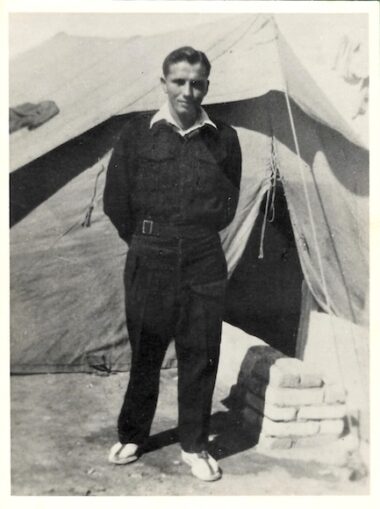
As for the photograph purchased with the letters, the soldier in POW uniform outside a tent is a match for the “SV Rot-Weiss Walldorf EV” player (see Desert Mystery: “Letters from a Feldgrau” Part 6) [linky] with the photograph possibly having been taken at Camp 210.
© John Tull 2025, Going Postal
Hans had progressed from being a Arbeitsmann in the Reich Labour Service in 1940, a Schütze in the Infantry Replacement Battalion 697 in France in 1941, a severely wounded Soldat in the Field Replacement Battalion XII/9 in Soviet Russia in 1942, an Obergefreiter in Africa in the Panzer Grenadier Regiment 115 in 1943 to end up as a POW firstly in Algeria, then Sicily and finally in the USA. Given the high casualty rates during his time in Russia and latterly in Tunisia, he was lucky to have survived the war and still be able to play football afterwards.
As for Evchen, I have found no records for her post-war but may find some clues amongst the 50+ letters still awaiting my translation that were written by her father Karl to her mother and her brother Johannes, and from his friends to Johannes when he too was in the Wehrmacht.
© John Tull 2025