
It takes a week to cycle from Penzance to Berwick. It took me 40 years. Because on the way, I wanted to include every town in England, in what amounted to some two years of day-rides. Most of these rides were point-to-point, but some were loops, and some looked on the map like a dropped noodle. It wasn’t a continuous line, but many separate lines, and all rides included towns I had not visited before. I used trains to get to starting points. Each ride had to be at least 20 miles, and in each new town, I had to touch a central feature, ideally the market cross or town hall. This is just one of hundreds of rides on this lifetime’s journey. A few more journey writeups can be found at my “Riding the Shires” website, from which this was taken, at Riding the Shires. Half a century of cycle-touring.
September 2024, Chiltern hills: I’ve had a fair few disasters in the saddle over the years, but usually in the middle of rides or after nightfall, when I’m tired, running out of time and no longer watching the ball. This one happened before the ride had started. In fact, it happened before I’d even caught the train to the starting point.
The plan was an ambitious hack across West Devon, starting near Plymouth. It was late summer, so I was going to have plenty of daylight, but I still had to get up at five to catch to the train into Devon, boarding at Reading. To reach the station, I had to cycle down the Chilterns through the dawn.
The previous evening had been very wet, and the downpour during the night so heavy that I’d awoken several times. I could hardly remember rain like it — you could hear it drumming and hammering down on the usually muting roof-tiles.
It was still pissing down at five-thirty when I set off. Minutes after leaving, I looked up at the pitch-black sky and wondered whether to abort. But the train and hotels were all paid for, with no chance of refunds. I took my streaming glasses off — better just not wearing them in this weather — gritted my teeth and headed down the lane in still total darkness.
About a mile in, a couple of orange lights were winking oddly ahead. It looked like somebody might be in trouble. Drawing nearer, I made out a stationary car, parked at a funny angle to the curb. Then I became aware of a strange drag on my wheels. Before I knew it, for I couldn’t see anything below the waist, I was knee deep in water. I knew this road; this wasn’t a dip, but it was a sort of cutting where water could shallowly gather. I pressed on, thinking it would just be a big puddle. But it got deeper, until it was like wading through a river. I passed another stranded car. After about a hundred yards, I began to wobble as the floodwater dragged me to a crawl. I realised I was going to fall off.
Desperately I tried for the edge of the road, but didn’t quite make it. I managed to flop onto the high verge, getting wet only up to the waist. But the bike, including baggage, went fully under for a good few seconds. I righted it as fast as I could and waded another 200 or 300 yards. It just went on and on. This was the worst flood I’d ever encountered in years of wet-weather riding, and I still couldn’t even see clearly what I’d blundered into.
But I knew one thing: I was soon going to find out how well a laptop computer copes with total immersion. I didn’t dare to check the damage on the spot. Instead, I just belted on blindly through the rain and then through the dawn, glided down the Assendon Valley and got into Henley in fairly good time. From here, I took a local train to Reading, where I sat around for a miserable half-hour in the rush hour waiting for the express to Plymouth. I was still leaving a trail of water wherever I walked, and chill was beginning to set in. I couldn’t remember a less promising start to a long ride, but I was grimly committed now.
The Plymouth train was warm and, to my astonishment, nearly empty. I wedged myself and bags into a table seat, unpacked and gingerly surveyed the damage. Which was considerable. First off, the computer was stone dead. I’d broken my iron rule of not wrapping the bugger in a plastic bag, because the briefcase — briefcase! — I’d stupidly chosen to put my luggage in was itself wrapped in a big carrier bag. So while I had outer protection, there was no waterproof inner wrapping. Unfortunately, the carrier bag had been breached when the bike went over. Not a lot of water had got to the laptop. But it had been enough. It wouldn’t start up, and never would again.
That, however, was only the top item on the list. When I’d taken my glasses off at the start, I’d stupidly put them into an outer pocket without their case. As a result, the right lens had been dented by a camera edge when I’d fallen over onto the verge, and it now had a big, blurry scratch. Also broken was my expensive back light, which ought to have been able to survive a quick ducking. And I’d left my padlock in the floodwater. All in all, a costly 30 seconds. To ice the cake, though my ancient mobile had survived, I couldn’t leave it on long as the charger worked through the now-dead computer.
The nearly empty train, again to my surprise, ran non-stop to Taunton, right across the Wessex heartlands. It was just as well there were so few passengers, as this meant I could spend the better part of half-an-hour – west Berkshire and Wiltshire – locked away in the toilet holding my soaked shoes under the dryer. I had another reason for doing this. Empty as my coach was, it wasn’t quite empty enough. At the other end sat a chav mother with her three infants, whom she allowed to run around the coach screaming their heads off as if this were a kindergarten. Being a resident of Britain, of course, I was used to stupefyingly selfish and obnoxious behaviour on public transport, but this horrible trio of shouting and shrieking brats eventually drove me out of the coach altogether.
We reached Taunton in little more than an hour, and then sat there for 15 minutes because “the relief driver is late.”That was because the silly man was coming by rail, of course. A train driver, of all people, should have known better than to rely on the trains. This delay lengthened to 30 minutes between Exeter and Plymouth, because we got stuck behind a slow train. I did some more shoe-drying in the toilet, but the powereful hot-air blast was proving surprisingly ineffective.
When we eventually pulled into Plymouth, the weather had cleared a bit and I thought that the day’s woes might be over. Alas no. Because of the delay I’d missed the connection on a local to Calstock, which I now needed because, having lost time, the whole leg from Plymouth to Holsworthy would have been too much to ride. Not knowing what to do, I drifted helplessly around town a bit, until I passed a bus stop at which a Tavistock service was due. Tavistock was en route. It pulled up as I hesitated. Trusting the driver would take a foldable, I got on. He nodded “OK.” From Tavistock, I’d at least get five hours of daylight riding out of this wretched day.
This too proved a very British public transport journey. At the second or third stop, a jaunty, wired-looking bloke in his thirties came aboard singing at the top of his voice. He sat in the slightly raised back row of the lower deck, from where he regaled a scattering of embarrassed shoppers with a selection of MOR evergreens, in particular, Can’t help falling in love. Over and over he sang it, undisturbed by the driver. That song is irritating enough even when done properly, but there was something downright spooky about his leering face toothlessly mouthing the words “can’t help falling in love with you” as he serenaded elderly ladies with shopping bags. He kept it up, with breaks, throughout the whole incredibly slow ride to Tavistock via Derriford hospital. I’d hoped he’d be getting off there for his weekly session with the drug nurse, but he stayed aboard. Nobody dared to tell him to shut up.
It was lunchtime by the time I got off at Tavistock and finally started the ride. Though this town has Saxon origins and grew fat on the mediaeval wool trade, its face today is Victorian, like Camborne’s, as it became a copper-mining centre. I didn’t have time to do it justice and missed everything of interest, I think, except the statue of its local hero, Francis Drake, commanding the junction at the crossing of the River Tavy.

Devon lane
My route was through the unknown Devon, the great swathe of the county that’s neither moor or coast, and lies far away from the major communications corridors. For most of the day, I was riding across undulating farmland between three moors, Bodmin, Exmoor and Dartmoor, all of which came into and out of view, and at one point were all visible simultaneously. I didn’t pass through a single town before the destination.
The soggy-looking sheet of low cloud never really lifted all day, but the rain didn’t return. It was a strange kind of non-weather, a sullen calm after the torrents, and there was a curious lack of animation in the scene. I had few occasions to get the camera out, and when I did I found that the morning’s disaster had buggered this up too. Drops of water had somehow got into the lens. But it did eventually dry out.
There really isn’t much else to say about this ride. The going was easier than I’d expected, along quiet lanes that meandered along through hamlets and villages of Devonian granite capped with slate roofs, with delightful names like Chillaton, Quither, Tinhay, Broadwoodwidger and Whimble. The terrain was rolling rather than hilly, like a rumpled quilt, patterned with squares of green pasture and yellow maize, and seamed with thick hedges and trickling streams. There were even a few airy miles of ridge-riding. I chewed on a flapjack at a lonely petrol station on a rise somewhere. I sat on a bench on a little village green looking out to the dark, shallow dome of far-off Dartmoor. By a field gate, I watched a bull lasciviously sniffing a cow’s anus, from which a stream of greenish shit spurted and splattered amorously at his fore-hooves. I was sure he was about to attempt a mount, but they were dragging out their moment of bovine sexual tension, and in the end I got bored with waiting. In this way, I knocked off about 35 miles in about six hours at my usual laboured West Country pace.
It was all pleasant enough, but this large agricultural tract of England’s third-largest county lacked the cob-and-thatch charm of its southern and eastern parts. There weren’t even any good churches to stop for. I was also quite surprised at the badness of the signposting. Some junctions had no signposts at all, and quite a few posts had broken arms.
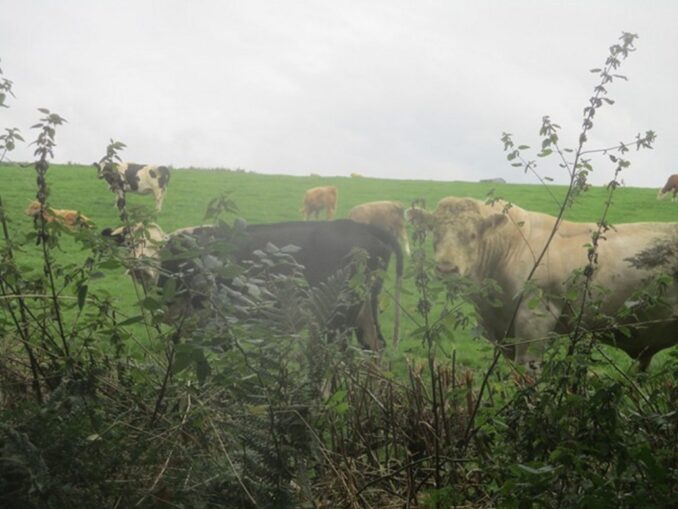
Bovine courtship
I didn’t dry out from the morning immersion, despite the six-hour airing. It was disgusting blowing my nose into cold, soggy pocket tissues. Even my wallet contents got wet. The only accessory that had escaped unscathed was, of all things, the old analogue Walkman I used to record these notes.
Darkness had just fallen when I rolled into Holsworthy, after long miles of dusky lanes. I entered the town via the old disused railway bridge, which in the murk resembled a mediaeval archway framing the main street rising behind it. It reminded me slightly of the entry to Alnwick.
My room was at — let’s say — The Roebuck, which, as I’d fervently hoped, proved to be a town-centre coaching inn, though my room overlooked the outhouses at the back rather than Holsworthy’s old market place. Still, the building had history. It had been a coaching house on the minor Exeter to Bude route, the cheery manager explained, and once had stabling out back.
For me, no coaching inn is complete without ridiculously twisting stairways to stumble over, a dangerously low sloping ceiling to bang your head on, and a wonky old key-lock to struggle with. Once I’d battled my way into my room, I rubbed my smarting ankle and sore bonce and then, with something approaching rapture, took all my clothes off. If you have ever spent the whole day in cold, wet socks, underpants and shirt, you’ll know what I mean by “rapture” here. Then I walked over to the shower cubicle.
I suppose I’ll know my travelling days are done when I can no longer find things to moan about in hotel rooms. I thought I’d seen it all – the dead TVs and radiators, the flat remote-control and door-lock batteries, the junk-shop furniture, the street and disco noise, the wifi signal so weak it seems to be coming from Mars, the stale UHT milk sachets, the toilets without toilet paper – but The Roebuck broke new ground. Here was a shower cubicle that a normal adult male of average girth couldn’t get into.
It was shaped like a telephone booth, only the door opened inwards. That was the problem. This design meant that only somebody less than eight inches thick could get round it to the showerhead. At first, I simply couldn’t believe my eyes. Surely they’d tested it before marketing the thing? Surely I was missing a clever retraction mechanism, some hidden lever? Nope. Like a potholer, I edged myself into the cubicle, and, as expected, got stuck, pinioned by the door into a corner. If I forced the issue, I could see myself causing the entire rickety unit to burst apart, leaving a bare showerhead in a sea of broken perspex panels. I gave up and gingerly eased myself back out. Then I laid a few plastic bags on the carpet and washed at the little sink in the toilet, with the help of an empty litter bin.
I thought about stomping downstairs to moan at the manager, but apart from making him feel bad, I couldn’t see what that would achieve. It wasn’t as if he was going to call in the emergency services to retool the shower on the spot. And the other rooms likely had the same shower unit anyway. I supposed it was just possible that every adult male guest, on finding the shower unusable, had had exactly the same thoughts as me, and so nobody had ever told him. At any rate, I said nothing. I liked the place and I wanted him onside.
Refreshed, after a fashion, I went down and sat in the bar, eavesdropping a trio of locals effing and blinding over a Sky TV report on an Israeli attack on Beirut that had killed 365 people. Snippets of their talk betrayed a clear lack of sympathy with the Arabist cause.
“Fucking ’Ezboller, ’iding in their tunnels, had it fucking coming, didn’t they? Know who I feel sorry for, them fucking Maronite Christians ..
“Eh? Marrow- what? Wossat then, Joe? ..
“All that fucking sectarian shit .. Price of lucerne’s a bugger, innit?”
My steak and ale pie arrived quickly, and very fine it was for the price. I went up to the bar afterwards and chatted with another regular, who told me a bit about the town.
“Old market town, in the Domesday book. Not much to add to that really.” The main thing about Holsworthy today, he said – and surely I’d noticed this myself – was its isolation. “There are only three places you can get to by direct public transport from here, Barnstaple, Bude and Tavistock. That’s it. Three bus routes, and they’re fast either. Anywhere else, you’re stuck if you ain’t got your own wheels. Nothing long distance at all.” l later checked that: he was basically right, though he left out Okehampton. “Not that anybody wants to come here anyway. Summer overspill from Bude is what keeps the hotels in business.
“And yet, for all that, it’s a traffic nightmare. Roads are way too narrow and you get farm vehicles trundling through all day knocking bits off the buildings. But there’s not much else to complain about. I like the pace of life down here. It’s quiet, but not dead like some country towns. There’s community life here.” (Part 2 to follow)
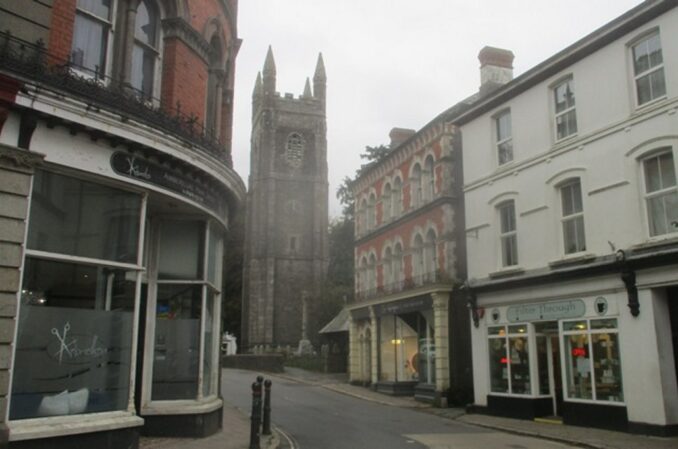
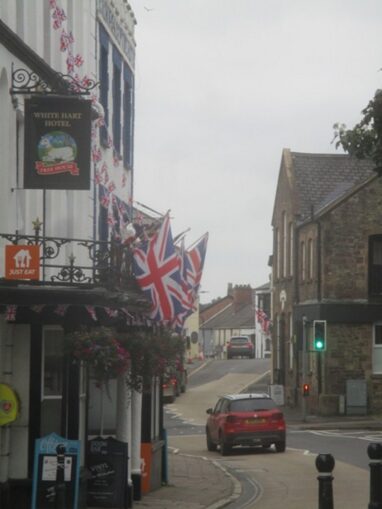
Holsworthy
More like this can be found at my website Riding the Shires. Half a century of cycle-touring.
I’m fine with being quoted (up to two paragraphs), but all rights @joeslater.
© text & images Joe Slater 2025