Collingwood was the other admiral at Trafalgar. He was the first into the fight, took charge of the whole fleet after Nelson’s death and brought every British ship through the storm that followed. He was then made Commander-in-Chief of the Mediterranean fleet, a post he held for five years without once setting foot in England, during which he defended Sicily, backed the Spanish against Napoleon and dealt with the governments of Naples, Spain and the Ottoman Empire.
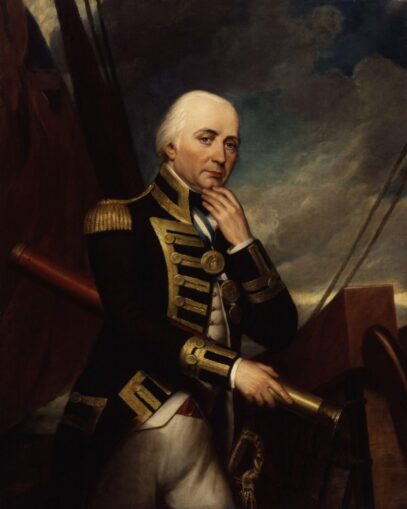
National Portrait Gallery, Public domain, via Wikimedia Commons
[Editorial note] A little preface to this story as I’ve been looking forward to this one for some time…
Growing up in Newcastle, my father would often take our family to the coast at weekends and in particular Tynemouth.
My father, being a creature of habit, liked to go through the same routine every time we visited, which would always include a visit to Collingwood’s monument, which would be accompanied by the same story, again every single time, about his actions in the Battle of Trafalgar and how he had been overlooked in favour of Nelson. I can’t recall how many years this routine lasted, but it was many to say the least. Being a child I would always find this routine extremely tedious, preferring instead to visit the arcades and Spanish City over at Whitley Bay, and ask why we kept having to go every single time to what I considered to be a very boring place.
Thirty years later I am deeply grateful to him for instilling in me a sense of pride in my home region and for educating me on our forgotten heroes that were never taught at school. For those of you who are wondering, my father is still around today and, yes, he still goes on about Collingwood. Anyway… Here you go!
It is 21 October 1805. The admiral’s servant, a Mr Smith, went into the great cabin of HMS Royal Sovereign and found his master already up. Had Smith seen the French fleet? He had not. Then he should go and look, said the admiral, because they would all be seeing a great deal more of it shortly. Smith looked, saw “a crowd of ships to leeward”, then turned round and found himself watching the admiral instead, who was shaving “with a composure that quite astonished me”.
On deck the admiral met Lieutenant Clavell and told him to take his boots off. “You had better put on silk stockings, as I have done: for if one should get a shot in the leg, they would be so much more manageable for the surgeon.” Then he went round the gun decks and told his officers: “Now, gentlemen, let us do something today which the world may talk of hereafter.”
The admiral in question was Cuthbert Collingwood.
The Side
Collingwood was born on 26 September 1748 at number 86 on the Side, the steep street that drops from St Nicholas’ church (now the cathedral) down to the quayside. His father was a merchant whose business went bankrupt. At twelve he went to sea in the frigate Shannon under his cousin Richard Brathwaite. Then came Jamaica, and a frigate called the Lowestoffe, and on it a lieutenant ten years younger than him called Horatio Nelson, who had an uncle who happened to be Comptroller of the Navy. In the 18th-century navy that was roughly the equivalent of your dad owning the football club.
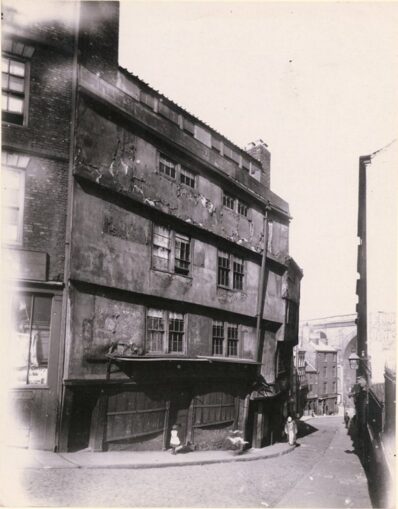
TWAM – Tyne & Wear Archives & Museums, No restrictions, via Wikimedia Commons
Nelson’s shadow
For the next few years Collingwood followed Nelson up the ladder one rung behind, in his own words: “Whenever Lord Nelson got a step in rank, I succeeded him: first in the Lowestoffe, then in the Badger, into which ship I was made Commander in 1779, and afterwards in the Hinchinbroke, a 28-gun frigate, which made us both Post Captains.” The Badger job came with the rank the navy in those days called master and commander.
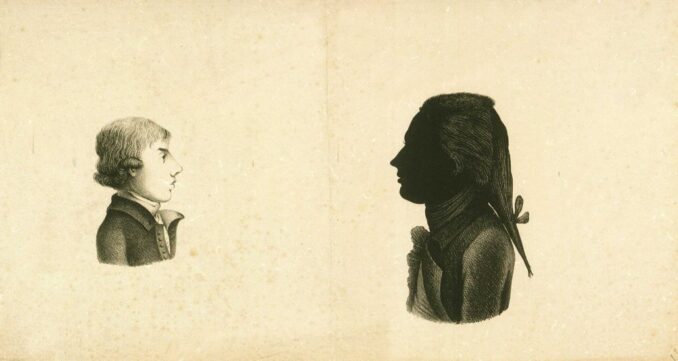
Vice-Admiral Cuthbert Collingwood, Public domain, via Wikimedia Commons
Off Cape St Vincent on Valentine’s Day 1797 Collingwood took the Excellent into a Spanish first rate of 112 guns and opened fire, as he told his wife, from “not farther from her when we began than the length of our garden”. Then he went to bail out Nelson’s ship, the Captain, which had got itself into a scrap with two Spaniards at once. Nelson wrote the next morning: “‘A friend in need is a friend indeed,’ was never more truly verified than by your most noble and gallant conduct yesterday.” Collingwood wrote back that “it added very much to the satisfaction which I felt in thumping the Spaniards, that I released you a little.”
Morpeth
In June 1791 he married Sarah Blackett, the daughter of a Newcastle merchant who was also the town’s mayor, at St Nicholas’, the same church he had been baptised in. They rented a house on Oldgate in Morpeth and had two daughters, Sarah in 1792 and Mary Patience in 1793.
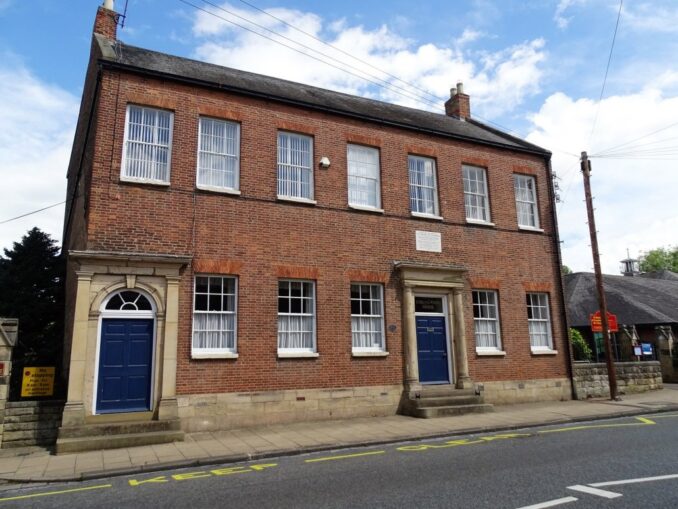
The Collingwood House by Robert Graham, CC BY-SA 2.0, via Wikimedia Commons
By his own account Morpeth was the place he was happiest, which makes it all the more sad that he spent so little time there. From sea he wrote that “whenever I think how I am to be happy again, my thoughts carry me back to Morpeth”.
In May 1803 the war with France started up again and he left to rejoin the fleet. He would never see the house again.
Trafalgar
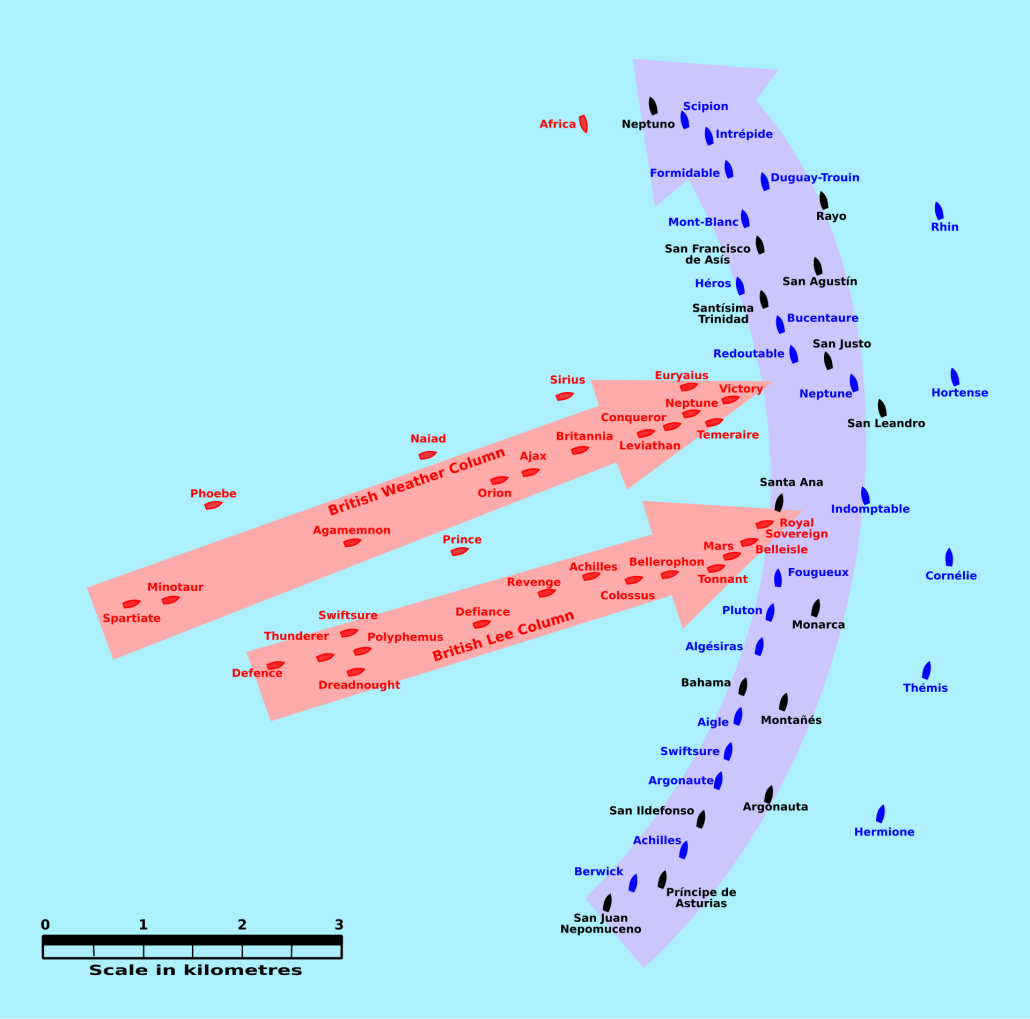
Ten days before the battle Collingwood moved his flag from the Dreadnought to the Royal Sovereign, which had just come out from England with a freshly cleaned copper bottom. This meant that on the morning of 21 October, in very light winds, she was faster than anything else in the fleet and pulled well ahead of the rest of his column.
Pinpin, CC BY-SA 3.0, via Wikimedia Commons
From the Victory, Nelson watched the Royal Sovereign head into the enemy line and said: “See how that noble fellow Collingwood takes his ship into action. How I envy him!” At more or less the same time, a mile ahead of everyone else, Collingwood said to his own officers: “What would Nelson give to be here!”
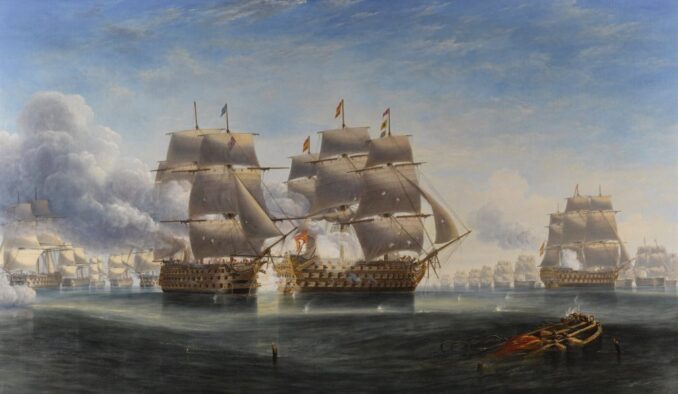
The Royal Sovereign sailed under the stern of the Spanish flagship, the Santa Ana, fired a broadside and a half straight through her stern windows, and then pulled up alongside her so closely that the two ships’ yards locked together. For around a quarter of an hour she fought on her own before any other British ship could reach her.
James Wilson Carmichael, Public domain, via Wikimedia Commons
By the end of the afternoon the Royal Sovereign had lost two of her masts and 47 of her crew. Meanwhile on the Victory, at around a quarter past one, a musket ball fired from the rigging of the French ship Redoutable had gone through Nelson’s shoulder and lodged in his spine. He died at half past four.
Collingwood now had the fleet.
The storm
His own ship was too badly damaged to carry on, so he moved across to the frigate Euryalus and started writing the dispatches. That night a huge storm blew in, and it lasted for the best part of a week. Seventeen enemy ships had surrendered during the battle, but only four of them made it to Gibraltar; the rest were wrecked, sunk, burnt or recaptured. Not a single British ship was lost.
He was made Baron Collingwood of Caldburne and Hethpool and given a pension of £2,000 a year. However, a few months later his bank wrote to tell him that “all my money in their hands is exhausted by fees on the peerage, and that I am in their debt”. His reply to Sarah says a lot about the man: “I rejoice, my love, that we are an instance that there are other and better sources of nobility than wealth.”
Five years at sea
After Trafalgar he was made Commander-in-Chief in the Mediterranean, and that is where he stayed. The job involved keeping the French and Spanish fleets bottled up in port and, from 1808, supporting the Spanish uprising against the French, almost all of it done by letter from his cabin. In 1806 he wrote home that he was “in very good health, considering that I have scarce put my foot on shore these three years; but my body grows weak and my limbs lady-like.”
He asked to come home a number of times (“Tough as I have been, I cannot last much longer”), and every time the answer from London was that there was nobody else who could do the job.
Bounce
This really is quite a sub-story within a story.
Bounce the dog had been with Collingwood since 1790, when he came on board the Mermaid as a puppy, and according to his master he “delights in the ship and swims after me when I go in the boat”.
When Collingwood was made a lord, Bounce appears to have taken it rather more seriously than he did. In a letter home in December 1805 he wrote: “I am out of all patience with Bounce. The consequential airs he gives himself since he became a Right Honourable dog are insufferable. He considers it beneath his dignity to play with commoners’ dogs, and truly thinks that he does them grace when he condescends to lift up his leg against them.”
By 1807 Bounce was “very well and very fat, yet he seems not to be content, and sighs so piteously these long evenings, that I am obliged to sing him to sleep”. He even sent his daughters the words, which are his own version of a song from Shakespeare’s Much Ado About Nothing:
Sigh no more, Bouncey, sigh no more,
Dogs were deceivers never;
Though ne’er you put one foot on shore,
True to your master ever.
Sadly, in August 1809 Bounce went overboard one night and was lost. Collingwood wrote: “He is a great loss to me. I have few comforts, but he was one, for he loved me. He was wiser than many who hold their heads higher, and was grateful to those who were kind to him.”
Acorns
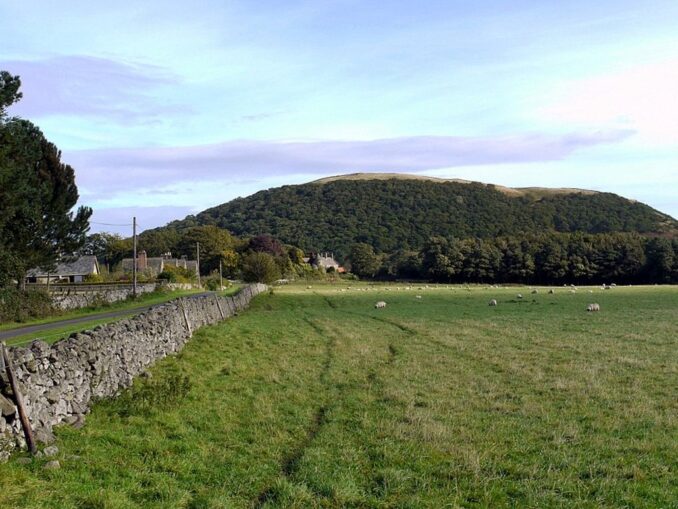
There is a well-known story that Collingwood used to walk around the Northumberland countryside with his pockets full of acorns, pushing them into the ground wherever he saw a gap so that the navy would never run out of oak for its ships. Whether he actually did this himself nobody can say for sure, but the idea certainly came from him. In a letter of 1805 he wrote: “I wish every body thought on this subject as I do; they would not walk through their farms without a pocket-full of acorns to drop in the hedge-sides, and then let them take their chance.”
Hethpoolbell Wood from Hethpool by Andrew Curtis, CC BY-SA 2.0, via Wikimedia Commons
After his death Sarah carried out his wishes and had oak trees planted on the Bell, the hill above Hethpool in the Cheviots. They became known as the Collingwood Oaks and, according to the estate, there was one for every British ship at Trafalgar. The date depends on who you ask (1813 or 1815), but the trees are still there today. Sadly for the navy, by the time they were big enough to build a ship with, ships were being made out of iron.
The last voyage
By February 1810 his health had failed completely, and he could barely walk across his cabin. He was finally allowed to go home. On 3 March, at Port Mahon in Minorca, he handed over his command, and on the evening of the 6th the Ville de Paris made it out of the harbour and set sail for England. When he was told he was at sea again, he said: “Then I may yet live to meet the French once more.”
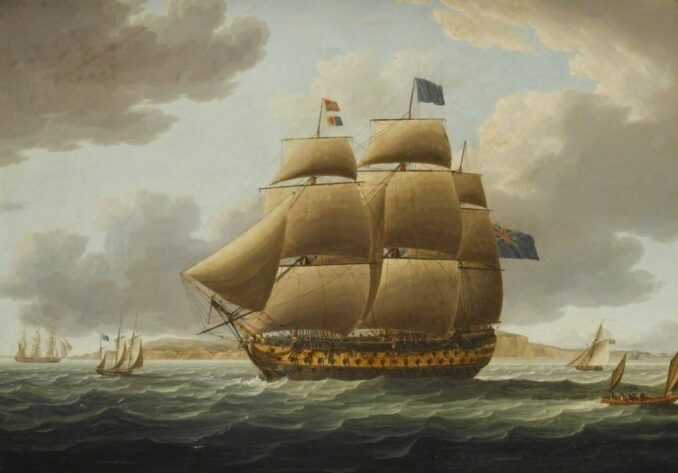
Thomas Buttersworth, Public domain, via Wikimedia Commons
The next morning Captain Thomas came into his cabin and said he was worried the rough sea was disturbing him. Collingwood replied: “No, Thomas, I am now in a state in which nothing in this world can disturb me more. I am dying; and I am sure it must be consolatory to you, and all who love me, to see how comfortably I am coming to my end.” He died at six o’clock that evening, 7 March 1810, aged 61.
His body was brought home in the frigate Nereus, commanded by Captain Peter Heywood, who years earlier had been a midshipman on the Bounty and was sentenced to hang for mutiny before being pardoned. Collingwood was then laid in state in the Painted Hall at Greenwich, the same room where Nelson’s coffin had lain four years before, and on 11 May 1810 he was buried in the crypt of St Paul’s beside him. Nelson had been given a state funeral watched by enormous crowds. Collingwood’s interment was a private one, and the Duke of Clarence wrote to Lady Collingwood to say he would have come had he known. He had asked for his title to be passed on to his daughters, as he had no sons, but this was refused and the title died with him.
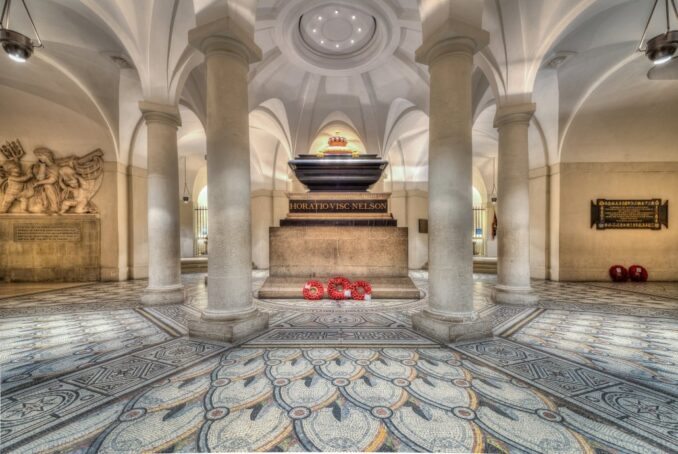
mhx from London, United Kingdom, CC BY-SA 2.0, via Wikimedia Commons
Tynemouth
Nelson’s column went up in Trafalgar Square in 1843. Two years later the people of Tyneside paid for a monument of their own by public subscription, on the headland at Tynemouth overlooking the mouth of the river. The statue is by John Graham Lough and the base was designed by John Dobson (likely to feature in a future article), the architect behind much of Newcastle’s city centre. In 1848 four guns from the Royal Sovereign were added either side of the steps.
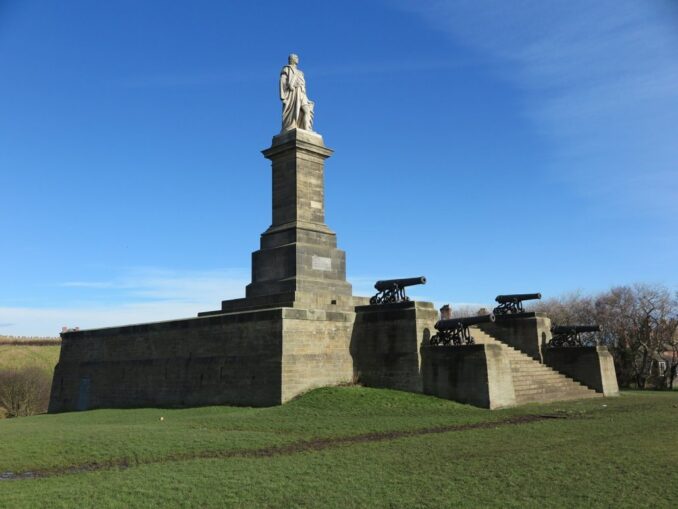
Collingwood Monument and Guns, Howl Ings, Tynemouth by Geoff Holland, CC BY-SA 2.0, via Wikimedia Commons
So, to summarise: Nelson got the column in London and the state funeral, whilst Collingwood got a statue on a windy headland at Tynemouth.
If you ever happen to be in Tynemouth, I would strongly recommend a walk up to the monument. And if there is an older gentleman hanging around telling anyone who will listen about the Battle of Trafalgar, please do say hello to my father.
© Paranoid Android 2026