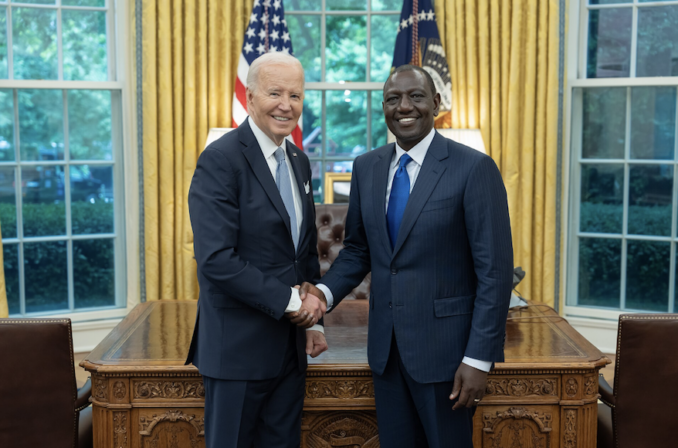
President Joe Biden poses for a photo with President William Samoei Ruto,
The White House – Public domain
While WSR attempted to wear his Koran Keir hat in attempting to navigate his tensions between African unity, Chinese ties, and the US’s evolving strategic priorities, he blinked first when dealing with the Don.
US Deputy Secretary of State Christopher Landau visited Kenya in January 2026, with WSR describing Kenya-US ties as being anchored on mutual respect and shared strategic interests. WSR and Landau also discussed counter-terrorism efforts in Somalia, with Landau underscoring the urgent need to reassess strategies after more than two decades of persistent security challenges. Talks also covered the ongoing civil war in Sudan.
Post meeting WSR in Nairobi, Landau visited the coast announcing the State Department is funding a US$70 million project to expand the current drone runway at the Manda Bay airbase as well as wider military presence in Turkana and Wajir. The base at Manda Bay is seen as a key hub for US military operations in Somalia and the region.
US strikes have targeted strongholds of al-Shabaab, an ISIS affiliate in northeastern Somalia’s Puntland region, and al-Shabaab in southern Somalia. The ground bases widen the military footprint in line with the US’ National Security Strategy and the pivot away from aid to business investment.
The obvious conflict of interest strategies appears with US strengthening its footprint security while WSR is going in the opposite direction in seeking both vote and financial support from Somali business/population. This is further compounded by WSR’s announcement on 13 Feb 2026 that Kenya’s border with Somalia will reopen after nearly 15 years, receiving support from camel herders in Jubaland/Mandera. This ties in with the Shirika Plan to seek to harvest votes given WSR’s national support has evaporated.
Given the strategic significance as a Counterterrorism Hub in East Africa: Kenya serves as a regional base for U.S. and allied operations against al-Shabaab and other terrorist groups. Further, this aims to feed into the regional stability the US provides ahead of Somali deportations from the US.
Landau’s announcement of a US military role in Kenya, provides a likely opportunity to deploy in Turkana and Wajir, PMCs at a far cheaper cost and more professionalism and accountability in having regulated forces with a peace enforcement deployment that is in keeping with the Kenya laws.
Given WSR deploying Kenyan forces on underfunded, depleted missions in Eastern Congo and Haiti, a closer look at who replaced Kenyan forces reveals more. The return of Erik Prince with his latest iteration, Vectus Global (VG). VG is now deployed in Eastern DRC on behalf of the DR Congo Government. VG is also active in Haiti with a 10-year agreement. Prince’s international, diverse career in both military, business and high-level political contacts has kept him at the forefront of economic trends and investment opportunities in emerging markets. His role has been tailored to fit in with the Don’s National Security Strategy.
Ongoing bilateral dialogue is ongoing between Kenya and the US, within which is the distinct possibility for the US contracting Vectus Global to participate in strengthening border security, reforming customs and immigration services etc. at Wajir, Mandera, Dadaab and Turkana.
Similar to arrangements in Haiti, the initial plan is for Vectus Global receiving performance-based security and infrastructure development commissions: 20% of increased customs revenues, offsetting money laundered Constituency Development Funds (CDF) and Somali money laundering from US to Kenya during the first three years, and 15% thereafter.
In addition, VG would ideally seek to have an inbuilt guaranteed fixed commission of import volumes, regardless of its effectiveness.
Beyond the sovereignty issues raised by outsourcing public security to private actors, the surge in the use of PMCs [Private Military Companies] to intervene in contexts of organised crime and illicit economies raises questions about the risk of criminalising private actors, and of fuelling, rather than containing, extractive, collusive and corrupt practices. While details remain unclear, the proposed dialogue and arrangement points to a potential transfer of critical functions – security and revenue collection (given the money laundering to Kenya from US) – into long-term private outsourcing. It would in the short term dilute any WSR control, while remaining under the statute of Kenya’s sovereign laws.
From privateers to PMCs
The practice of hiring contractors to fight one’s battles is as old as war itself. Throughout history, leaders have enlisted mercenaries to bolster their armies and privateers to plunder their enemies.
Examples range from ancient Greek and Roman armies to more recent ones, such as the mercenaries hired by the Sierra Leonean government in 1995 to combat rebels from the Revolutionary United Front/West Side boys. In the 1990s and early 2000s, PMCs – particularly those based in the US, the UK and South Africa – made fortunes by providing services to governments and regional and international organisations.
According to international norms, it should be regional or international organisations that intervene in conflict and crime zones. However, geopolitical wrangling and a lack of mandates and political will make it harder to mobilise such organisations in hotspots where they are needed. This can be seen in the recent scaling down of UN missions in the DR Congo, Mali and, soon, Lebanon. Furthermore, some consider PMCs to be more successful and cost-effective than peacekeepers.
Context and challenges – outsourcing sovereignty?
In Haiti, Prince is reported to have initiated two parallel arrangements with the government. The first involves a one-year contract for his staff to act as instructors and monitors, coordinating drone strikes against gang-controlled areas and criminal leaders, serving directly in combat operations, and deploying helicopters and vessels. The second arrangement, which has not been confirmed by the Haitian government, is said to be a 10-year agreement focused on restructuring and modernising customs and immigration services, including infrastructure development.
In this context, the opacity of contractual arrangements should not be viewed merely as a negative externality, but as an intrinsic feature that enhances their perceived value. Under the guises of efficiency, expediency and confidentiality, PMCs – and the governments that engage them – effectively obscure responsibilities and accountability, and blur established chains of command.
Meanwhile, Haiti’s police forces and previously the Kenyan-led Multinational Security Support Mission in Haiti (MSS) sorely lacked capacity and continued to plead for political, financial and material support. Nothing was forthcoming. Although the US and Panama (in the UN Security Council) and the Organisation of American States (through a roadmap) have made crucial proposals for the transformation of public security in Haiti, discussions regarding their concrete implementation have not yet been concluded. Meanwhile, the role of PMCs on the ground is becoming increasingly important.
Moreover, despite the presence of the PMCs, the situation in Haiti continues to deteriorate, with gangs dictating the pace of events. Gangs have not lost any significant territory in the capital since the arrival of PMCs in March, and have dramatically expanded their influence in the provinces.
Development at a price
What do these kinds of operations mean for combating organised crime and the political economy that supports it, particularly with regard to illicit arms trafficking, the majority of which originates in Somalia? Might the deployment of PMCs escalate violence rather than reduce it? Private armies can exert force, but can they deliver justice? If Prince’s forces capture al-Shabaab members, what would they do with them?
One of the biggest issues with deploying PMCs is accountability. The oversight mechanisms controlling Vectus Global are shrouded in secrecy. Who do they report to? How will they collaborate with WSR, the current Kenya Government? And how will WSR collaborate with the Don?
At present, there are more questions than answers. Although there are international guidelines to regulate the use of private security companies, such as the Montreux Document.
Wider regional strategy
With Israel recognising Somaliland, and the potential of VG also seeking a training/monitoring role, a visible VG presence in N/NE Kenya would severely neuter illicit Somalia trade. This would gain significant further traction if or when the Don also recognises Somaliland, who have offered the US a Gulf of Aden base as it will represent an economic counter to the BRICS agenda. Meanwhile, WSR continues to attempt to engineer an election result in his favour.
© AW Kamau 2026