
Looting, pillage, theft, billions in disbursements, all on the honour system
We are all Somalis now
In Minnesota, the bear hug of American liberal virtue, with its self-congratulatory sense of generosity and its lack of any serious demands on the people it thinks it’s helping, embraced a Somali community with the mentality, internal coherence, and organisation needed to fully exploit its hosts. The Somali enclave rapidly gained in political power, in part because of the ability of various rival clan networks to turn out large numbers of voters in low-margin DFL primaries. The Somalis became an organising and voting force in the local DFL and began winning elections: to the Minneapolis school board in 2010, to the city council in 2013, and to the state House of Representatives in 2016 — it would take Ilhan Omar just two more years to make it to Congress. Meanwhile, by the late 2010s, the furtiveness and modest scale of existing frauds joined with the in-group discipline of Somalis to create a dense screen of protection for thieves.
The state’s entire view of its role in society would soon change in ways that made the frauds far easier to execute. In 2016, Minnesota introduced a $35-million programme that provided direct funding to state-based nonprofits working on issues of racial equity. Over the next few years, the state embraced an easily abused model of service delivery through private-sector clients, even as evidence mounted that these programmes were beacons for fraudsters.
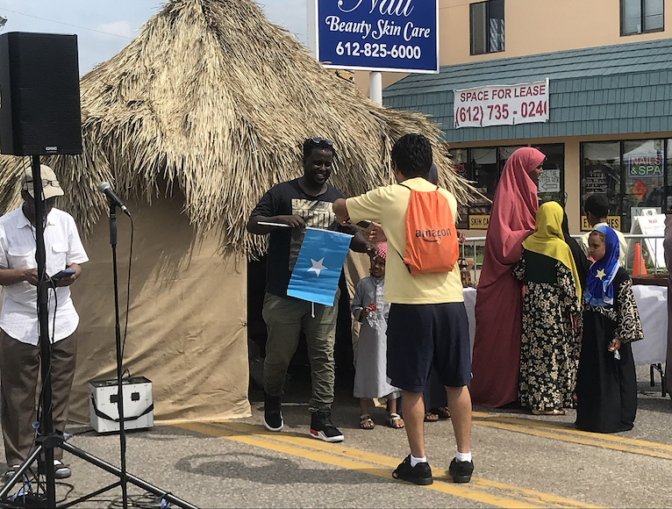
Somali Independence Day Celebration (Minneapolis),
Myotos – Licence CC BY-SA 4.0
In 2018, a whistleblower claimed that over $100 million in payments through the state’s childcare assistance programme had been fraudulent. The way the scam worked was dismayingly simple: Daycares and other childcare providers, which require a license to operate in Minnesota, would obtain names and identifying information for children eligible for state-subsidised care and then bill the government for services they hadn’t actually rendered. Mark Koran, a Republican state senator and former tax official who has worked closely on the fraud issue for nearly a decade and who I met in Saint Paul, said that millions of dollars in such proceeds were taken to East Africa in cash. In 2017, Twin Cities travellers declared $100 million in physical cash transfers out of the country to airport customs agents. (This is the only year for which Koran and his colleagues could obtain this number from sources in the federal government, though they have repeatedly asked for it.)
The childcare-assistance fraud involved licensed businesses using information about real children to scam the government. In Minnesota, the COVID-era US Department of Agriculture school-lunch replacement programme made it possible for nearly anyone to make money just by claiming they’d fed a certain number of people each day, often without having to provide their names or otherwise prove that the people they claimed to be feeding even existed. Like other pandemic-relief efforts, the MEALS Act, coauthored by Ilhan Omar during the emergency phase of the pandemic and aimed at replacing free meals that children would have been getting in school, was designed to distribute money as widely and as quickly as possible. In Minnesota, the programme was largely safeguard-free for much of its existence.
A small nonprofit called Feeding Our Future acted as a fiscal sponsor for many of the Somali-run groups seeking to access the USDA money. FOF would send its partners’ site applications to the Minnesota Department of Education, which would issue an identification number to each partner nonprofit. Feeding Our Future would receive billing sheets from these partners, which the group would upload to a state portal. The reimbursement money would go straight from Saint Paul to Feeding Our Future, which kept a 15 percent commission for overhead before forwarding the money downward. In time, authorities grew suspicious enough to want to see rosters of children but made few if any visits to any of the supposed feeding sites, some of which claimed to be distributing thousands of meals a day out of storefronts, parking lots, and public parks.
The state was aware that many of its partners’ claims didn’t add up. As Koran recalled, a state auditor’s report found that in 30 separate instances, someone complained to government officials that Feeding Our Future recipients had falsely claimed to be handing out meals on properties they owned. Astonishingly, instead of investigating the complaints, the state referred them to Feeding Our Future CEO Aimee Bock. “They gave it to the fraudsters to resolve that particular issue,” recalled Koran. Perhaps unsurprisingly, the state “continued to pay out on those 30 sites even when their owners said they didn’t exist.”
There were other signs of fraud in the programme, too. Somalis known to have modest incomes began posting pictures of new cars and houses on Instagram. In late 2020, the Minnesota Department of Education began delaying its approval of Feeding Our Future-related grant applications and rejecting a number of them outright. Sensing that the state might cut off funding entirely, Bock claimed that the rejections were the product of anti-Somali racism and sued in order to increase the pace of funding. In mid-2021, a Saint Paul court ruled that the Department of Education had no grounds for stalling the flow of money to Feeding Our Future.
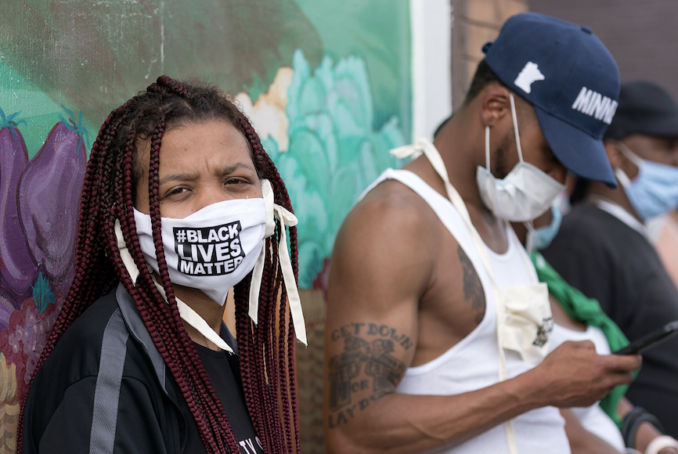
Tuesday after the death of George Floyd in Minneapolis,
Lorie Shaull – Public domain
Bock oversaw a remarkably efficient system for extracting state money on behalf of the Somalis working under FOF, with the group and its partners eventually billing taxpayers for 90 million meals for children in a state with only 5.7 million residents. The federal government later alleged that a mere 3 percent of the money that cycled through the group went towards the actual feeding of real children. In March, Bock was convicted of six counts of fraud and conspiracy.
People involved in the Feeding Our Future case variously describe Bock as an insecure person who badly wanted to be a hero and a movement leader for the dispossessed, and more generously as a person who fought incredibly hard for every cent she believed her partners were legally entitled to. If Bock was the central node of the fraud, she was not actually its mastermind. The fraud spread so widely and quickly that it appeared to have no real architect. Word of the Feeding Our Future money galloped through the Somali community, which kept the secret from non-Somali Minnesota with ironclad discipline. The clan system acted as both pathway and protection for the fraud. One Twin Cities Somali alleged to me that most of the Feeding Our Future scammers were from the Hawiye clan, while a similar fraud, run through a group called Partners in Nutrition, was a Darod grift. Upon hearing this description of the frauds, another source alleged that while the vast majority of FOF scammers were in fact Darod, most of those prosecuted have been Hawiye. It is difficult to assess such claims, though they speak to the endurance of the clans as the chief organising social framework for Somalis 35 years into the community’s arrival in free and democratic America, as well as the ease with which the clan can become a vector of corruption.
During the course of my reporting, I met with a Somali who ran a social-services organisation that was investigated over fraudulent invoices related to the state’s COVID-era meals programme. This person claimed that the state had repeatedly and mysteriously over-reimbursed their organisation, an adult daycare centre, and that a non-Somali nonprofit executive whose organisation acted as a fiscal sponsor and intermediary with the government refused to return the money, saying they’d rather keep the 15 percent commission. What was striking about our encounter was that this person wasn’t conversationally fluent in English. It was possible to run what the state believed to be a multimillion-dollar government-funded relief project without knowing how to speak the language used by 88 percent of Minnesotans.
Through every fraud case, the Somali community displayed what professor Samatar described as “the solidarity of thieves.” Bad actors within the community would approach potential coconspirators without any fear of betrayal. Even the people who said no to phenomenal offers of tens of thousands of dollars in free taxpayer money didn’t inform the authorities that a major, community-wide fraud against the public was in progress. Potentially criminal oddities, like my source’s overpayments — if that’s what they really were — went almost totally unreported to anyone in government. The FBI learned about Feeding Our Future from a whistleblower in the Department of Education, and not from any of the scam’s ground-level witnesses or participants.
When COVID hit, Jama, my guide at the Karmel Mall, was in charge of a small but largely inactive nonprofit organisation, and though its work had been unrelated to education or food relief, he claims he briefly provided 300 meals a day for which he invoiced the state through Feeding Our Future. “If you actually did the work it was exhausting,” said Jama. I asked him how he’d even learned about the Feeding Our Future money bonanza. “Oh,” he said, “everybody knew about it.”
Later he pointed to a storefront on Lake Street, now a checkerboard of indoor Mexican markets and halal butchers. “This guy has an adult daycare, a grocery store, and a nonprofit — in the same building,” my guide said. “It’s a one-stop shop. Two handouts, one business: That’s the game in town.”
Scamming the State of Minnesota — and the Federal government, which provides funding to state-administered Medicaid programmes — was almost comically easy. One autism clinic received $13 million from Medicaid while also claiming it fed 500 children a day through Feeding Our Future. One health clinic made 250 Medicaid claims — for transportation, language interpretation, and other services — for one patient. Another billed Medicaid for over 21 hours of daily work by a single therapist. Still another clinic owner used the identity of 344 Somalis to bill for phantom services — and continued billing for 188 of them even after their company was kicked off of UCare, one of Minnesota’s Medicaid-funded health insurers.
Liz Collin, a reporter for the right-of-centre Twin Cities website Alpha News, said the organisation receives tips related to alleged fraud almost every day, many of which come from Somalis. As Collin notes, state websites helpfully list how much money nonprofit partners of human-services programmes get from the government. Anomalies are easy for any motivated person — a state investigator, say — to spot. “I’ve checked out the addresses,” says Collin. “It’s not that difficult.”
In late September, Collin followed a tipster’s lead and observed a storefront adult daycare in south Minneapolis. There was no one behind the counter, and no one entering or leaving. She then called the daycare before a reporting visit. Thanks to the warning, the operator had been able to find “six or seven older East African women. It was a small office in a strip mall with a few chairs and tables and no TV.” The place was then empty again on several subsequent visits. The organisation had received $1.2 million in public money in 2024.
A mile away from this dubious daycare was a similarly ethereal autism centre with an empty parking lot and no one inside. The owners claimed to Collin that ten to fifteen children arrived after school each day. She dropped by the site for a week, and found no people of any age using it for any reason. That organisation received $2 million in taxpayer funding.
What’s odd about the Minnesota fraud is its ongoing tenacity despite scores of federal prosecutions, despite these frauds being one of the state’s major political issues. “It’s likely somewhere between four and six billion a year that’s being taken from citizens feeding all of these nonprofit networks for which they’re not providing any real value to the people in true need,” Koran estimated.
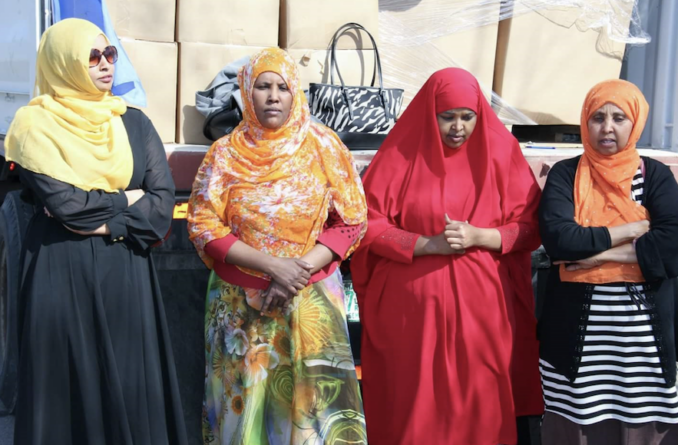
Dahran Women & Youth Organization based and incorporated in Minneapolis,
Voice Of America – Public domain
The strangest chapter of the Feeding Our Future saga hints at one of the reasons the grift continues, even though everyone knows about it. In the Spring of 2024, during one of the first trials of the alleged fraudsters, five Somalis attempted to bribe a member of the jury, promising $200,000 — of which $120,000 was delivered to a family member of one of the jurors — in exchange for a not-guilty verdict. These plotters filmed the cash exchange to blackmail their target, who nevertheless revealed the plot to the FBI on the eve of the trial’s final day. The conspirators helpfully provided the juror with a list of arguments that could be used to convince other jurors to acquit: During deliberations, she should contend that the prosecutions were a racist witch-hunt against a black Muslim immigrant community.
The plotters and fraudsters are facing years in prison, but a version of their argument has become something close to conventional wisdom. “No one in any position of authority has made the connection between the multibillion fraud and the Somali community,” says Glahn. “People say we should stop fraud, but nobody in Minnesota has said, ‘the Somalis are a bunch of fraudsters.’”
That includes prominent elected Republicans. I asked Lisa Demuth, speaker of the House of Representatives, why it was that so many of the state’s frauds seemed to relate to organisations that served Somalis. “I kind of thought about that question,” Demuth said, pausing and weighing her next words, as if treating the question as a possible trap. “I don’t know. Because any type of opportunity for people to access state dollars should be available to anyone. But our internal controls need to be in the agencies.”
***
It is true enough that the Somali fraudsters are only taking advantage of an existing, badly decaying system that they didn’t create. The defrauded programmes are all based on a delivery method for public benefits in which nonprofits bill the state for services they claim to have provided, and the state assumes that they are telling the truth. For reasons conceivably ranging from a culture of simple bureaucratic incompetence to the active and deliberate abatement of fraud in exchange for political contributions and other kickbacks, Minnesota’s government has chosen to exert little real supervision over the nonprofits, which operate under far looser rules than government agencies.
Surely, Minnesotans — no matter how liberal — care what happens to their tax dollars. What makes the programs politically sustainable is that the costs of the fraud are in fact nationalised, spread across a vast nation of 340 million people rather than a single state of 5.7 million. Feeding Our Future was funded through emergency grants from the US Department of Agriculture. Various capers involving housing stabilisation, autism services, medical transportation, and translation were all funded through reimbursements from Medicaid.
More than one person described Minnesotan social-service delivery as an “honour system,” and the state has the trappings of a place that might believe it can handle such an arrangement. Representative Walter Hudson and I met in the state capitol in Saint Paul, a white marble Beaux-Arts temple to antique notions of American civic comity. Every room has a conspicuous copper plaque announcing that room’s maximum occupancy, as well as a large and accurate analogue clock. The carpets and conference tables are spotless, and the walls and ceilings look unmarked by time’s passage, or by any ambient nastiness. Minnesota isn’t New Jersey or Louisiana, in other words — it is a paradise of Midwestern social democracy, without a strong tradition of political graft. “I think that what you describe as the squeaky-clean, wholesome, Midwestern, Norwegian culture of Minnesota provided fertile ground to stage an operation like what we’ve seen. Because who’s going to suspect it, right?” Hudson said. “Plus, we are a generous people.”
Some critics have claimed that the system was in fact built to be defrauded, and there is at least circumstantial evidence to support that suspicion. This past spring, Governor Tim Walz worked with Democrats in the state House of Representatives to block a bipartisan Senate bill that would have created an independent inspector general’s office to investigate fraud in state agencies. The only state employee who has been fired over any of the well-documented fraud convictions is an assistant commissioner for housing and homeless services, who left government the day before a scheduled House fraud-prevention committee hearing that would have required him to testify under oath. It is fair to say that the systems producing the frauds are being protected and perpetuated at the highest levels of government.
David Feinwachs, an adjunct professor at the University of Minnesota law school and the former general counsel for the state’s hospital system, went a step further, claiming that fraudsters are merely copying at the individual level a practice the state itself has codified over many decades — namely, the systematic use of Medicaid to defraud the Federal government. Feinwachs has alleged that Minnesota has been deliberately overbilling Medicaid to the tune of around $1.3 billion a year since at least 2015, and probably earlier. The main vectors of state-sanctioned fraud, he’s stated, are Medicaid programs operating through a waiver issued under Section 1115 of the Social Security Act, which conveys “permission to conduct experimental programs outside of Medicaid rules with no oversight, no auditing requirements, and no licensing requirements.”
In Feinwachs’s view, “Minnesota has transformed the 1115 waiver programme into a license to steal.” He’s alleged that for decades the four insurance companies that handle Minnesota’s Medicaid programme have reported that most of their reserves exist in the form of money that the state supposedly owes them, meaning that the insurers treat the state’s resources as money that they actually, currently possess. “More than half of what appears on paper to be HMO reserves is actually money the state has yet to pay the HMOs,” the executive director of the Minnesota Council of Health Plans confirmed in a 2015 letter to the Star Tribune, in response to Feinwachs’s claims. Feinwachs does not treat this manoeuvre as some sort of benign accounting trick. He believes that state government Medicaid overbilling operates as a kind of slush fund, with insurance companies and state agencies working together to confuse the status of billions of ill-gotten dollars — an arrangement from which both the companies and politicians benefit.
Feinwachs’s explanation has the simultaneous flaw and virtue of condemning everyone: The DFL uses its Medicaid-funded money-pit to maintain the party’s patronage networks and the state’s de facto fraud-based system of government, while Republicans — the party of corporate greed rather than strictly political greed — don’t want to be stuck with the political and financial bill if the scheme collapses in some future era in which they are actually in control in Saint Paul. If the fraud is so totalizing, why heap blame on any single midlevel actor or group of actors, like the Somalis?
I met Feinwachs through Omar Jamal, a former Somali diplomat, current Ramsey County sheriff’s deputy, and longtime advocate within the local Somali community. Omar spent over a month in ICE detention earlier this fall, although no one could tell me why. Jamal showed me a letter from the Department of Human Services, warning a Somali medical-services provider that a “credible allegation of fraud” had triggered a total cutoff of payments from Minnesota Health Care Programs. “It’s the state using immigrant populations as a scapegoat,” Omar claimed. “It’s like after 9/11, when they thought we were all Al Qaeda… The community is now coming crying.” If this is true, it means that even after the revelations about Feeding Our Future, autism assistance, and housing stabilisation, large numbers of Twin Cities Somalis still see the state government as their only real customer — and expect the money to keep flowing.
***
The Somalis may be right. The Minnesota honour system might prove to be so convenient, so entrenched, and so useful for the creation of backdoor patronage systems that it can never be allowed to die. It is certainly a vast system, one that will only get bigger when the state introduces an astoundingly broad taxpayer-funded paid family-leave scheme next year. Glahn noted that the most common job in Minnesota today is as a personal-care attendant, of which the state has between 100,000 and 200,000, many of whom are paid through government-reimbursement schemes.
Hudson theorised that a highly permissive attitude towards fraud was a way for Democrats to permanently secure the electoral loyalty of the generally religious and conservative Somali community. “They came into town and it was, how do we lock this community down?” said Hudson, who is African American, explaining what he believes the Democrats’ thinking to be. “Well, number one, we show up and we tell them all about how terrible Republicans are and how Republicans want to eat their kids and send them home. Step number two, we identify the most influential players in the community and we figure out a way to make sure they get nice and rich. Then it’ll be their job to return the favour by organising their community to vote for us.”
Hudson’s theory is speculative, of course. However, it is hard not to notice that many of the state’s leading politicians seem to act as if an atmosphere of loose political morals works to their advantage, which means that people at lower levels of the system are stuck operating within an environment that is almost nakedly corrupt.
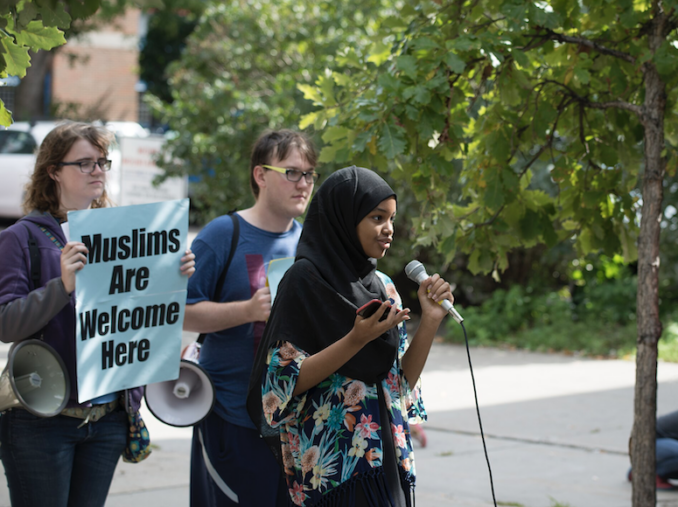
Minneapolis, Minnesota,
Fibonacci Blue – Licence CC BY-SA 2.0
For example, a Twin Cities Democratic strategist explained to me how outreach to Somali voters typically works: A campaign will pay a Somali political organizer, a community fixer “well-connected in a clan or tribal system to a certain group in a certain neighborhood or building” to set up meetings that resemble political rallies, perhaps with the candidate sitting on a throne-like chair at the front of a public-housing gym or rec room, packed with voters in traditional dress. At hubs like the Karmel Mall, the candidate might glad-hand with merchants and then meet with a dozen Somali elders in an upstairs conference room, few of whom speak English. “Now what happens in the community after that meeting?” the strategist said, sounding like he was describing American advisors engaging with tribal chieftains in some faraway village in Afghanistan during the glory days of the Freedom Agenda. “You really don’t know.”
During the early-voting period in Minneapolis, which lasts 45 days by absentee ballot and 18 days for in-person voting, he continued, campaigns also pay Somali contacts to arrange rides to early-voting sites and to hand out sample ballots to the people they transport. “My understanding is it’s not strictly illegal,” the source said. He added that it was impossible to know whether the drivers being paid by the campaigns were also being paid through easily-defrauded state reimbursement programs. Though large numbers of Somali votes reliably materialise every election, no one who doesn’t speak Somali can really understand how or why.
In the growing, indeterminate area that bridges the radically different cultures of Minnesotan niceties and clan-based Somali politics, darker possibilities breed. Ilhan Omar won her 2020 primary by a mere 2,500 votes, at a time when the Somali community was swimming in new cash, thanks to Feeding Our Future. Ilhan Omar’s close relationship with the Safari restaurant (whose co-owner Salim Said is one of the major nodes of the Feeding Our Future fraud) was a topic of discussion on the recording of Ellison’s December 2021 meeting with the accused scammers. Guhaad Hashi Said, long known as one of Omar’s “enforcers” in the Somali community and a former aide to the congresswoman, is one of the Feeding Our Future defendants. Omar filmed a video of herself at Safari handing out free meals — paid for by unknown parties, quite possibly including the US Department of Agriculture — during the pandemic. In her May of 2025 financial disclosure, Omar reported her own net worth to be between $6 million and $30 million.
While one can speculate about how exactly these verifiable facts fit together, it is safe to say that the combination of repeated convictions for frauds totalling in the hundreds of millions of dollars and the torrents of loose cash continuing to cycle through community-based organisations that rely on politicians to keep the spigots open is not generally seen as an indicator of good governance.
Collective looting of the public coffers is now the state’s solution to the American puzzle of how we all should live together. That is why no wake-up call to the state’s political class resulted when Abdi Salah, a widely respected senior aide to Minneapolis mayor Jacob Frey, pled guilty to fraudulently obtaining state funds through his own nonprofit. State senator Omar Fateh, Frey’s defeated opponent in November’s mayoral race, introduced a bill making it easier for counties to file housing-stabilisation referrals to private-sector companies — it then turned out that Fateh’s wife, a county employee, owned one such company. Fateh also authored a $500,000 direct appropriation to a local Somali-language YouTube channel. When the channel ran ads for Fateh that didn’t appear as official campaign expenditures, Fateh claimed he had paid for the spots in cash but had forgotten to report it.
The summer DFL convention in which Fateh earned the party’s endorsement ended in chaos, with accusations that pro-Frey delegates had been effectively disenfranchised by pro-Fataeh convention managers affiliated with the hard-left Democratic Socialists of America (DSA). The DFL vacated the endorsement, and in the wake of the convention mess the state party put its Minneapolis branch on probation. Still, the DSA’s involvement was a new twist on what has become a familiar political plot.
“The Socialists get to lead the civil rights movement and then they use Somalis for blackface,” one longtime Minneapolis DFL activist complained to me. “That’s the arrangement. Do you get what I’m saying?”
© Armin Rosen 2026
Armim Rosen is an independent journalist, published in County Highway, and presented here through A.W. Kamau.



_2019-06.jpg)


.jpg)