
At various stages of its journey from Arabia through Turkey and into Europe, coffee has been known as the Devil’s Brew and the forerunner of Viagra. The fact that it made it to England is largely due to Pope Clement VIII, who declared that coffee could be a Christian drink as well as a Muslim drink, wittily declaring: “The Devil’s drink is so delicious we should cheat the Devil by baptising it!”
The first coffee house in England was opened in Oxford in 1650 by a Jewish man called Jacob. It was based on the first kahvehane coffee shop set up in Istanbul in 1475; essentially, it was a social centre to discuss current affairs, play games, listen to music and share news. Two years later, the first London coffee house was opened by Pasqua Rosée, a servant of a Turkish goods trader, in St Michael’s Alley.
By 1675 there were more than 3,000 coffee houses in England, most of which followed the kahvehane model and carried names that spoke of their origin: The Turks Head, The Jerusalem Coffee House, Ye Blackmore Head, The Saracens Head, The Sultaness, The Solymans Coffee House and my own particular favourite, The Oriental Cigar Divan. Some even offered accommodation and attracted men who liked to discuss the topics of the day. In fact, coffee shops were exclusively for men and led to criticism by women who stated that “coffee shop customers were more capable of solving the problems of the world than their own affairs”. (The Going-Postal of their day?)
The coffee was sold as having medicinal qualities and was made from very finely ground coffee, sugar and cumin in a pot called a cezve or an ibrik. The process involved heating the grounds in water to just below boiling point to build a froth, and repeated to create an extra-strong beverage which is served with the grounds, in exactly the same way that Turkish coffee is still produced today.
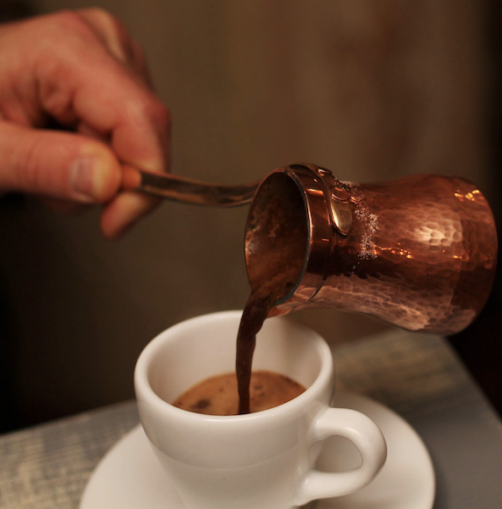
A Turkish cezve, also called a Greek μπρίκι (bríki),
Eaeeae – Licence CC BY-SA 3.0
By the end of the 17th century coffee shops were largely in decline. The short-lived foray into the exotic only catered for a small audience of the monied male elite, and coffee came up against a much more formidable opponent.
In 1662 Catherine of Braganza married Charles II and is largely credited with popularising tea, first through court and later to a wider, largely female audience. At first the tea was imported from Holland through the Dutch trading company and from Portugal. It carried a lower tax than coffee & began to be traded in large quantities. Subsequently, the East India Trading Company won the monopoly for importing tea and made the beverage affordable to every class of person and, in turn, made it the nation’s favourite drink. Coffee was in the doldrums and would remain so for a further 300 years.
While coffee was still available, it usually came in ground form, was mixed with boiling water and generally stewed to death. There were, however, some rather brave attempts to overturn the status quo. In 1771 a Mr John Dring of Southwark patented a solid flavoured cake of coffee, which dissolved in hot water & is recognised as the first known example of instant coffee.
A little later, in 1876, Campbell Paterson invented an instant coffee syrup made from coffee, chicory and sugar, which could be mixed with hot water or milk to make an instant coffee. It was launched to the military in 1876 and to the public in 1885. It is still available today under the patented name of “Camp Coffee”.
It was, however, the Italians who did more than any other country to further the development of coffee as a beverage for everyday consumption. They not only seized the opportunity to improve the finished product but also exported their technical advances to the rest of Europe and, more importantly, to America. The renaissance began with the work of Louis Bernard Rabaut and Edward Loysel Deantis (both French), who paved the way for Luigi Bezzera in 1901 to invent the first commercial espresso machine, which used high-pressure steam for a stronger brew. This was followed by the filter drip system using paper filters, patented by Melitta Bentz in 1908, and the moka pot, which was invented by Alfonso Bialetti in 1933 and is still used by thousands of customers across the world. The simplicity of design is quintessentially Italian and brings quality coffee into the reach of every household, when all you need is a moka pot and a simple grinder.
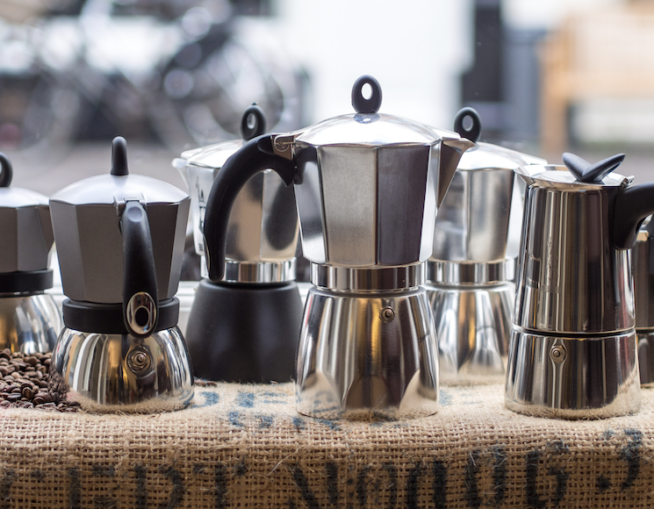
A selection of Bialetti moka pots at Koffiebranderij BOON in The Hague,
Takeaway – Licence CC BY-SA 4.0
Not content with improving coffee in their home country, the Italians began to seek new markets abroad & arrived in Soho, London, in the mid 50s to regenerate the coffee market. At the time the espresso machines and coffee beans were imported and the capital was destined to wait for pioneers like Bruno & Sergio Costa, who opened their coffee roasting plant in 1971 in Lambeth.
It is said that the Costa brothers taught the English how to drink espresso. Some years later I had the privilege of meeting them and they were extremely knowledgeable and wickedly funny in a self-deprecating way. God only knows what they would make of the product that sells under the Costa name today. My sister rather accurately describes it like drinking coffee from an un-emptied ashtray. My sister knows a thing or two but is a mite too shy to mention it.
The Costa brothers opened their first “authentic” Italian coffee shop in Vauxhall in 1981, serving coffee in porcelain cups and creating an ambience that many sought to copy.
So along came Café Nero and Starbucks and all the rest until Whitbread dived into the coffee market, acquired Costa Coffee for £19 million and allowed for expansion of the brand. Bruno and Sergio stayed on as advisors for 18 months and then departed.
Coffee sales were absolutely booming in Britain from the 1990s and more and more people were taking up brewing the beverage at home. It would however not be until 2023 when coffee sales exceeded those of tea to become the most consumed beverage in the UK. Today the coffee market is worth a staggering £2 billion per annum and shows little sign of abating despite the best efforts of the chess champion tea maker from Westminster.
At present 81 countries grow coffee for commercial sale, with 53 countries producing more than a thousand tons per annum and 36 countries producing more than ten thousand tons per annum. The biggest producer is Brazil and, rather surprisingly, in second place comes Vietnam, which has made giant inroads into the Asian market, along with India. The African coffee market (where it all started) is in serious decline, while emerging countries like Peru and the Philippines are producing some first-rate coffees which suffer more by distribution problems than quality.
A lot of commercially grown coffee is sold as green coffee on the commodities market, bought by big production companies for roasting abroad. It is said that good coffee follows the 80:20 rule, where 80% of the effort goes into cultivation and 20% goes into roasting.
For newcomers to ground coffee, Lavazza probably offers the most palatable product choice to start with. It is however best, if you are going to grind your own, to avoid supermarket beans as they have a longer shelf life than is good for the product.
There are essentially only two types of coffee beans being grown today, which are;
Robusta (Robusta canephora)
Robusta are grown at lower altitudes on a plant trimmed to six foot to aid harvesting. They have a high caffeine content and, as the name suggests, a robust flavour.
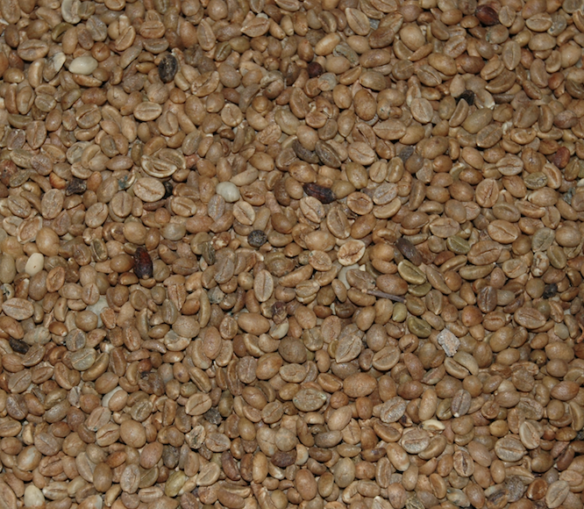
Unroasted coffee beans of the variery Robusta,
C. Barbedo – Licence CC BY-SA 3.0
The beans are picked as red berries and dried before the roasting process. They also have a very high caffeine content with a punchy flavour and can be low roasted, medium roasted and dark roasted and be medium or fine ground. They are often mixed as a blend with Arabica beans to add a bit of oomph. Please be aware however that drinking a dark roast fine ground Robusta coffee is akin to flying at low altitude, at high speed and without a plane.
Arabica beans (Coffea arabica)
Arabica has, by cross-pollination, over 10,000 varieties around the world and is grown at higher altitudes in areas that have a decent rainfall. It has a less bitter flavour than Robusta & enjoys subtle fruit flavours.
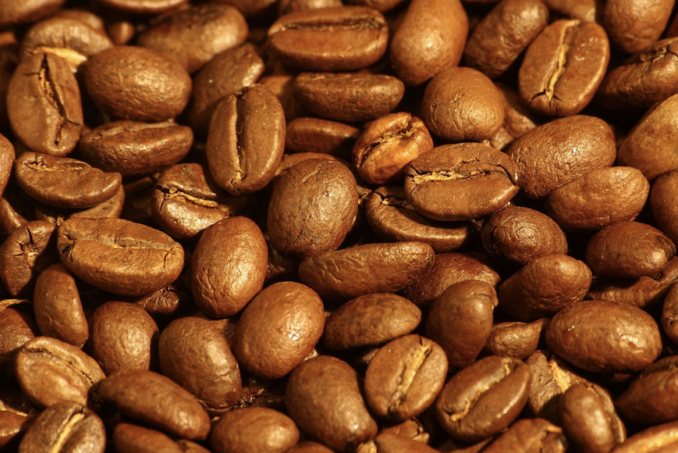
A pile of medium roasted Arabica coffee beans,
Ragesoss – Public domain
As a rough rule of thumb the higher Arabica is grown, the better the flavour and the lower the yield, which is why Blue Mountain coffee from Jamaica costs £125 per kilo.
There is also a myth, no doubt circulated by marketing gurus, that 100% Arabica means a better cup of coffee. This is not true and very much depends on the origin of the bean and the roasting and grinding of it. I personally prefer a 90% quality Arabica, 10% Robusta blend on a dark roast, but each to their own.
And so, with 10,000 varieties of Arabica, from 81 countries, which can be mixed with Robusta, on a low, medium or fine grind using light, medium or dark roast, the possibilities are almost endless to produce the perfect cup of coffee.
While all manner of coffee machines and grinders exist, I personally go for the simple approach, which is really easy when you do not adulterate coffee with cow juice.
Cappuccino lovers should look for a small Gaggia-type machine with a milk frother, but for me it is a coffee grinder with three settings from Lidl, bought a few years ago for a tenner, and a moka pot. The grinder also does nuts and condiments and is perfect for only producing a small amount, keeping the coffee fresh.
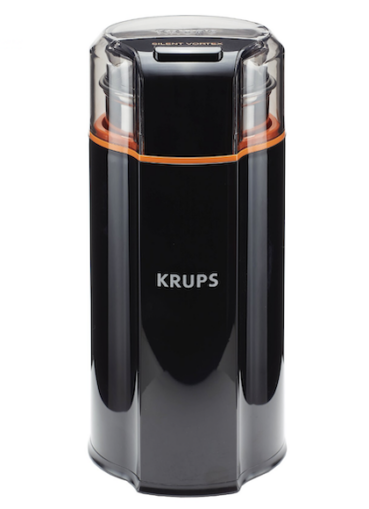
Krups Silent Vortex Coffee Grinder,
Shenderson1 – Licence CC BY-SA 2.0
A quick word of warning. Occasionally a stone finds its way into the coffee beans. Check to see that they are not put into the Silver Crest or similar machine or they can bugger up the grinding wheels. I also have a small flat plate which I place on the stove to stand the moka pot on to keep the coffee hot. All very Italian, I know, but it makes superb coffee.
There is an awful lot of drivel written about coffee, but it is all about trying things out and deciding if the method and taste is for you.
In Asia there is a coffee called Kopi Luwak, which is made from beans which have been digested and secreted by the Asian palm civet, where it is argued that the enzymes in the mammal’s body neutralise the acidity in the coffee bean. A similar coffee exists in Africa called Black Tusk, where the coffee beans have passed through an elephant. I have tried Kopi Luwak and am of the opinion that collecting coffee beans that have come out of a civet’s bottom is just a ploy to extract more money from the liberal elite who will pay more for anything that they think makes them superior.
By contrast I am not snobbish about people who drink instant coffee. It is, after all, real coffee made in a totally different way. The beans are made into a slightly more concentrated brew and then the liquid is sprayed into very dry hot air, where it instantly turns into granules or powder. OK, so they do not use the best beans, but it is still mostly drinkable.
At the moment I am making a shot of coffee with 85% organic Arabica coffee from Peru (£24.99/kilo) and 15% Robusta beans from Vietnam (£11.99/kilo), and working on the fact that a kilo of coffee beans yields a fine grind of 140 espressos, I am therefore paying less than 18 pence a cup. When you compare that to a retail cost at Costas of £2.20, then you begin to see what a lucrative commodity coffee is. This is probably why Whitbread managed to sell Costa Coffee to Coca-Cola for £3.9 billion in 2018.
The last word goes to a sweet waitress in a restaurant overlooking the cathedral in Bologna. At the end of a fabulous meal of local meats and cheeses, followed by a really punchy tiramisu, she asked Mrs “An” if she would like a coffee. Mrs “An” requested a cappuccino! The waitress smiled and said, “No, I asked you if you wanted a coffee!”
Viva espresso!
Article and photographs © AÑO NUEVO 2026


