Following on from Part 1…………………
BB replied to me thus :
Dear DJM
Thank you for your kind reply. Your work is remarkable. Like you, I believe these photos are historical documents in their own right. The extreme conditions under which they were taken, as well as their preservation for over eighty years, are a true feat. Even Robert Capa, in the fury of the Normandy landings, could not have done better!
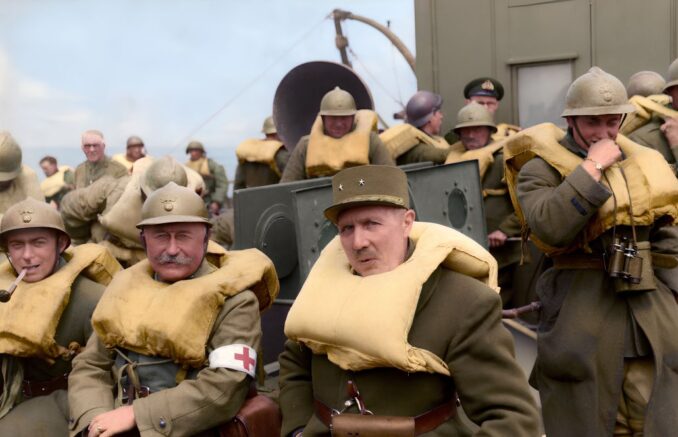
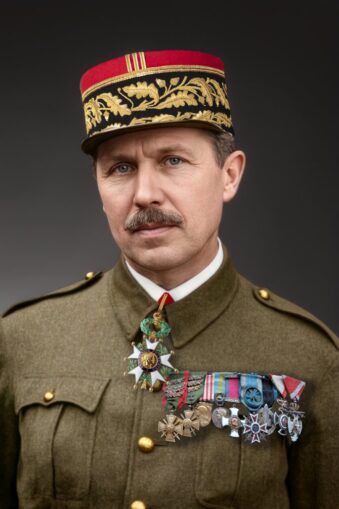
As it happens, General Bougrain (https://en.wikipedia.org/wiki/Gabriel_Bougrain), pictured on the deck of the Queen of Thanet, is my Grandfather. It is, therefore, a very moving memento for me. He always remained deeply grateful for the very warm welcome he received from the British authorities and the public during his brief stay in England in June 1940.
Kind regards,
BB
* * *
It would have been churlish not to reply by letter & enclosure…..
My dear BB,
Thank you for your email. This information is beyond serendipity…….truly astounding !
Given the revealed connection, it is my utmost pleasure to forward you the original photograph of your Grandfather en-route from Dunkirk to England in 1940. The reverse has the hand written note of Horace (erroneously identifying the Red Cross “Officer”).
Yours sincerely
DJM
* * *
His reply
Dear Mr. Morris,
I have just received the original photo of Dunkirk and I would like to thank you very sincerely for your kindness. I am attaching, on one hand, a scanned, restored, and colourised version of this photo and, on the other hand, a photo of General Bougrain. As a Captain in 1919, he was awarded the Distinguished Service Order by Winston Churchill, then Secretary of State for War. Please accept my deepest gratitude once again.
Best regards,
BB
* * *
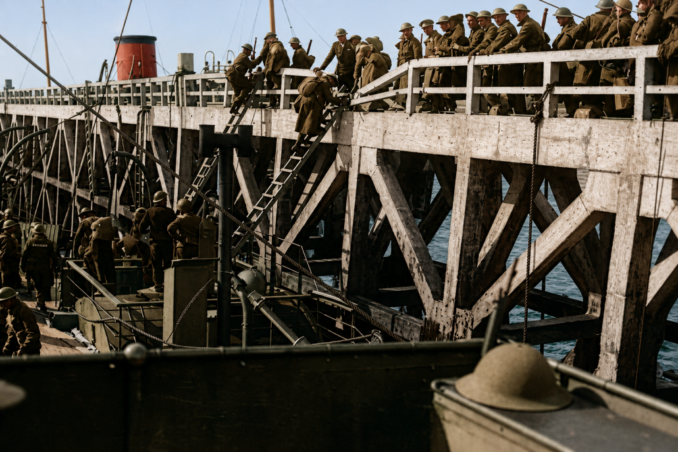
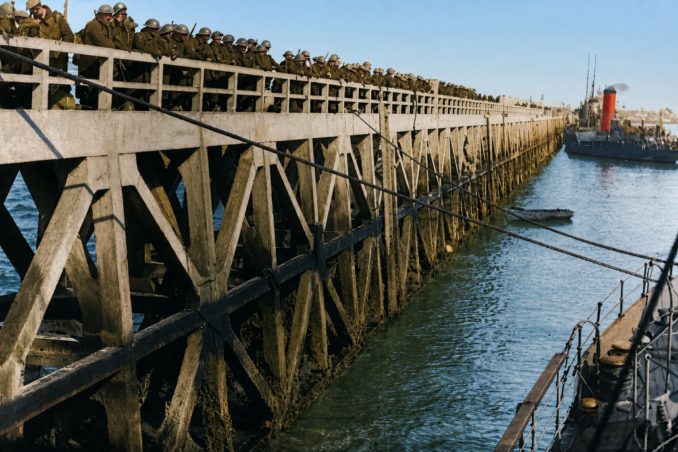
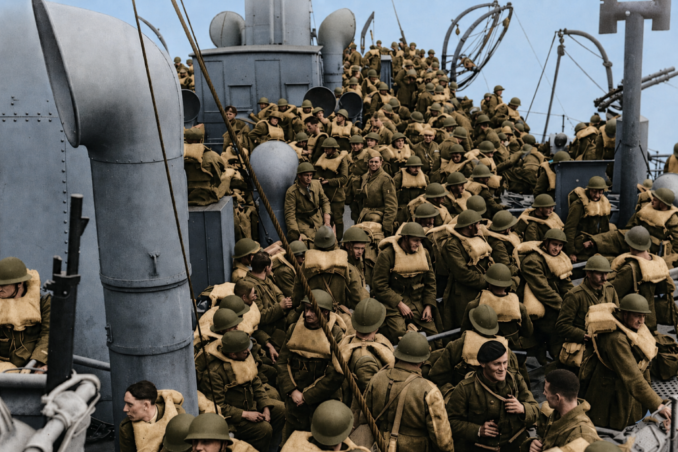
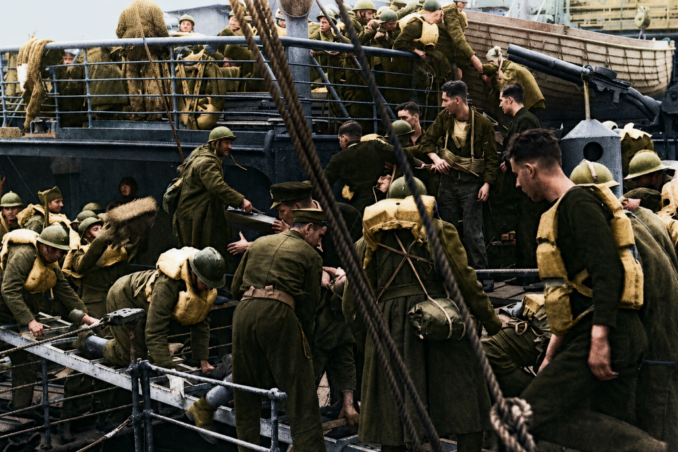
BB was kind enough to pass on restored & colourised copies of the Rumsam snaps taken during the Dunkirk evacuation.
© DJM 2026
© DJM 2026
© DJM 2026
© DJM 2026
© DJM 2026
Whilst there’s no doubt these do add a certain je ne sais quoi, Dunkirk will forever be etched in my mind as a black & white conflict. BB was also kind enough to send the English translation of General Bougrain’s text, excerpted from his book “Sous la Croix de Lorraine, Combats de la 2e DLM, mai-juin 1940” (Under the Cross of Lorraine, Battles of the 2nd DLM, May-June 1940), regarding the evacuation of Dunkirk.
(…) In the pitch-black night, I make my way back to De Panne with my staff officers, walking along the sea: ships silhouette against the sky in the glow of a fire consuming one of them. It is no longer a matter of embarking “with kind British assistance.” Captain Simon is dispatched to Malo-les-Bains and to the Fort des Dunes—the Army Group Headquarters—to report on the situation. I find the brigade, artillery, and engineer commanders, as well as the unit commanders, and I issue my orders to move all elements of the D.L.M. without delay to the Zuydcoote area to station there while awaiting instructions. I want to avoid, at all costs, any major gathering in this De Panne area when dawn breaks, due to the aerial danger. It is no longer even possible to move along the roads on foot; the vehicles, almost all of them British, are tangled up with one another, not only across the entire width of the roadway but even in the ditches.
On foot, at the head of the D.L.M., I head through the dunes toward Zuydcoote, which the armored vehicles reach directly. Day breaks; as far as the eye can see, one can spot units of all kinds, both French and British, heading toward Dunkirk or stationed near the road. The units of the 2nd D.L.M. are in good order, well-framed, their leaders at the front, and though very exhausted, everyone straightens up upon seeing me; those I question declare to me that they are quite confident “we’ll pull through,” as usual. What can one not hope for with such men?
At Zuydcoote, I find elements of the 1st and 3rd D.L.M.; Colonel Dario is kind enough to lend me a car. Captain Simon has not yet returned, and I wish to go to Malo-les-Bains and Dunkirk to obtain orders: will I be able to get there? I manage to do so, though not without difficulty. I eventually learn that the Cavalry Corps is responsible for organizing the embarkation conditions for the three D.L.Ms, and that it is to set up at the Malo-les-Bains casino along with the staffs of these three divisions to facilitate communications. I go to the casino, which is packed; in a room on the ground floor, General Vernillat is drawing up embarkation plans for the army. But it is Admiral Abrial, in Dunkirk, who takes the decisions. Up to this point, very few people have been able to embark, for lack of boats. I have never seen a spectacle comparable to the one presented by the beach and the dunes. The structures of sunken ships can be seen; some are still burning. British troops venture into the sea, the men with water up past their shoulders, some even disappearing beneath the waves, to haul themselves into the small boats transporting them to the ships that cannot draw near. Planes fly overhead, dropping bombs. Warships patrol relentlessly, and their anti-aircraft guns fill the sky with white puffs. Now and then, a plane can be seen crashing into the sea and a parachute swinging before disappearing into the waves. The beach is littered with vehicles of all descriptions, abandoned machine guns, or cannons. The waiting troops bivouac in the dunes, without shelter. Dunkirk can be seen through clouds of smoke illuminated, in places, by the glow of fires. Soon, shells begin bursting on the beach, in the dunes, and around the casino, whose windows no longer have glass.
There is now much more room in the casino: only General Vernillat remains, continuing with his staff to draw up and revise manifests, along with Colonel de Beauchêne, who now commands the 1st D.L.M. with his staff officers, and myself with my entourage. Chief Medical Officer (Lieutenant-Colonel) Cros has set up a first-aid post in the basement with the staff of the divisional medical group (G.S.D.), and all his personnel go out to look for and rescue French and English wounded, showing the greatest devotion. The two chaplains of the D.L.M.—Father Courtois, who was an officer during the 1914-18 war during which he lost an eye, and Father Marguier, a parish priest from the Paris suburbs—assist them with their usual zeal. The sound of gunfire draws closer, indicating that the ring is closing around Dunkirk: the odds in favor of an embarkation are dwindling more and more. All available armored vehicles have been placed at the disposal of the General commanding the 16th Army Corps, along with the machine guns and mortars.
The night passes while the artillery bombardments intensify; on May 31, at one in the morning, we receive orders to form organized groups of 1,000 men, divided into sections of 250. The first groups begin to embark in the afternoon, on the quays and outer piers of the port of Dunkirk. The wait is long and painful, now that there is no more fighting. We are reduced to slaughtering stray horses to feed the units. Squadron Leader (Major) de Moustier, who commanded a squadron group of the 4th G.R. (Reconnaissance Group), came to join us; surrounded in Lille with his unit, he had asked for permission to take his chances to avoid being taken prisoner, and, armored vehicles in the lead, he charged through with his detachment, which he succeeded in bringing back almost entirely intact. Like everyone else, he had to abandon his vehicles when crossing the last British positions. I have him and his men embark with the first detachment of the division: he has earned it. I leave in the night for Dunkirk with the last group of the D.L.M., which includes Ported Dragoons; daylight appears when, on June 1st, we enter the city, which we must cross to reach the Quai de l’Embecquetage, our objective. The bombardments and fires have destroyed almost everything. We narrowly avoid an artillery barrage unleashed on a crossroads; as we have no guide and the route is not signposted, we navigate as best we can; I lean toward a Moroccan rifleman who seems to be sleeping along the path: he is dead. We finally arrive at the assigned quay: we have to wait. The units are dispersed to reduce the risk of aerial bombardments, which are continuous but mostly directed against the ships. At 9 o’clock, we board the Prague, whose crew is British, in perfect order. Medical Colonel des Cilleuls, director of the Cavalry Corps medical service and an old comrade of mine, takes passage with us, which will allow us to exchange a few sophistries. We had been under sail for about two hours when we were attacked by aircraft; a leak sprung in the stern. The ship has to be evacuated. The transfer takes place in the utmost calm; the men even exchange jokes. I am obliged to go and fetch Colonel de Bellefon, who, after shaving, was preparing to enjoy a well-deserved rest. Only one British sailor disappeared, thrown into the sea by the blast of one of the bombs. We arrive at the Margate roads at 4:30 p.m. and are immediately boarded onto trains toward an unknown destination. All along the route, we are the object of constant ovations and attention; at every stop, young women generously distribute tea, sandwiches, and cigarettes.
On June 2 at 6:30 a.m., we arrive in Weymouth; the units are sheltered in schools or on sports fields. The men clean themselves up and share their impressions. On the beach, young people and children are bathing and frolicking; parents watch over them, sheltered under brightly striped tents. Looking at such a peaceful sight, it is hard to believe that we have just lived through such painful days. Everywhere, we are the object of thoughtful attention from the inhabitants. But orders reach me to embark at 3:30 p.m. on the Archangel, which weighs anchor at nightfall; on our ship, officers and men belonging to units foreign to the D.L.M. have taken their places, having sunk upon leaving Dunkirk with the ship that was transporting them (…)
Barbier, CC0, via Wikimedia Commons
So, there we are dear Puffins……….. Going Postal, the organ that brings Nations together, across the Sea…
© DJM 2026