
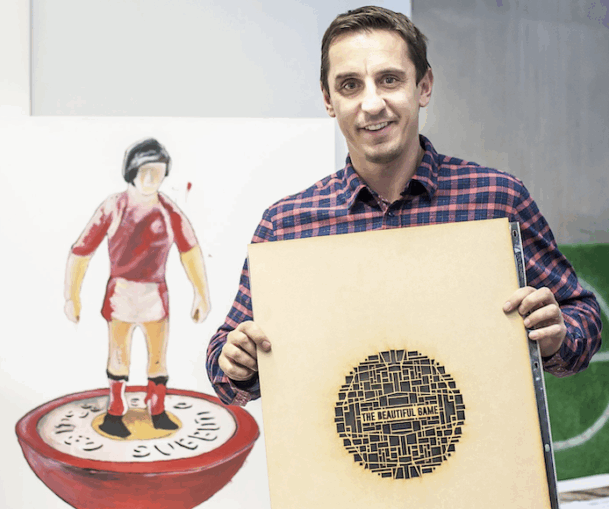
Gary Neville in 2014,
University of Salford Press Office – Licence CC BY-SA 2.0
‘It’s a fact of life that where we come from is important. I used to lie in bed thinking about themes where I could address the players that would make an impact on them. I would talk about miners, shipyard workers, welders, toolmakers, people who’ve come from poor backgrounds. And I used to ask them, what did your grandfather do? What did your father do?’
‘Taking away all the trophies I’ve won and the great players I’ve had, I think it’s a thing about life. I have to get the feeling inside them that what their grandfathers worked for and their grandmothers is part of them. And they have to display that meaning. It’s a fact of life that where we come from is important. You come out with an identity. I come from Govan, I’m a Govan boy.’
So spoke Sir Alex Ferguson in the Amazon documentary, Sir Alex Ferguson Never Give In during the reflective aftermath of his 2018 life-threatening stroke. The former Aberdeen, Manchester United and Scotland caretaker manager won 49 trophies during his managerial career, 38 of which came during his 27-year spell as United boss.
When pondering the risky and expensive gamble of signing 31-year-old Teddy Sheringham, Ferguson (they say) insisted the Spurs striker brought his father to Old Trafford for Teddy’s contract talks and medical. Ferguson’s chairman, Martin Edwards, thought Sheringham too old and too expensive. However, as a lean football mad former policeman, who played squash and tennis several times a week, father Paul boded well for the last few years of Sheringham junior’s career.
Puffins obsessed with wendyball will recall Wayne Rooney’s father, Thomas, to be a former boxer and never a stick insect. By age 32, the former Evertonian was playing in America. As for Teddy Sheringham, he made 104 league appearances in a United jersey and won everything, including the European Cup, and was 2001’s PFA Players’ Player of the Year and the Football Writer’s Footballer of the Year. His 42nd birthday found him still turning out in the league for Colchester United.
Two and a half decades later, another former Manchester United footballer and Ferguson protégé has hit the headlines. The day after the Manchester Yom Kippur attack that left two dead, Gary Neville found himself at the centre of a social media firestorm after posting a video on LinkedIn. In it he explained why he had removed a Union Jack flag from a building site he’s developing in Manchester.
He began by expressing his condolences regarding the previous day’s knife and car attack on a Heaton Park synagogue. Neville went on to say the building site flag was being used “in a negative fashion” and expressed concern that symbols like the Union Jack were being weaponised to create division in society. He also criticised what he called “angry, middle-aged white men,” suggesting they were contributing to a culture of division.
The response to Neville’s comments was swift and brutal. Still trending on X a week later, the retired footballer and present-day SKY pundit and property developer received a wall of negative comments. Flags were held up at Salford City’s (a club in which he is co-owner) next home game, saying ‘Gary Neville Traitor Scum, Own Goal Nev’. So much for what social media tells us of the 50-year-old father of two, but what of the genes? What would his old manager, Alex Ferguson, have to say?
Son of Neville Neville and Jill Harper, Gary was born in Bury in 1975, making him older by two years than his twin siblings Phil and Tracey, more of whom later. A sporting tribe, father Neville played cricket in local leagues, Jill played netball at the same level. Family legend has it that Neville senior was a decent footballer whose career was cut short by appendicitis. Jill, also a decent footballer, hasd her career ended aged eleven when she became too old to play in boys’ teams.
Both parents worked for Bury FC, Neville as a commercial manager, his wife as club secretary. A promising footballer, Gary attended the town’s Elton High School. The family home was at Greenmount, halfway between Bury and Ramsbottom, in a comfortable detached home next to a golf course. In 1991, when aged 16, Gary left school to become an apprentice at Manchester United.
When passing through the youth system, he was on £29.50 a week plus £10 expenses. By the mid-90s, the right full back was a first-team regular at Old Trafford and part of what was to be known as the legendary class of ’92 intake of young Red Devils.
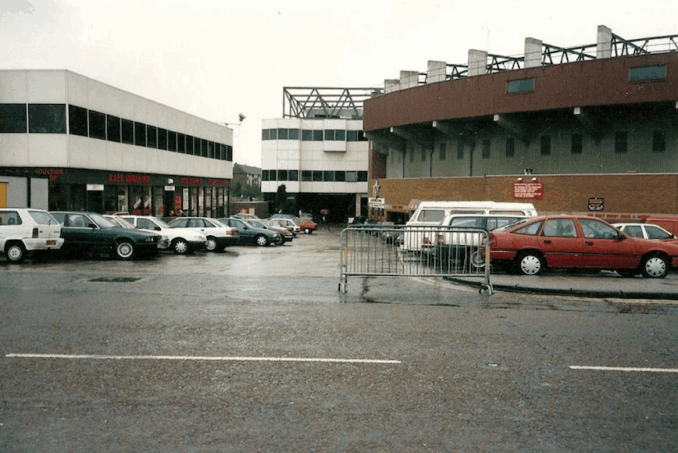
Outside Old Trafford in 1992,
Øyvind Vik – Public domain
Contemporaries included his brother Phil, David Beckham, Ryan Giggs, Nicky Butt and Paul Scholes. Beyond the turnstiles at Old Trafford, football was beginning to boom, but had yet to reach the stellar heights of today. The top earner at Man Utd was the exceptional Eric Cantona, on £18,000 a week. At the time, the average Premier League salary was £2,750 a week. Decent money, but given his role at nearby struggling Bury FC, Neville senior will have been aware of the pitfalls.
Even a full career as a player ends at about 35. Before that, injury, loss of form or a class of personalities can end a career. Added to which, there are sharks in the water. As Gary Neville said himself, “I’d like to see the removal of agents from the game. Footballers think they need agents – but it’s not the case, players need good advice and good accountants – but they don’t need people taking hundreds of thousands of pounds off them.”
Canny Neville senior became his sons’ agent and set up companies to manage their income. In 1996, he incorporated Gary Neville Limited, which was to become Tiger Sports Management and then Signature Developments before reverting to the Tiger name and being bought out by Relentless Holdings – another Gary Neville vehicle. Across the next 30 years, Gary’s business interests expanded to what the Manchester Evening News calculates to be ‘a business portfolio spanning property, hospitality, education, media and sport.’
As a player, Gary made 400 league appearances for Manchester United and 85 for England. He managed Valencia briefly. In business, the MEN informs us, ‘Football fans will know he’s also part-owner of League Two side Salford City alongside former Class of 92 United teammates. As of January 2024, he was listed as a director of 56 businesses on Companies House and is involved in media, hotels, pubs, restaurants, and education in a broad £100 million business empire, according to the reports.’
‘He also has a big interest in property development, which started in his early 20s, building up a chain of hotels and townhouses. His most high-profile projects are the Stock Exchange Hotel in London, in which he holds a 40 percent share, and Hotel Football overlooking Old Trafford.’
‘He also runs a residual image rights and sponsorship firm called Tiger Sports and co-owns Buzz 16 Productions which has produced programmes including The Overlap and Sky’s Class of 92: Full Time. Alongside his wife, he co-owns Relentless Group, Michelin-star restaurant The Man Behind the Curtain as well as owning the Sir Ralph Abercromby pub in Manchester.’
Phew!
Elsewhere in the enterprising family, sister Tracey was to become a Commonwealth gold medal-winning netball internationalist. Sure enough, a company was set up, International Netball Roadshow, but without the accompanying excess of football. In a 1998 interview, Tracey told the Independent newspaper, ‘The sport pays my expenses, and I’ve got a bit of Lottery funding. Sponsorship isn’t very good apart from a squad tie-up with Gilbert, but I am lucky in that I’ve also got a footwear deal through my brothers with Diadora. It’s a sort of family sponsorship, you might say.’
Her twin brother Phil made 505 appearances for Manchester United and Everton and 59 international appearances for England. After retiring from playing he was caretaker manager of Salford City and manager of England women’s team before heading stateside to manage Inter Miami and his current club, Portland Timbers. In between times, he deputised at Valencia for his brother.

Construction at the Stock Exchange,
Gerald England – Licence CC BY-SA 2.0
It has not all been plain sailing for older sibling Gary. Hotel Football reported a £3.2 million loss and owed £10 million in loans during the pandemic. The Man Behind The Curtain, the company behind his Michelin-starred restaurant, went into liquidation with almost £1 million in debt.
Gary has received backlash for advertising for workers at his luxury Stock Exchange Hotel on the minimum wage while charging over £800 per night for a suite. His £400 million St Michael’s development in Manchester was met with controversy after his company proposed demolishing a historic pub, a decision he later admitted was a “huge mistake”.
Ten years ago, he moved his safe-as-houses PFA pension into a plan which invested in commercial property – and lost the lot. More recently, he became a partner with Consello Strive whose website is so deep in the gobbledygook that it’s difficult to tell exactly what they do. At a guess, Gary receives a commission for introducing high-value individuals in his social circle to Consello investments. Think of Gabby Logan and her husband Kenny’s controversial brand ambassadorship which earned commission for introductions to a financial products company.
One therefore wonders of Gary’s political and social comments. Are they genuine or aimed at being on the right side of a high-value investment demographic? Is it his money that is being invested in his businesses or, like a nieve young footballer, is his high profile being used through a myriad of companies by middleman furthering other people’s commercial interests? Time will tell.
Elsewhere, International Netball Roadshow still operates and provides sports training to youngsters in the Manchester area. Tracey is an MBE and the head coach of the Melbourne Mavericks netball team. Neville Senior died of a heart attack in 2015, aged only 65. A stand at Burys Gigg Lane stadium is named in his honour.
Bearing in mind the previous caveats, we wish the enterprising Nevilles well, but suggest they think business and sport rather than politics. Our best wishes extend especially to Phil’s daughter and Gary’s niece, Isabella. Born 10 weeks early and living with cerebral palsy, when younger her mother Julie said in interview that Isabella could walk but often needed to be assisted by walking aids. On family days out, she had to use a wheelchair.
Not to worry, now aged twenty-one, Isabella’s socials show her travelling the world through her father’s football management career while, quite literally, standing on her own two feet at various exotic locations around the globe.
© Always Worth Saying 2025




.JPG)
