Welcome back my friends to the flamboyance that never ends, as Fabulously Flamboyant Friday sashays up to the crease to deliver yet another groin-polished googly from the gasworks-end of musical magnificence.
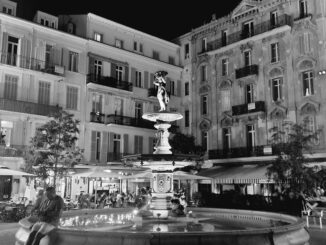
A few weeks ago I found myself in Brighton, the self-styled gay capital of the UK – on a Friday night, no less – for a live event that was part of a short UK tour by a popular beat combo. As I had a few hours to myself, I decided to go for a wander along the front to admire the groynes and embark upon a quest for some decent fish ‘n’ chips (I failed) and a decent pint of ale (I succeeded).
In part one of this article we examined the hugely successful US gay disco scene of the early to mid 1970s through the prism of the 1969 Stonewall riots in New York. However, as I was wandering around on a very bright and pleasant summer’s evening, I realised I didn’t have the faintest idea why the area in and around Brighton & Hove had become so synonymous with a pleasantly relaxed and easygoing attitude toward sexuality and gender? In other words, Brighton – why are you gay?
So – sans fish ‘n’ chips – I settled down in a comfy hostelry and began my quest for information at the splendid website of Brighton & Hove Museums, and it seems we need to start our journey (perhaps unsurprisingly) with the ever truculent and reliably perfidious French. Because Brighton, a once sleepy mackerel fishing port, was transformed into a very substantial garrison town as a direct response to the somewhat unsettling, head-severing shenanigans associated with the French Revolution (1789 – 1799) that were taking place just a short hop across the English Channel.
As the French Revolution was followed almost immediately by the Napoleonic Wars (and Brighton had already been sacked, burnt, raped and pillaged by the French in the 16th century) it is perhaps unsurprising the powers-that-be thought it prudent to station a significant number of fighting men on the south coast of England; and, as a result, Brighton became a substantial garrison town and was suddenly packed to the gunwales with thousands of fit, young, fighting-age men.
I have little doubt that a great many of Brighton’s Ladies were thoroughly delighted by this turn of events, but so too of course were a great many of the chaps, and it is argued by a number of academics that the vast numbers of soldiers in the town soon began to draw a significant number of gay men to the Brighton area.
Over the same period of time, Brighton began its transformation into a popular and fashionable health resort. This all began when a certain Dr Richard Russell started banging on about the health benefits associated with taking the sea air, splashing around in sea water and even drinking the stuff (silly sods). And, as a result, high society began to sit up, pay attention, and was soon being drawn to the south coast town. So popular did this seaside nonsense become, that before very long even the Prince of Wales (soon to become King George IV) began to frequent the by now deeply trendy seaside resort of Brighton.
The arrival of sophisticated high society inevitably generated a desire for sophisticated entertainment, which in turn resulted in the construction of various new galleries, restaurants, entertainment venues and theatres. This culminated in 1807 with the opening of the Theatre Royal, Brighton – a social event that placed the town very firmly on the A-list of places to be seen.
Brighton was now a highly fashionable metropolitan centre of style and culture, and this made the town the ideal venue for premiering, polishing and perfecting new plays before they transferred to the cultural epicentre of London. As a result, Brighton soon began to fill with the famous and fabulously flamboyant gentlemen of stage and theatre.
However, there is another key factor in this story – the railway. With the advent of a direct railway link between London and Brighton in 1841, the journey from the metropolis to the south coast suddenly became easier, faster, cheaper and far more convenient for people of all classes – and they were soon flocking to the seafront for health, entertainment and, of course, pleasure. Which brings us neatly back to the town garrison and the subject of the British army and male prostitution.
The history of British army soldiers supplementing their army salary with a spot of “rent boy” activity has been well documented by a number of authors, and I can particularly recommend Soldier Heroes & Rent Boys by Matt Houlbrook if you wish to explore this subject in greater depth. But, briefly stated, wherever there were large numbers of poorly-paid soldiers, there would inevitably be a significant number of fit young men on the lookout for wealthier chaps who were willing and able to cough up cash for a spot of gentlemanly relaxation.
By the 18th Century, “molly houses” (the term used for venues, taverns or even private rooms that were used as meeting places for gay men) were common. These venues facilitated socializing, sexual encounters and male prostitution. While molly houses were not in any way tied to the military, soldiers from working-class backgrounds (with their notoriously meagre pay) were often drawn to such economic opportunities by the brutal realities of financial hardship in the military (payment for a single session with a typical client could apparently exceed a week’s pay for a humble private).
By the 19th century, contemporary accounts suggest male prostitution had become quite visible in the popular “cruising areas” of London such as St James’s Park, Hyde Park and Piccadilly Circus, where soldiers – particularly soldiers from the Brigade of Guards – were known to solicit clients. It seems the Military and civil authorities would often turn a blind eye to these activities – unless of course a public scandal ensued.
Reading accounts from this period, with largely working class soldiers looking for wealthy clients, the dynamics of social class inevitably rears it’s head and contemporary commentaries seem to fall into two main camps, with well-heeled clients often viewing their working-class partners with a mixture of sympathy, desire and disdain. J.R. Ackerley, for example, (a BBC Johnnie in the 1920s and ’30s and literary editor of The Listener) seems to have been very disparaging about his purely transactional working-class partners, whereas the writer John Lehmann seemed to take a more friendly view, describing young soldiers as seeking protectors, framing these relationships as paternal or even brotherly, rather than simply being about sexual gratification and payment.
Contemporary accounts unsurprisingly focus on the prostitution activities of soldiers based in the capitol. However, once the rail link between London and Brighton opened in 1841, it seems a significant proportion of this trade moved south to take advantage of the substantial seaside supply of military privates (and other ranks, of course) that were now within easy reach of the metropolis.
There is of course a darker side to this tale. Male prostitution seems to have been a reasonably lucrative side-hustle for our gallant boys in uniform, but it should be remembered that being a practising homosexual was still very much outlawed, could land you with a substantial stretch in chokey, and of course could bring about your complete and utter social ruin (as Oscar Wilde was soon to discover).
As a result, it seems a significant number of enterprising young soldiers decided they could go a little bit further and, after landing a suitably lucrative client, would up both the ante and their earning potential by indulging in a spot of friendly blackmail. As the alternative could easily see a chap brought up before the beak on a very serious charge of Attempting to Procure an Act of Gross Indecency, one suspects a good many of the soldier’s unfortunate clients would keep schtum about being blackmailed and would simply cough up the cash.
However, despite the odd spot of blackmail, by the 1800s it would seem that Brighton’s reputation as a relaxed, liberal and cosmopolitan location had been firmly established. Oscar Wilde delivered a series of lectures at the Royal Pavilion and returned to the town in the 1890s to rent a room at the Royal Albion Hotel with a young lad called Alfonso Conway. This of course would prove to be a fateful liaison for Wilde (who, at the time, was at the height of his fame) as the Marquis of Queensberry (the father of Wilde’s lover, Lord Alfred Douglas) would later hire a private detective to track down Conway, and Wilde of course would famously end up in court answering a series of impertinent – but deeply damaging – questions about his tangled private life.
Nevertheless, Brighton’s reputation continued to grow and by the early 1900s the town had started to flourish as a gay destination. With the establishment of socially relaxed pubs, clubs and other establishments, the burgeoning gay and lesbian scene began to explore a spot of early activism. The Royal Albion Hotel is now seen as something of a linchpin venue, as it was the first venue in the town to openly host a “Ladies Only” Tea Dance in the early 20th century (unlike the less fortunate chaps, ladies indulging in a spot of hot girl-on-girl action faced no sanctions under the law).
After the 1967 partial decriminalisation of homosexuality, Brighton really upped its game: the Gay Liberation Front started to hold meetings there in the early 1970s and the UK’s first Gay Pride march was held in 1973. Appropriately, it concluded with a gay tea dance at the aforementioned Royal Albion Hotel.
Before long, Brighton’s universities were cementing the area’s status by pioneering degrees in sexuality and gender, post-graduate courses in gender studies and even Phd programmes in politics, gender and sexuality. Now, with almost 11% of the population identifying as gay, lesbian or bisexual (according to the 2021 census) Brighton boasts the highest LGB population percentage in the UK and is widely and rightly hailed as the unofficial gay capital of the UK.
Unfortunately for me, Brighton also seems to house the highest percentage of vegan eateries on the planet. So, after failing to procure a decent portion of fish ‘n’ chips, I began to make my way through Brighton’s astonishingly young and energetic Friday night revellers to prepare for my evening’s labours. And, bye the way, our event that night was held in the Brighton Centre – one of my favourite venues outside of London. So tonight’s disparate musical selection has been provided by musicians who have, over the years, performed in that splendid venue.
Anyway, I think that’s probably quite enough of my Brighton based babbling for one evening, so I shall bid you TTFN, dear Puffins. May all your passages be salubrious, your gardens inclined and your puddles well jumped.
Goodnight, and may your frog go with you – Not ‘arf!
Featured Image: Still taken from the 2012 televised debate between broadcaster Simon Kaggwa Njala and LGBTQ activist Pepe Julian Onziema, broadcast by the Ugandan NBS television show, Morning Breeze. Fair use/Fair dealing.
© Ivory Cutlery 2025