
Shakespeare made him famous. The Scots gave him his nickname, which a well-known football club adopted 500 years later. This is the story of a man who lived his life in maximum gear throughout… accelerating to a hard stop.
Born a Percy of Alnwick on 20 May 1364 (just this statement alone tells you he was in for an interesting life), Henry Percy was killed at 39, by most tellings with an arrow through the face. In between he was knighted by Edward III as a child, captured at one battle, ransomed for a fortune, made a Knight of the Garter at 24, ran a French duchy for John of Gaunt, dethroned one king, fell out with the next, and rode south to die in a field outside Shrewsbury.
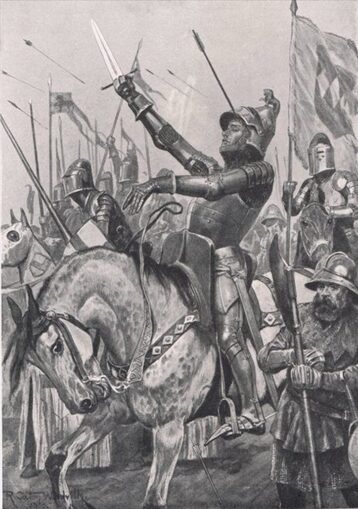
See page for author, Public domain, via Wikimedia Commons
The Scots gave him the name
Most English heroes are named by the English. Hotspur was named by the people he spent his career trying to kill. The Scots, watching this young Percy heir charge up and down the border at speed, started calling him “Haatspore“, meaning the man whose spurs were always hot. It was meant as a tribute, and it was also a warning.
He was made Warden of the East March in 1384 or 1385, when he was barely 20. The job was to hold the Anglo-Scottish border, which in practice meant burning down villages on one side and not being burned in return. He was very good at it. The medieval north was not a place for eloquent diplomats (though come to think of it, the modern day North probably doesn’t have much time for them either).
Otterburn: the night he lost a battle and won a legend
August 1388. The Scots, led by James Douglas, 2nd Earl of Douglas, raided south into Northumberland. Hotspur rode out from Newcastle to catch them. He caught them at Otterburn after dark, with his army strung out behind him on the road, half of them still marching.
He attacked anyway, because that’s what he did.
The Scots have been singing about what happened next ever since. Days earlier, in a skirmish outside the walls of Newcastle, Douglas had knocked him down and taken his lance and his pennon, and Hotspur had sworn to get it back before the Scots were home. That is why he was at Otterburn. In the night fighting Douglas was cut down in the melee, nobody knows by whose hand. The Scots, leaderless, kept fighting. They won (not the ending you probably expected). Hotspur was captured along with his brother Ralph (also probably not what you expected… who named anyone Ralph back then?). The ransom was 7,000 marks, and Richard II put up £3,000 of it. That is not the price you pay for a junior officer.
Two of the great medieval ballads originate from that night: The Battle of Otterburn, and Chevy Chase (yes, really). The second one gets the history quite wrong, but it was so beloved that Sir Philip Sidney said it stirred his heart like a trumpet. Maryland still has a town called Chevy Chase. The American actor’s nickname is usually traced to that town, which took its name from the ballad. None of it happens without a 24-year-old from Alnwick charging into the dark with half his men still behind him.
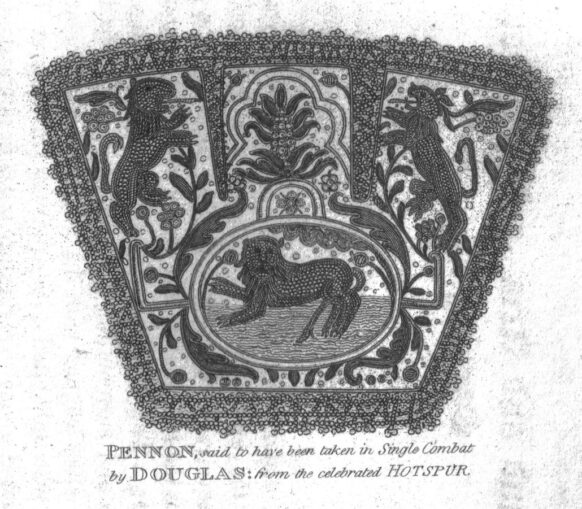
L. Pennell, Public domain, via Wikimedia Commons
The portrait problem
Here is something the books rarely mention. Nobody knows what Hotspur actually looked like. No contemporary portrait of him exists, and the later images all show him in armour with the visor down. There is no surviving description of his face, no death mask, nothing. When Alnwick’s community trust commissioned a 14-foot bronze statue of him in 2010, the sculptor Keith Maddison had to use the face of the current heir to the dukedom, Earl George Percy, as a stand-in. He is the face in bronze. The most famous medieval warrior from the North East has, in effect, no face.
This is why Shakespeare could do whatever he wanted with him.
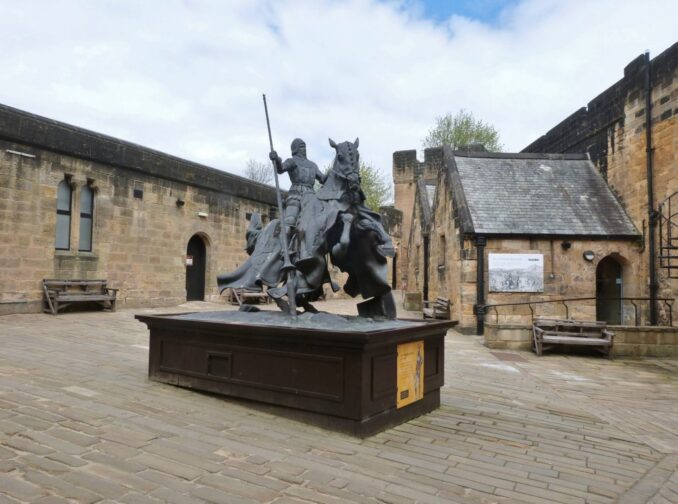
Sir Henry Percy, ( Harry Hotspur ). Hero of Alnwick by Derek Voller, CC BY-SA 2.0, via Wikimedia Commons
Aquitaine, Cyprus, Prussia
People forget how much of Hotspur’s career happened a long way from Northumberland. In 1383 he was off in Prussia on a Baltic Crusade with the Teutonic Knights. In 1386 he was reinforcing the English garrison at Calais and raiding into Picardy. In 1387 he led a naval force to relieve the siege of Brest. In 1393, before he was 30, he was sent on a diplomatic mission to Cyprus. I would be very understanding if this was for a rest.
From 1394 to 1398 he ran the Duchy of Aquitaine for John of Gaunt. That is a whole French region governed by a man from Alnwick. He kept popping back to England, to Ireland, to Calais, then back to Bordeaux. He logged more sea miles than most modern travel writers.
The kingmaker who got the king wrong
1399. Richard II, increasingly paranoid and unpopular, had exiled his cousin Henry Bolingbroke. When Bolingbroke landed at Ravenspur to reclaim his stolen inheritance, the Percys (who will feature in a future article) joined him at Doncaster. Without that support, the rebellion does not work. Bolingbroke became Henry IV. Hotspur and his father had put him on the throne.
The reward was lavish. Lands, offices, the Sheriffdom of Flintshire, the lieutenancy of north Wales. Henry IV needed the Percys, and he knew it.
He also could not pay them. The crown owed Hotspur wages for defending the Scottish border that never arrived. The king refused to ransom Hotspur’s brother-in-law Edmund Mortimer when the Welsh captured him. He demanded the Percys hand over their captured Scottish nobles from the victory at Homildon Hill in 1402. He kept promoting his teenage son Prince Henry into military authority that the Percys felt was theirs.
(Noticing all the Percy references yet?)
By the summer of 1403 Hotspur had decided the man he had put on the throne was a tyrant. So he decided to get rid of him too. As you do when you’re Henry Hotspur.
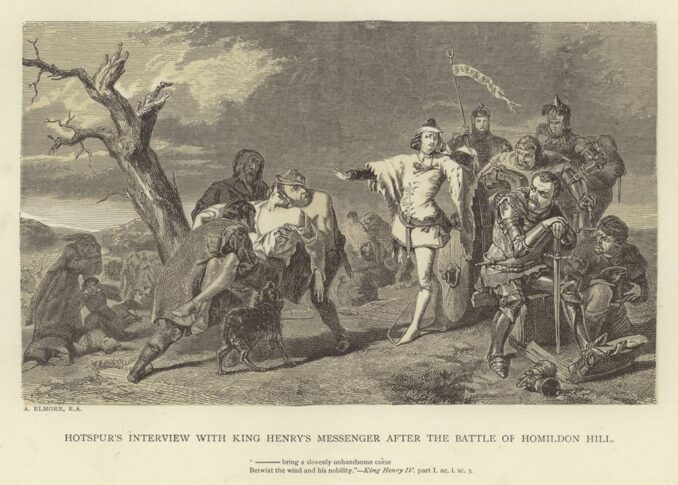
Alfred Elmore, Public domain, via Wikimedia Commons
Shrewsbury, 21 July 1403
Hotspur marched south with his uncle Thomas Percy, Earl of Worcester, and a force of Cheshire archers, expecting to link up with Owain Glyndŵr’s Welsh rebels and his father’s army from Northumberland. Neither showed up in time. He had a few thousand men. Henry IV brought a royal army to meet him at Shrewsbury.
It was the first battle on English soil where both sides used longbows in large numbers. The slaughter was enormous. Then, at some point in the chaos, Hotspur lifted his visor. The usual telling is that he wanted a better look at the field. An arrow hit him in the face. He was 39. Without him, the rebellion collapsed in minutes.
Shakespeare, writing nearly two centuries later, gave the killing blow to Prince Hal in single combat. It did not happen. Hal was a 16-year-old boy fighting his first real battle, with an arrow in his own face that he kept fighting through. Hotspur was 23 years older than him. The famous duel is a literary invention. The arrow was probably real.
The man who was killed twice
Henry IV is said to have wept when they brought him Hotspur’s body. His kinsman Thomas Neville, Lord Furnival, took it to Whitchurch in Shropshire for burial. Then a rumour started: Hotspur is not dead. He survived. He has been seen in the north.
The king’s response was theatrical and grim. He had the corpse dug up, brought back to Shrewsbury, and propped upright between two millstones in the market square. People queued to look at it. Once satisfied that the rumour was killed, the king then carried out a posthumous execution. Hotspur’s head was sent to York and stuck on a spike at Micklegate Bar. His four quarters went separately to London, Newcastle, Bristol and Chester.
Eventually the bits were collected, returned to his widow Elizabeth Mortimer, and buried at York Minster. In January 1404, Parliament declared him a traitor after the fact, and his lands were forfeit to the crown. They killed him five times, in five different ways, just to be sure.
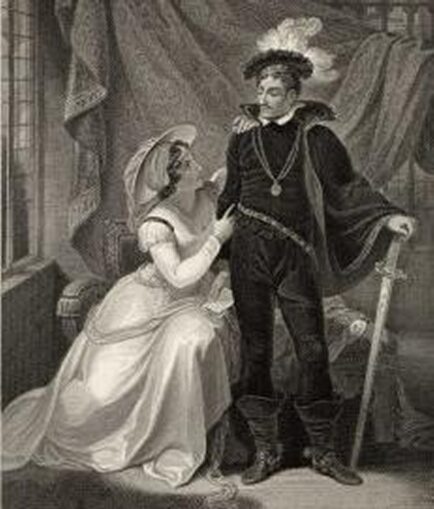
Painted by Robert Smirke, engraved by James Neagle., Public domain, via Wikimedia Commons
An 18th-century engraving of Hotspur, painted by Robert Smirke and engraved by James Neagle in 1795. Nobody alive in 1795 knew what he looked like either. Public domain.
Why a football club from Tottenham?
If you mention Hotspur to anyone in modern Britain, the first thing they think of is a north London football club. So how did a 14th-century Alnwick warrior end up giving his name to Spurs?
Hotspur’s descendants, the Percys (yes, them again), owned a large amount of land around Tottenham. When the schoolboys of the Hotspur Cricket Club formed a football club there in 1882, looking for a properly grand name, they kept the family hero whose old estate they were playing on. The cockerel on the badge comes from the spurs: fighting cocks wore them, and so, the story goes, did he.
What he actually was
Hotspur was not a thinker. He was not a great strategist either. His record in battle was patchy: triumphant at Homildon Hill, captured at Otterburn, killed at Shrewsbury. What he had was nerves of steel. He attacked when most people would wait. He charged when most people would dig in. He told the king of England, the man he had personally enthroned, that he was a tyrant and then rode south with a few thousand archers to try and dethrone him.
His statue at Alnwick stands 14 feet tall and his face belongs to a man born 600 years later. His name belongs to a football team. His battles belong to ballads people sing in Edinburgh and Newcastle. His bones are in York Minster. His body went to four cities.
For a man whose actual life lasted only 39 years, he certainly lived them to the fullest.


