
Kenya faces another wave of austerity. In this running photo essay series, we capture how it’s adjusting the lives of Kenyans and creating new social phenomena.

© Jimmy Kitiro 2026, Going Postal
John Githongo, Kenya’s anti-corruption czar, once recounted a story from his university days. He and his friends would spend campus holidays and early career nights at the Serena Hotel, then a favoured watering hole for students. But after the IMF and World Bank structural adjustment programmes of the late 1980s and 1990s, this iconic spot became inaccessible overnight. Beer prices tripled in one fell swoop of decontrol, thrusting structural adjustment from balance sheets and finance ministers’ budget statements into the real lives of ordinary Kenyans. Today, Kenya faces another wave of austerity. In this running photo essay series, we capture how it’s reorienting our lives and creating new social phenomena.
Perhaps the most apparent feature of our adjusted lives today is Fuliza – a word now embedded in Kenya’s vernacular as a coping mechanism for hard economic times. We have become the proverbial nation that pays Peter to pay Paul. From boda bodas to mama mbogas, salons, and bars, everyone seems to run a Fuliza tab. This normalised absurdity has become a running theme of our daily existence.
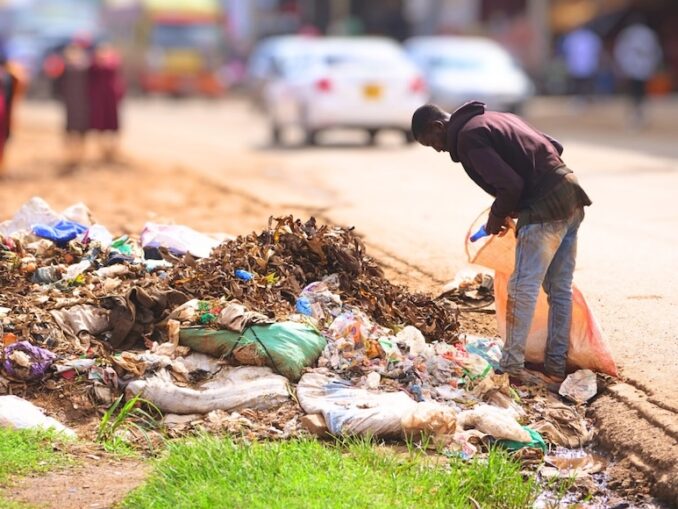
© Jimmy Kitiro 2026, Going Postal
Years ago, a friend I worked with in Mathare quipped, “In Mathare, nothing goes to waste. Everything – even sh*t – has a price.” In that nugget of wisdom, he painted a grim picture of how those living on the underbelly of capitalist society must scrape by. Today, we see the rise of such activities. The garbage economy is emerging as a prominent feature of Kenya’s survival economy.
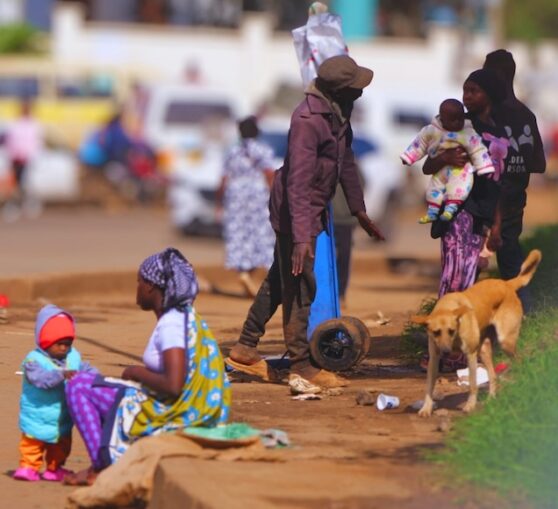
© Jimmy Kitiro 2026, Going Postal
In the 1990s, Nairobi and other urban centres swelled with street families. Lacking economic opportunities, they took to the streets to beg for scraps to eat. Children dropped out of school due to financial hardship, and glue-sniffing became a hallmark of an underclass unable to afford education. A recent Usawa study reveals that at least 1.3 million children are now out of school. The gains of the Kibaki era have been reversed, plunging us back into that grim future we once fled.
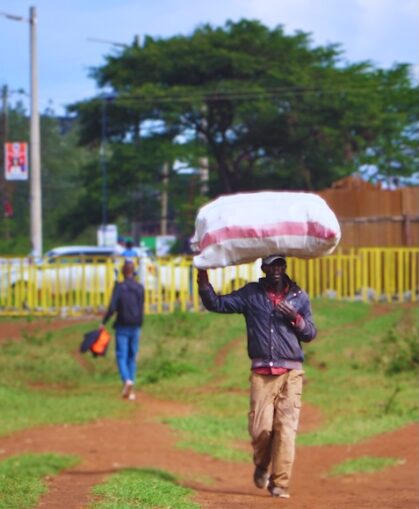
© Jimmy Kitiro 2026, Going Postal
The average Kenyan family devotes at least 60% of its monthly budget to food. As the economy tightens and the taxman probes every crevice to push people into higher brackets, many are revitalising rural networks to bring food back from the village.

© Jimmy Kitiro 2026, Going Postal
As Kenya prioritises debt servicing over development, social services and infrastructure are relegated to the back seat. The young man must wade through water to reach school, his bridge washed away by recent floods.
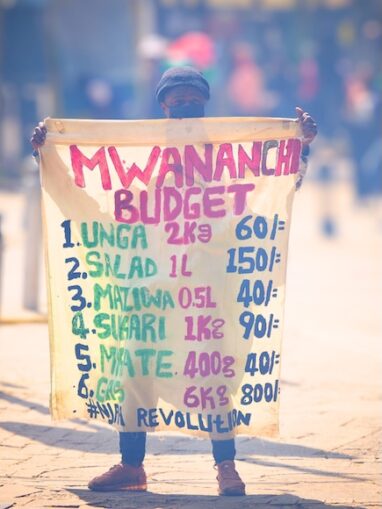
© Jimmy Kitiro 2026, Going Postal
There is an old political saying in Kenya: when the economy worsens, politics improves. Though politics has yet to improve, a general awareness, particularly among younger generations, of the country’s true state is taking root.
© Jimmy Kitiro 2026, Going Postal
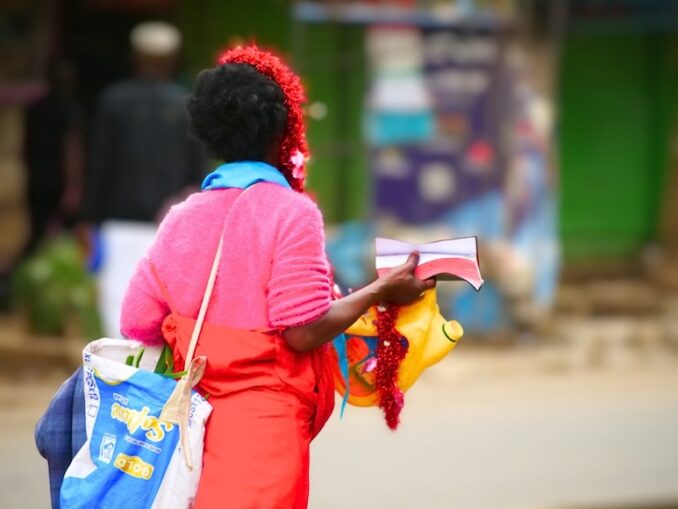
In the 1990s, amid massive retrenchments and the collapse of social services, people flocked to tent churches to make sense of the chaos. Prosperity gospel spread like wildfire: everyone was “catching their blessing” for deliverance from economic stagnation – or, if lucky, a prayer from the man or woman of God for a green card to greener pastures. Today, we observe a resurgence of street preachers and crusades. Unlike the 1990s, however, their primary message is end-times theology, presuming the rapture is imminent.

© Jimmy Kitiro 2026, Going Postal
A song by a budding young musician declares: “Zungu zungu, I have fallen in love with a mzungu man.” In a twisted way, the white man is cast as saviour, offering access to financial gain. This phenomenon is becoming part of our social reality, with the more recent example of a white European man who allegedly had sexual relations with close to 1,000 young Kenyan girls. It is reorienting social arrangements with far-reaching implications for our society.
© Jimmy Kitiro 2026, Going Postal
© Jimmy Kitiro 2026, Going Postal
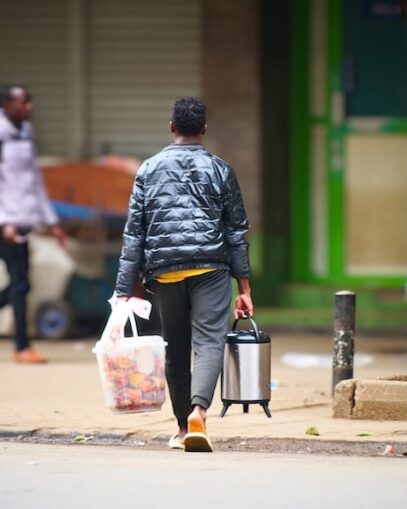
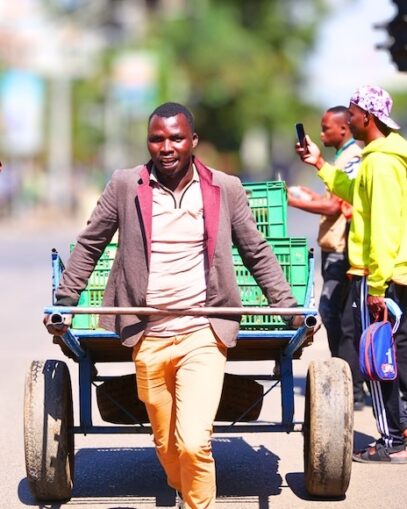
The day begins with the weight of the city. In the Fuliza Republic, logistics fall to men like the tea-bearer. He carries the warmth of a thousand morning conversations in a silver thermos, his footsteps steady on the pavement. Beside him, others shoulder burdens that would break lesser spirits – sacks of grain (Photo 004) or crates of produce pushed through the midday heat in a handcart (Photo 009). They are the human engines of a city that never stops moving. Hustling not to dream, but to stay away from the nightmare that is Kenya’s debt-driven austerity.

© Jimmy Kitiro 2026, Going Postal
In these times of austerity, the pool table and bar have replaced the boardroom for sealing “business deals”. At odd hours, one finds nicely dressed men (mostly) scheming and hustling for their next score. The hustle has shifted from corporate boardrooms to the streets. This informality signals not progress, but uncertainty, collapse, and the mediocrity of Kenya’s elite to have a political program for the prosperity of its people.
© Jimmy Kitiro and Joe Kobuthi 2026
April 5th 2026, Jimmy Kitiro is a photo-journalist and videographer. Joe is a philosopher, public theologian, and a political analyst based in Nairobi, Kenya. Shared with full approval