
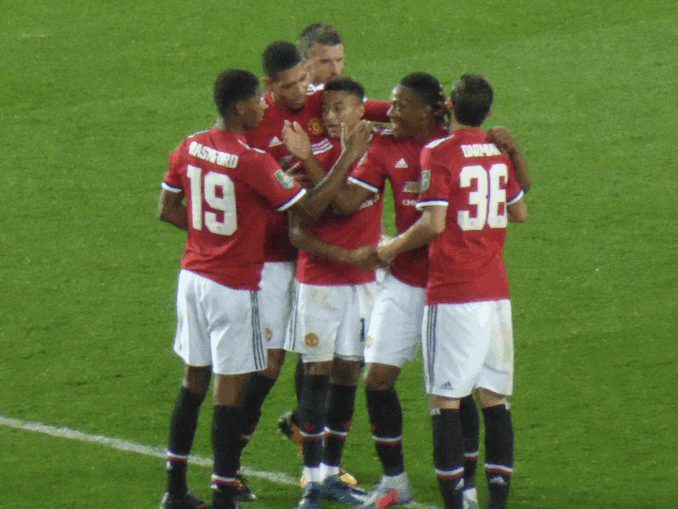
Manchester United v Burton Albion (4-1), Carabao Cup,
Ardfern – Licence CC BY-SA 4.0
The first game of the Premier League campaign kicked off on Friday, 15th August in front of 60,315 fans on the red side of Stanley Park. As Liverpool took on Bournemouth, the first goal of the competition crossed the line in the 37th minute when Hugo Ekitike converted from the spot to put the home team into the lead.
The ball hitting the back of the net is late to the show, as the first racist incident of 2025/26 occurred nine minutes earlier. This resulted in the game being paused by referee Anthony Taylor, thus kicking off an accompanying flurry on social and mainstream media.
Twenty-eight minutes into the new season, spectators and Sky Sports viewers witnessed Bournemouth number 24, Antoine Semenyo, walk to the touchline to take a throw-in. A man wearing a cap and a red Liverpool top pushes his wheelchair as far as the low barrier that separates the pitch from the disabled area at the front of the stands.
He shouts to the 25-year-old forward, who turns around and leans towards him. They are about six feet apart. The man in the chair addresses the player and makes punching gestures with his right arm, before pushing himself back into his space. Semenyo takes the throw-in. The interaction lasted for about five seconds.
A moment later, the Bournemouth player reports what’s happened to the referee, who pauses the game. As a result, a 47-year-old man is ejected from the ground. A state of affairs summed up by Sky in the following statement:
Regarding Antoine Semenyo incident
Tonight’s match between Liverpool Football Club and AFC Bournemouth was temporarily paused during the first half after a report of discriminatory abuse from the crowd, directed at Bournemouth’s Antoine Semenyo.
This is in line with the Premier League’s on-field anti-discrimination protocol. The incident at Anfield will now be fully investigated. We offer our full support to the player and both clubs. Racism has no place in our game, or anywhere in society.
We will continue to work with stakeholders and authorities to ensure our stadiums are an inclusive and welcoming environment for all.
Sky Sports
The 47-year-old was arrested the following day on suspicion of a racially aggravated public order offence. Taken into custody for interview, he has since been released on conditional bail while Merseyside Police make enquiries. Although that investigation is not yet complete, he has also been banned from all football grounds. However, we still don’t know what was said on the night.
As for the game, Gakpo scored a second for the home team in the 49th minute. But it was Semenyo who, according to the BBC, showed ‘great character and resolve’ to put Bournemouth back in contention when he pulled a goal back from close range in the 64th minute.
Fourteen minutes from time, it was Semenyo again who crowned a swift break with an equaliser. Two late goals from Chiesa in the 88th and from Salah four minutes into added time rescued the evening for Liverpool.
Later, on Instagram, Semenyo released the following statement:
Last night at Anfield will stay with me forever – not because of one person’s words, but because of how the entire football family stood together.
To my @afcbournemouth teammates who supported me in that moment, to the @LiverpoolFC players and fans who showed their true character, to the @premierleague officials who handled it professionally – thank you. Football showed its best side when it mattered most.
Scoring those two goals felt like speaking the only language that truly matters on the pitch. This is why I play – for moments like these, for my teammates, for everyone who believes in what this beautiful game can be.
The overwhelming messages of support from across the football world remind me why I love this sport. We keep moving forward, together. 🙏⚽
Or rather, he didn’t.
Semenyo’s Instagram account links to Reach.mt, the Maltese-based web domain of Reach Communication, ‘A people-driven content marketing and production agency’ headquartered in Malta. It is they who offer ‘scalable marketing services – including full outsourcing of your marketing’ and who have ‘a broad, impressive client base across Malta, the UK, the Middle East, and the USA’. Besides AFC Bournemouth and its players, they have partnered with high-profile clients in various sectors – including Visit Malta, L’Oréal Luxe, Daily Mail, The Times and Corinthia Hotels.
Their trademarked Reach Method creates high-quality videos, graphics and written material to manage an entire online presence. This includes SEO (Search Engine Optimisation to improve content visibility), social media, paid ads and influencer engagement. As storytellers through content marketing, they offer services from digital campaigns and video production to ‘strategic outsourced marketing solutions’.
Their commercial relationship with Bournemouth is branded as part of 9two4. Clicking on the link on Antoine’s Instagram account reveals to fans the strapline ‘embrace the race’ beside the picture of a black man. ‘Partnership and brand enquiries’ are encouraged by clicking on a link.
Beyond the cheesy digital marketing, mainstream media took up the storytelling. Fawning and predictable comment appeared across legacy platforms, including a four-minute piece on ITV News, previewed as an ‘incredibly powerful interview’. ‘An old and depressingly familiar theme,’ resulted in the 6ft 1in Ghanaian international, ‘bravely stopping the match’.
Knocking fighting in wars and rescuing children from burning buildings down the list, interviewer Steve Scott gushed, ‘A lot of people will say you were very brave to report it to the referee, to have the game stopped’.
As for Semenyo’s informed view of jurisprudence, having listened to a middle-aged man in a wheelchair for five seconds, the legal eagle concluded: ‘Mind-boggling. The punishment isn’t enough… could be jail time…’
Semenyo also attracted a response on social media. Back on the after-match bus and when doing his messages, a row of monkey emojis awaited amongst the adulation. So much for the London-born £75,000-a-week French national who chooses to play for Ghana. What about the chap in the wheelchair?
Identified as Mark, he has been disabled from birth, lives with his mother. A big Liverpool fan, photos have circulated on social media of his pitch-side selfies with present and former Liverpool players, including Emile Heskey (who is black) and Robbie Fowler.
As for the events of the evening in question, we have an eyewitness who took to social media to tell us what happened. The eyewitness is Nick Collins. Nick is also in a wheelchair and sits two spaces along from Mark in the bays reserved beside the touchline for disabled spectators. He informs us that Mark has had a season ticket for Anfield for many years and is passionate about the game, but often takes things ‘way too far’.
He has crossed the line before by throwing stuff at officials, usually chewing gum. Stewards look on, embarrassed, rather than do anything. During the match in question, Nick says:
About 28 mins into the game, Semenyo goes to take a throw-in. He’s not a player that goads the fans and seems like a decent lad. The sort of player that people want playing for their club.
For reasons I’ll never know, the fella near me in bay 7 (I’m bay 9) decides to go over to him in his wheelchair and shouts something at Semenyo. Semenyo then asks him to repeat it and he repeated it and threw his chewing gum at him. Then 2 mins later the play is stopped.
We missed the first goal because all of us were uncomfortable being around this guy, who’s now sat in silence, probably realising what he’s done and he’s soon to be in the sh*t.
We didn’t want him near us and people (including myself) were calling him a racist pr*ck. It was just uncomfortable to be around and we wanted him gone. The stewards didn’t have a clue what was going on either.
He was eventually removed from the ground at 21:01 by police. Firstly saying he’d refuse to move and wouldn’t leave, but then agreeing to leave, then kicking off. I’d gone to the toilet by this point but saw him kicking off near the exit.
If Puffins find the rhetoric a bit too boiler plate anti-racism, they may have a point. Semenyo is a great guy. Mark is a pr*ck. Everybody is on Semenyo’s side. Allegations of racism are so serious that nobody – like nobody – enjoyed the first goal. Everybody was uncomfortable. People at football matches are ‘fellas’. There are references in the extended piece to the number of goals scored by black players on the night.
For Mr Collins isn’t quite an ordinary fan. On his Twitter feed he describes himself as a father, husband and scoliosis warrior. This condition curves the spine and can confine sufferers to a wheelchair. He also self-describes as a journalist, uses the location tag ‘little xenophobic Britain’ and lists politics as the first interest in his profile.
I’m sure I’m not the only Puffin becoming wary of the way in which the likes of Reach Communications, Mr Collins, and ITV News have jumped aboard the football and race bandwagon. But why does such a bandwagon exist in the first place?
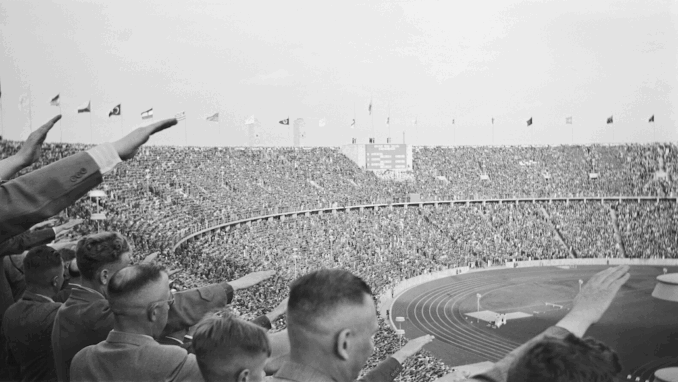
The 1936 Summer Olympics in Berlin,
Finnish Heritage Agency – Licence CC BY-SA 4.0
Throughout history, sport has been used to convey political messages by regimes and movements worldwide. In fascist Italy, Mussolini used the national side’s 1934 World Cup win to promote his type of nationalism. Nazi Germany used the 1936 Berlin Olympics as propaganda.
During the Cold War, Soviet and Eastern Bloc teams symbolised ideological strength, not least by dope-cheating in track and field. Argentina’s military dictatorship exploited the Blue And White’s 1978 World Cup victory to distract from human rights abuses.
These days players take the knee in support of Black Lives Matter to highlight what some see as social justice. Football’s mass appeal makes it a powerful platform for political expression and control.
Tony Blair’s New Labour embraced the sport as part of its strategy to connect with ordinary people and modernise the party’s image. Blair, a football fan with an iffy boyhood recollection of supporting Newcastle United, used the sport’s popularity to appear relatable and in touch with working-class culture. New Labour aligned itself with the Premier League’s rise, using football as if a symbol of Britain’s cultural revival.
The government supported stadium developments and promoted football in education and health initiatives. By associating with the game’s glamour and accessibility, Blair’s team projected a modern, inclusive and dynamic image. They wanted the game to build their version of national pride, reinforce their vision of a Cool Britannia, and to promote New Labour’s progressive left-wing agenda.
At the Premier League level in particular, English football tries to justify immigration and multiculturalism by showcasing diverse teams made up of players from various ethnic and international origins. This mirrors the establishment-preferred multicultural appearance of Britain.
Clubs are encouraged to celebrate cultural heritage through events, social media and community outreach, fostering so-called inclusion and unity. Note the use of the phrase ‘coming together’ in Reach Communication’s content – a phrase also overused during the reaction to last year’s White Lives Matter protests.
Stars from immigrant backgrounds become icons, often overpraised (e.g. Rashford), whose presence challenges opposition to mass, uncontrolled, unlimited immigration. Campaigns like Kick It Out, Football Unites, Racism Divides, Rainbow Laces, and taking the knee promote contentious political positions not shared by the fans.
The Premier League as a global brand embraces internationalism, reinforcing the assumption that a particular type of money-driven globalism strengthens the game. Football is thus thought at the political level to be a powerful tool for social cohesion and multicultural representation. If that bears no relation to reality, then so be it. The message is the medium – no matter how fake.
After pinning his careful and fortuitous right-place-at-the-right-time journalistic copy on social media, Mr Collins closed reader comments on his feed owing to their racist and disability-ist tone.
As for Bournemouth, away from victim Semenyo’s £3.9 million per annum five-year contract (with a £65,000,000 transfer-offer release clause), the once genteel English seaside resort now boasts at least three illegal immigrant hotels. Rows of Muslim men pray on the sands. Signs along the promenade implore new arrivals not to defecate on the beach.
© Always Worth Saying 2025


.jpg)