
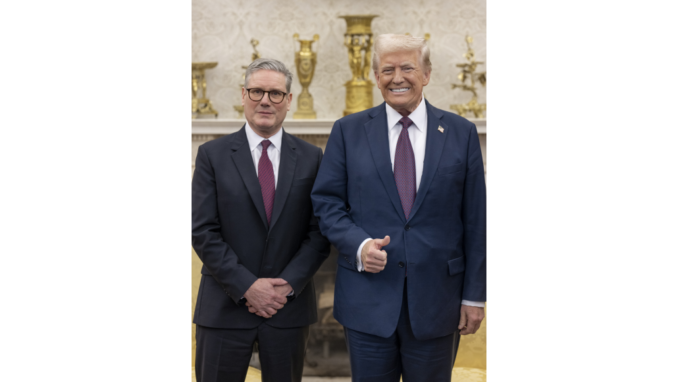
In February 1944 Winston Churchill first used the term “special relationship”. He was describing the relationship between the USA and the UK. I have long wondered how special this relationship really is.
Our initial relationship with North America was as the colonial power. Disagreements over taxation led to the War of Independence . We were beaten and so began the United States. In 1812 we had another disagreement with them and we had another short war and even burnt down the White House.
I remember one of those fixing up car shows and an American mechanic, probably in his 30s, was looking at an engine, might have been on a 1960s Maserati, that used Lucas fuel injection. On the injector is said Made in England, when he saw that he automatically said “The mark of the devil”. To me that says more than politicians bleating on about any kind of relationship.
In 1776 13 original colonies declared Independence. The reason was ostensibly taxation and representation (too much of one and none of the other). Britain retreated with its tail between its legs having been beaten.
In 1812 during the Napoleonic Wars the Americans declared war on us. The main reasons were us blockading France and hence interfering with US trade and the practise of boarding American ships and removing anyone who had previously served in the Royal Navy. There were also issues with us helping the Indians during American expansion. This war dragged on until 1814 and wasn’t finally settled until 1815.
Then we come to the US Civil War. Although we were officially neutral there was much trade between us and the Confederacy, our cotton mill owners still hankered after American cotton. The Union blockaded cotton exports so some mill owners used blockade runners. We also built some Confederate raiders, warships for the Confederacy, notably the CSS Alabama. After the war an international tribunal ordered us to pay the US $15.5 million in damages for the carnage they inflicted.
Now we reach World War 1. The USA was famously neutral and isolationist. Charles Lindbergh and many others were very much against any US involvement in the conflagration. Eventually in 1917 America joined in after what may have been several Churchillian plots to drag them in. There was the Zimmerman telegram offering to help Mexico recover territory from the US. There was also the very controversial sinking of the RMS Lusitania when 1,198 people died including 128 Americans.
Between the World Wars one of the favourite simulations for the US military was taking on the United Kingdom in a war. This seemed to be the centrepiece of their military planning, almost as if they expected it to actually happen. It was eventually called War Plan Red and was basically the US invading and occupying Canada. The plan was approved in 1930 but dropped in 1936 with the rise of the Nazis and the Japanese Empire. These two threats finally forced the US and UK to become allies.
When WW2 started we were on our uppers, brassic, skint, essentially penniless. We had never recovered from WW1 and here we were, stepping into the second. Germany had been preparing for war, we not so much. We were short of everything and only the USA could help us out of it. FDR ensured we didn’t even have a dollar stuck down the back of the sofa (I have seen a quote where he actually said that) before he decided to help materially and financially.
In September 1940 while the Battle of Britain was raging we sent the Tizard Mission to Washington. This was our attempt to gain help from the Americans. We gave them all our secrets including the cavity magnetron, details of an atomic bomb, the proximity fuse and the jet engine among others. All at no charge! I believe the American scientists were astounded at the cavity magnetron.
After FDR’s Arsenal of Democracy speech in December 1940 things were getting underway. In March 1941 the Lend-Lease Act became law We had already gotten 50 old destroyers in return for basing rights in the Caribbean but Lend-Lease opened the floodgates. We received over $30 billion of aid and the USSR over $10 billion. In theory we would return what we didn’t use and was not destroyed but much was used during the fighting.
One of Churchill’s primary WW2 aims was to preserve the British Empire. In contrast the Americans wanted to destroy it. There were frequent disagreements between British and American officers over these conflicting viewpoints when they met on the battlefield.
After WW2 we were still destitute, the late 1940s were a grim time. We were up to our necks in debt. In 1946 we were given a $3.75 billion line of credit. It was structured as a 50 year loan at 2% interest. The Marshall Plan began in 1948 and gave us over $2.6 billion which the Labour government squandered setting up the welfare state. In contrast the Erics spent their $1.5 billion aid on rebuilding their country and industry. Marshall Aid was in the form of grants and loans. In our case about $340 million had to be repaid and we finally paid all loans off in 2006. I can still remember the Caledonian Cyclops crowing about it.
Were it not for these loans and grants we could never have survived the end of the war.
In 1956 came the Suez Crisis. The Egyptians had nationalised the Suez Canal and we and the French wanted it back. We both decided to invade Egypt and occupy the Canal Zone with the help of the Israelis. The plan kicked off and we had landed troops in Suez but the Americans ordered us to stop in no uncertain terms. We had little choice and had to slink away with our tails between our legs.
This was when we finally learned that we were no longer a world power and continued to give away the Empire which we could no longer afford to maintain. Nearly all of the Empire is now self governing, There are very few true colonies left and even they have been renamed as British Overseas Territories.
My opinion is that this was the time when we learned that when America said jump, we would ask how high. The one notable exception was the Vietnam War which Harold Wilson wisely refused to join much to the objectionable LBJ’s displeasure. Satan Blair was nowhere near as reluctant and joined with Dubya in Afghanistan and Iraq after 9/11.
The term special relationship is much beloved by politicians on this side of the Atlantic, I don’t think the Americans see it in quite the same way. As I look back over this story it is clear to me that we are sometimes useful to have onside in military terms. A kind of fig leaf to pretend that is not just the Americans who are militarily involved in something. The thing about this special relationship is that the Americans don’t need us. We have been useful as aircraft carrier 1 at times and as a closer starting point for raids on the Middle East but in military and economic terms they don’t really need us. The special relationship is only special this side of the Atlantic.
In financial terms we have at times been kept afloat by American gifts and loans. They have however been repaid with interest. The Lend-Lease deal was an absolute bonanza for American manufacturing. While they set about dismantling our Empire, the Americans were building one of their own though they used the dollar as much as anything else to maintain it.
The exchange rate between the pound and the dollar makes for sobering reading. During the civil war it was about 12 to 1. In 1914 it was about 5 to 1 In 1939 it was about $4.67 to a pound. By the end of the war it was about 4 to 1 and has been sinking ever since. It now stands at about 1.34 to 1.
My own point of view is that huddling up with the USA was preferable to huddling up with the USSR though many Labour politicians would not have agreed with that. The European Union, chained to a sinking fatherland, may not survive the next ten years so why would we want to rejoin that. Maybe we should cozy up with Putin a bit before America returns to splendid isolation.
© well_chuffed 2026


