
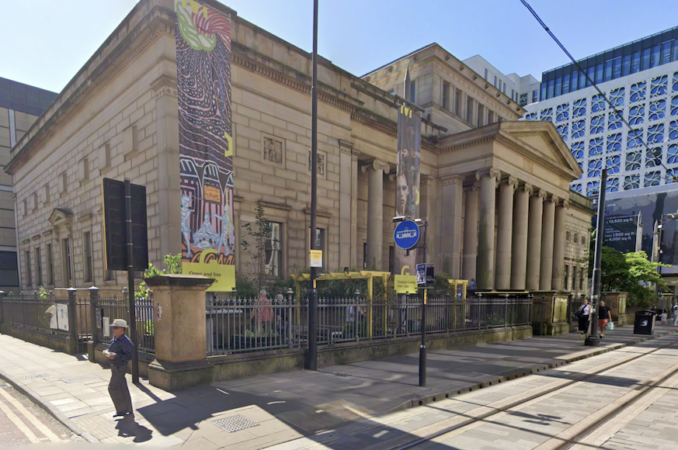
Doesn’t it go fast? This time last year, Mrs AWS and I took a Plutocrats’ tour to Manchester for the Christmas markets. Puffins already know we enjoyed a spin on the Manchester Eye, hurried past Canal Street and visited Barton’s Victorian shopping arcade. But I forgot to tell you we also visited the museum and art gallery on Mosley Street between the city’s Chinatown and Peter’s Square.
© Google Street View 2026, Google.com
The famous Manchester Art Gallery first opened as a public gallery in 1883 and contains over 46,000 objects, including paintings, sculptures, clothing and decorative arts. Originally developed from the Royal Manchester Institution, founded in 1823, funding came from wealthy nearby businessmen, industrialists, merchants and art supporters.
The original idea was started by three local artists: William Brigham, Frank Stone and David Parry. They encouraged well-heeled Mancunians to contribute through donations and annual subscriptions. Around £30,000 was raised to establish the Institution and fund its building.
In 1882, the Institution handed the building and art collection to Manchester Corporation. In return, the council agreed to spend at least £2,000 per year for 20 years on buying new artworks.
They spent wisely, not least through an aggressive acquisition of Pre-Raphaelite paintings.
These included works by founding members of the movement, including William Holman Hunt, Sir John Everett Millais and Dante Gabriel Rossetti. Thus, the Manchester Art Gallery became one of the most important centres of Pre-Raphaelite art in the world, with a collection of over a hundred of the movement’s paintings and drawings dating from the 1840s to the 1890s.
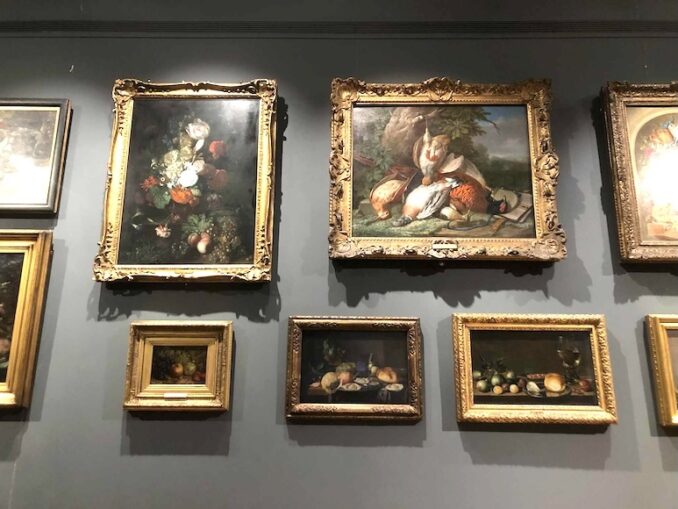
Unfortunately, Mrs AWS and I didn’t know what we were looking at and took pictures of all the wrong things. Not to worry, with Pre-Raphaelites perhaps in danger of becoming a bit cheesy and ‘new money’, Puffins might prefer dead cockerels from the 17th- and 18th-century Dutch school of still life.
© Always Worth Saying 2026, Going Postal
To the top right is Dead Game by Antwerp-born Pieter Andreas Rysbrack. Here the artist, who spent much of his career in England, renders hunted fowl with rich textures, dramatic light, and meticulous attention to plumage. Rysbrack signed and dated the oil-on-canvas work in 1740.
Popular among aristocratic patrons to display wealth and technical mastery, the work became the property of Robert Hatton, a prominent English businessman, railway director, and philanthropist based in the Manchester and Salford area during the Victorian era.
Born in Warrington, he built a substantial fortune and became a major figure in regional banking, infrastructure, and charitable giving. The painting was donated to the gallery by the Hatton family in 1908.
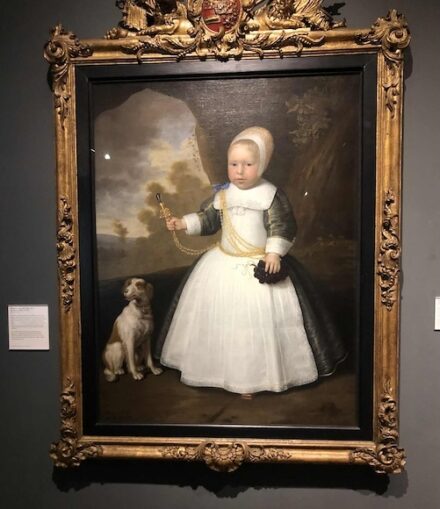
Also of the Dutch school is a 1660 work entitled Portrait of a Boy With a Dog. This Dutch Golden Age oil-on-canvas portrait is by Jan Albertsz Rotius and depicts a wealthy toddler dressed in formal attire alongside a small spaniel. In 1660s Europe, all young children — both boys and girls — wore long skirts and dresses until boys were “breeched” (put into trousers) around the age of six or seven.
© Always Worth Saying 2026, Going Postal
Contemporary viewers would have immediately recognised the child as a boy by the heavy gold chain draped across his chest and waist. A Latin inscription on the canvas (AEtatis I – 1660) tells us he was one year old when painted.
The right hand holds a rinkelbel, an elaborate rattle made of smooth grey crystal set in gold. Dangles bells at the end of a gold chain. In 17th-century Holland, these served as teething toys, charms believed to ward off evil spirits, and displays of family wealth.
In the opposite hand, sits a bunch of black grapes, while a small spaniel wearing a bell collar sits obediently at the feet. In Dutch portraiture, a well-trained dog and fruit symbolised good upbringing, obedience, and moral education.
The portrait was purchased at a London auction around 1820 by a Mr Prestwich for £50. It passed down through his family until Miss Catherine Scott bequeathed it to the Manchester Art Gallery in 1930.
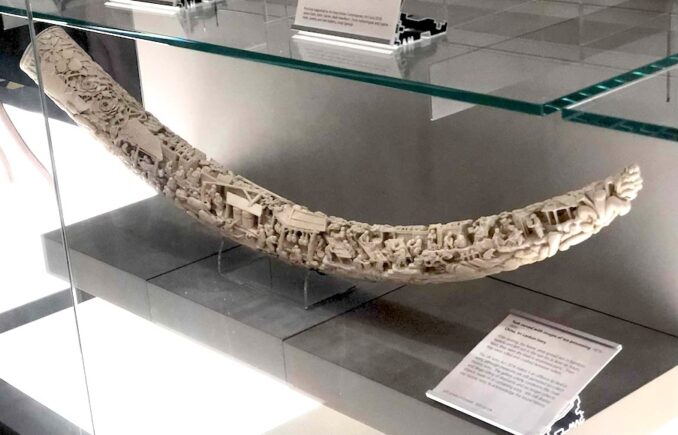
Elsewhere in the galleries lies an elephant tusk carved with scenes of tea packing dating from 1874. Made in Guangzhou (we’re not allowed to call it Canton on planet museum), the tusk comes from an elephant shot in Gahle, Shri Lanka (likewise, Ceylon) in 1874. Canton was famous for the complexity of the designs created by its skilled craftspeople, with this piece showing the various stages of tea processing and packing in China.
© Always Worth Saying 2026, Going Postal
After picking, leaves were spread in bamboo baskets, which were left in the sun for at least six hours, turning them dark due to oxidisation. Next, they were dry-fried in enormous pans, then rolled and crushed between rollers. The carving would have taken hundreds of hours and was possibly commissioned by a wealthy tea merchant. It was gifted to the museum by a Mrs O’Connell in 1937.
If you’re not allowed to say Ceylon, you’re not going to be allowed to shoot an elephant, and, sure enough, the catalogue and display case labelling inform us that today ivory is ‘controversial’. Trade in new ivory (dating after 1947) has been banned by international treaty since 1989 due to rapidly declining elephant numbers, but the illegal ivory trade is increasing, and about a hundred elephants are still slaughtered every day for ivory.
Some conservationists argue that even trading antique ivory promotes demand for new ivory carvings. Large quantities of antique and illegal ivory were destroyed in Hong Kong recently in opposition to the continuing slaughter of elephants. Exquisitely carved on the other side too, the case needs a mirror.
Only joking, Mrs AWS knows the difference between a Pre-Raphaelite and a Dutch ‘hackverk’. Sic:
© Always Worth Saying 2026, Going Postal
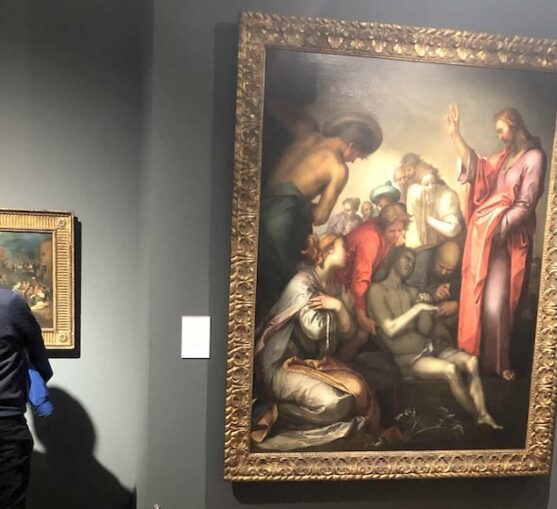
What? This is a Northern Mannerist? The Raising of Lazarus by Abraham Bloemaert, daubed 200 years prior to the Pre-Raphaelites? Oh. Not to worry, speaking of Northern, we can all recognise a Lowry.
© Always Worth Saying 2026, Going Postal
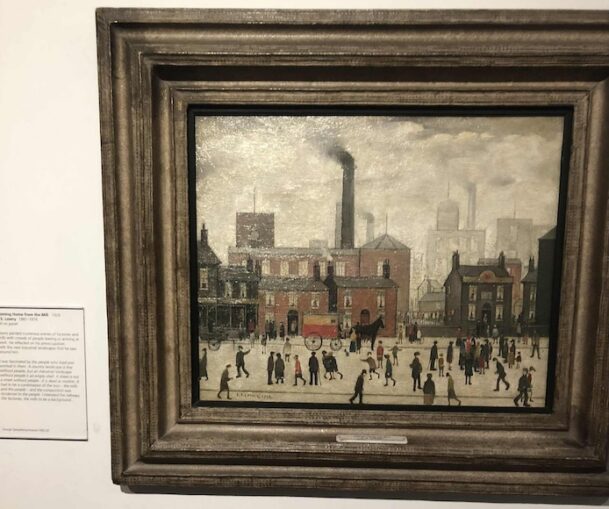
Coming Home from the Mill is a 1928 oil on panel. Famous for capturing the industrial landscapes of North West England, here Lowry depicts a crowd of his signature ‘matchstick’ figures heading home at the end of a shift past smoking factory chimneys, red-brick buildings, and a horse-drawn cart in a composite Northern town. The piece reflects his lifelong fascination with the everyday lives of working-class communities set against the backdrop of heavy industry.
Am I the only Puffin who thinks Lowry a tad over-praised? Perhaps Mamon might settle the argument.
Those who understand such things tell me an authentic game or hunting still life by Pieter Andreas Rysbrack generally sells at auction for roughly £2,000 to £10,000. Dutch Golden Age portraits by Jan Albertsz Rotius typically command tens of thousands of pounds. Paintings by Abraham Bloemaert similar to The Raising of Lazarus might achieve roughly £115,000 to £350,000. Whereas a Lowry of the stature of Coming Home from the Mill would likely be valued in the multi-million-pound range.
Shows how much I know!
© Always Worth Saying 2026