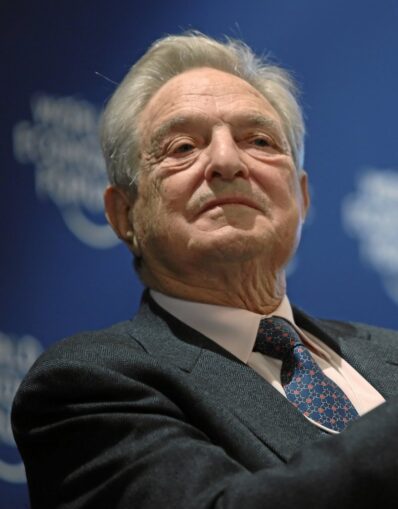
George Soros was no mere speculator; he was a master of calculated risk, navigating the labyrinth of markets with a precision that belied his professed indifference to mathematics. His grasp of financial mechanisms surpassed that of most, and he surrounded himself with a cadre of sharp minds. Success over decades, in a realm as unforgiving as high finance, cannot be chalked up to fortune alone. He possessed every prerequisite for his meteoric rise: erudite yet cunning, fiercely intelligent and impeccably informed, he pursued his aims with unyielding resolve and a readiness to wager boldly. To some, he appeared cold, commanding, and manipulative—qualities tempered by neither charisma nor moral scruple. Opinions on his true character diverge sharply, but one facet of his ascent cannot be overlooked: the patronage of influential allies, whose role has already been noted.
Through a peculiar brand of system critique, Soros amassed immeasurable wealth, wielding power and influence on a scale few could rival. The “man of a thousand faces” claims to have devoted significant resources to reforming global financial markets, advocating for rules—such as banning perilous instruments like Credit Default Swaps, which he likened to “ticking time bombs”—that would curtail even his own profits. He decries speculators’ “excessive” margins and points to rival hedge fund managers who funnel millions to lobbyists to dodge higher capital gains taxes, while positioning himself as a champion of such levies. This, he argues, would channel wealth back to society, ensuring that all benefit from the colossal gains of speculation.
A noble sentiment, yet its sincerity strains credulity in a man whose life has been an unrelenting quest for riches. Nor, he insists, do his vast philanthropic expenditures serve to salve a guilty conscience. On this, Soros likely speaks truth: remorse for the havoc his speculations wrought—displacing countless lives—seems foreign to him. He has even claimed, with a touch of wry humour, to be “cursed with an extremely poor memory,” unable to recall the intricacies of his legendary bet against the British pound. A selective memory can be a convenient shield, particularly when summoned at will. Reflecting on the 1992 devaluation of the pound, Soros maintains it bore a silver lining: Britain’s exit from recession into growth. Yet he candidly admits that his motive was not systemic reform but raw profit—a goal he achieved in spades. The dissonance between his actions and his rhetoric is striking. Soros has repeatedly called for the wealthy to bear a heavier tax burden, a stance that suggests a commitment to equitable justice. In a CNN interview, when asked if he supported President Obama’s proposal to raise taxes on the rich, he replied unequivocally: “Yes, very much… The super-bubble led to a sharp rise in inequality, and now we face sluggish growth. Better income distribution would leave the average American better off.”
This principled facade crumbled in April 2015, when a Bloomberg report exposed an inconvenient truth: Soros, the self-professed advocate of fair taxation, had deferred his own tax obligations for years. Exploiting a loophole in U.S. tax law, he reinvested client fees into his fund, amassing a deferred sum of $13.3 billion—a figure so astronomical it might belong in the realm of cosmology, as if each dollar marked a year in the universe’s age. Though the loophole was closed in 2008, Soros faced a potential tax bill of $6.7 billion. When Bloomberg sought comment, he was conspicuously silent. Yet in 2011, he had publicly endorsed higher taxes on the wealthy, declaring, “I, too, should pay more!” Such pronouncements, in light of his tax deferrals, ring hollow, inviting accusations of hypocrisy—or, at best, a sly literalism. Perhaps Soros meant precisely what he said: he should pay more, even if he didn’t.
This is but one thread in a tapestry of contradictions. Soros demonises fossil fuels yet invests in coal ; professes admiration for Germany while he was betting against the Deutsche Mark and urging the nation to shoulder disproportionate burdens for Europe ; and railed against George W. Bush while aligning with broader U.S. policy currents. Each paradox, whether readily unraveled or stubbornly opaque, points to a central question: what serves Soros’s interests most? This lens is essential to understanding the sprawling network of organizations he commands and their true purposes, which often lie veiled beneath the sheen of altruism. Soros’s life has embodied a profound tension between essence and appearance, between the principles he espouses and the actions he pursues. His defenders see a visionary reformer; his critics, a consummate manipulator. Yet all agree on one truth: his billions, and the influence they wield, have reshaped the world in ways both profound and contentious, leaving a legacy as complex as the man himself.
Teh End
© DJM 2026