If you were ever handed a bottle of Lucozade when ill as a child, you can trace the origins of this back to a Stockton-born surgeon, a baby who died on his ward in 1908, and a chemist’s shop at Barras Bridge. A man called William Owen, who as far as anyone can tell never mixed a drop of it, got all the credit. Time to sort that out.
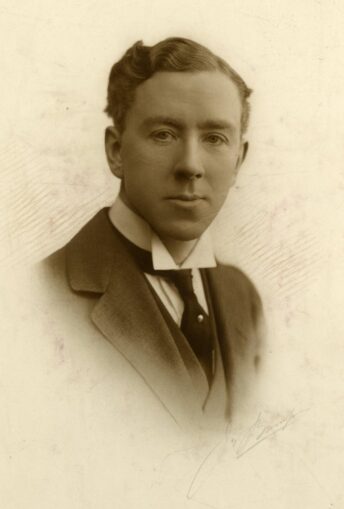
Newcastle University Special Collections, Pybus Archive FP/3/4/32, public domain.
Stockton and a change of heart
Frederick Charles Pybus was born in Stockton-on-Tees on 2 November 1883. His first plan was to be a vet, and he was a veterinary pupil at about sixteen when he saw his first tumour. He then changed his mind and switched to medicine, because, according to his own papers, he couldn’t stomach the way the animals were treated, in particular being operated on without anaesthetic.
He enrolled at the College of Medicine in Newcastle in 1901, qualified in 1906, the year the Royal Victoria Infirmary opened, and got a job there as a house surgeon, which is where this story really starts.
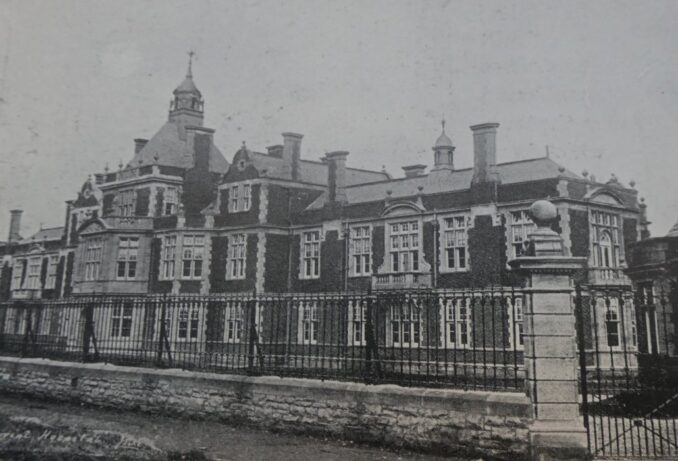
The RVI, 1908
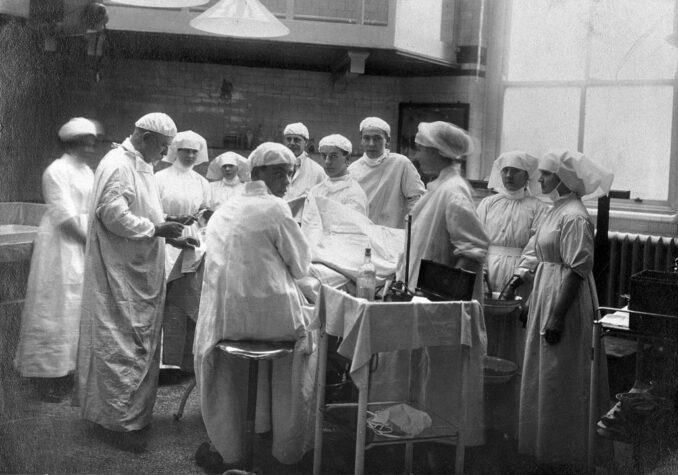
See page for author, CC BY 4.0, via Wikimedia Commons
We know what happened because Pybus typed it up himself, in capital letters (to make sure we didn’t forget about him?), on 4 March 1974, aged 90, under the heading “LUCOZADE (NOTES) R.V.I. 1908”. The note is in his papers at Newcastle University.
A baby boy under a year old was admitted with an intussusception, which is where a section of the bowel telescopes into itself, and was operated on the same evening under chloroform. The operation went well. In the early hours Pybus was called back to find the child blue, with dilated pupils and breath that “smelt heavily of acetone”. There was nothing he could do, and the child died later that night. Pybus did the post mortem himself and found a very fatty liver, which they put down as delayed chloroform poisoning.
What they worked out later was that the cause was starvation. A small child kept without food before an operation ‘ran out of fuel’, and the chloroform sadly finished the job. So, in his words, “we made a solution of glucose, pleasant as a drink and coloured and flavoured”, and gave it to patients right up to the moment they went into theatre.
When he moved on to the Fleming Memorial Hospital for Sick Children in Jesmond [Editorial note – in a case of pure coincidence I actually used to work in this building], he took the drink with him and it was used on all of his wards, before surgery, during fevers “and just for ordinary thirst”, until the whole hospital had adopted it. His verdict on it, 66 years later: “The use of this glucose prevented this happening so far as I know for ever afterwards.”
See page for author, Public domain, via Wikimedia Commons
The chemist in Barras Bridge
When Pybus went into private practice, his patients were in the nursing homes of Jesmond and Gosforth, and the prescription for his glucose drink went to a chemist’s shop at 151 Barras Bridge, W. Owen & Son, established 1847. It was quite a shop. Rebuilt in 1894 “to a palatial standard” and, more to the point, with a mineral water factory out the back (as you do), making soda water, lemonade, ginger ale and a tonic water that was claimed to be good for the liver. In other words, a chemist’s shop that had all the kit for making a fizzy drink.
Pybus is quite clear about what happened next: “The demand was such as to cause the assistant to start making this drink which he called… Yes you know what it is… Lucozade.” The assistant was one William Walker Hunter, a miner’s son from Dunfermline who had been running the shop as manager since about 1919. By his own account to Beecham, he had the carbonating equipment in the basement and the idea of getting as much glucose as possible into a fizzy drink flavoured with lemon and orange oils. He also got rid of the taste of sulphur dioxide, the preservative in medicinal glucose, which in Pybus’s words meant the hospital version was “never perfect”.
Hunter sold it at half a crown a pint, which Pybus noted sourly “after all was about as much sugar as an ordinary lump of cane sugar”. The brand’s own history says the first bottles went out in 1927 under the name Glucozade. In January 1929 the Chemist and Druggist reported that Mr W. W. Hunter had taken over the business from Mr A. Ernest Owen, and by the end of 1930 Hunter had applied to register “Lucozade” as a trade mark in his own name, not the firm’s. By 1933 W. Owen & Son were advertising it to the trade as a “nutrient food beverage” with the magnificent line “Intensive medical propaganda ensures a steady demand”.
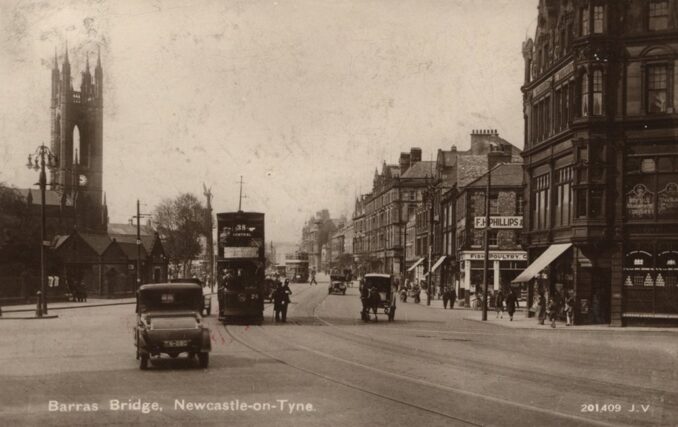
Newcastle Libraries, public domain.
So who was William Owen?
The original W. Owen opened in Collingwood Street in 1847, selling a liniment for croup, whooping cough and lumbago at 1s 6d a bottle. A. Ernest Owen, who owned the shop in the 1920s while Hunter ran it, sold up to him in 1929 and walks out of the story. Nobody has ever produced a word to suggest either of them mixed anything.
So how did he end up with the credit? Pybus’s note actually leaves a blank where the chemist’s name should go. When Newcastle University wrote the story up in 2013 the blank was filled in with “William Owen”, which is more or less what it said over the door, and the name has been copied from one website to the next ever since. If you want to be remembered as an inventor, the trick is apparently to have your name painted above the shop where somebody else does the inventing.
(Personally I care more about the money than the fame)

Public domain, via Grace’s Guide.
Beecham
In 1938 a Macleans salesman called John Gibson told H. G. Lazell of Macleans about “a Mr. Hunter, the owner of a chemist business named W. Owen & Son”, who had a glucose drink that had grown too big for him to handle. Gibson’s figures showed that if the Newcastle sales could be matched nationally the turnover would be over £1,000,000 a year, at which point Lazell went up to Newcastle “post-haste”, spent a day in Hunter’s plant and agreed a price of £90,000, plus a bonus if sales topped £100,000 a year in the first two years. In December 1938 Macleans told the trade they were taking over the selling of Lucozade, promising “soundly directed propaganda among the medical profession”. For a time after the war, Lazell reckoned, Lucozade was providing about a third of Beecham’s UK profits.
Pybus’s version of the same deal is shorter. The chemist “eventually sold out to one of the big drug firms and indeed I think for about £10,000. Of course, I did not share in this at all, but I sometimes wish I had.” He was out by a factor of nine, though probably for the best that he didn’t realise.
From sickbed to sports field
For the next forty years Lucozade meant somebody in the house was ill: heavy glass bottle, crackly yellow cellophane, “Lucozade aids recovery” on the label, kept on the bedside table next to the medicine. In the 1980s Beecham swapped the invalid in bed for “Lucozade replaces lost energy” and Daley Thompson, the Olympic decathlon champion, glugging it between events. UK sales roughly tripled between 1984 and 1989 to almost £75 million, and in September 2013 Beecham’s corporate descendant GlaxoSmithKline sold Lucozade and Ribena to the Japanese drinks group Suntory for £1.35 billion.
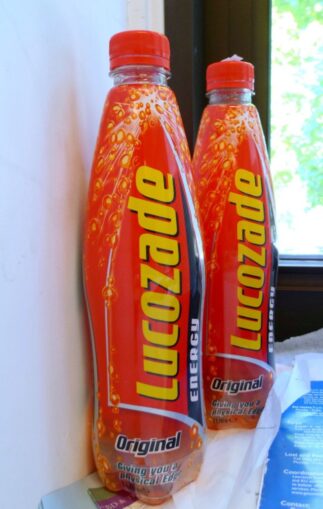
FHKE, CC BY-SA 2.0, via Wikimedia Commons
What Pybus did with the rest of his life
Quite a lot, as it turns out. He spent the First World War as a Major in the Royal Army Medical Corps, mostly operating on wounded soldiers at Armstrong College, which had been turned into the 1st Northern General Hospital; his papers record at least 1,364 operations by 1919, some of them in what had been the Fine Art department. He joined the RVI as an honorary surgeon in 1920, published The Surgical Diseases of Children in 1922, and stayed at the RVI until he retired in 1944, having been made Professor of Surgery along the way.
In 1925 he set up his own Cancer Research Institute in Newcastle and ran it for thirty years. He became convinced that the soot in city air was giving people cancer, and in 1955, with G. R. Clemo and E. W. Miller, he published a paper in the British Journal of Cancer under the title “The carcinogenic action of city smoke”. He also thought smoke from chimneys was a bigger danger than smoke from cigarettes, which has not aged quite so well, although nobody now argues with him about diesel fumes. He then went campaigning for cleaner air, and the University credits his work with helping bring about the Clean Air Act of 1956.
Public domain, via Wikimedia Commons.
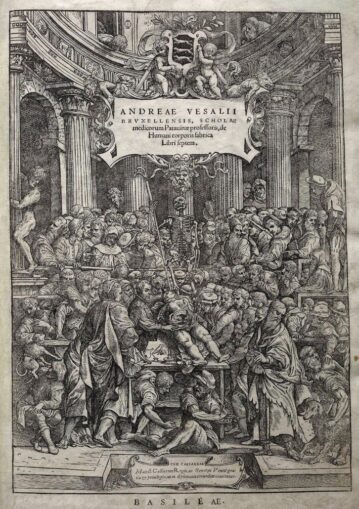
Then there were the books. Over forty years he built up a collection of around 2,000 books on the history of medicine, going back to the 15th century, starting with a Vesalius folio whose plates, he said, had “wetted his appetite with a vengeance”, along with engravings, letters, portraits, busts and, for reasons best known to himself, bleeding bowls. He gave the lot to Newcastle University in 1965, where it is still held today. He also found time to try to resurrect the Company of Barber Surgeons and Tallow Chandlers of Newcastle upon Tyne. Quite honestly I don’t know how the city got by without tallow chandlers all that time.
He never married, collected an honorary doctorate from the University in 1966, and died on 10 March 1975, aged 91, a year after he sat down and typed up the story of the baby, the glucose and the chemist in Barras Bridge.
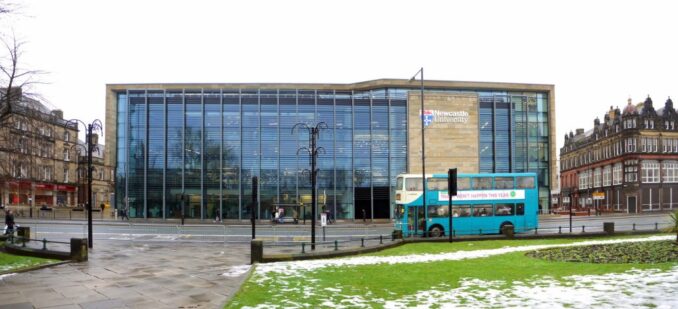
Andrew Curtis / Newcastle University King’s Gate Building, Barras Bridge
So, to summarise
Pybus had the idea, Hunter got the £90,000 and William Owen got the credit. Hunter died in 1954 and is buried in Jesmond Old Cemetery, which is about a mile from the shop, the children’s hospital and the house on Jesmond Road where Pybus was living in the 1920s, so the whole story happened within a short walk of itself. If you are ever passing the Haymarket, the air shaft is still there, and I would strongly recommend raising a bottle to the surgeon who sometimes wished he had.
© Paranoid Android 2026