
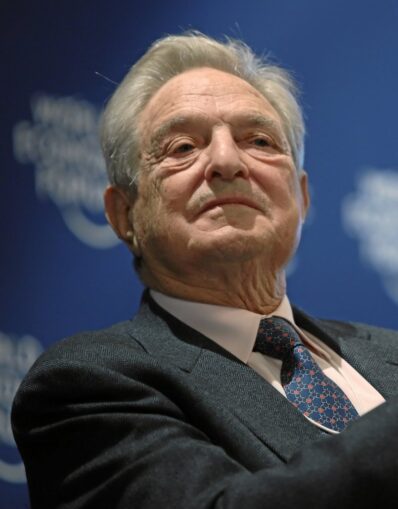
According to F. William Engdahl, a German-American political scientist and incisive commentator, George Soros secured the allegiance of 99 “sophisticated investors,” as mandated by U.S. law for a fund of such ambition. Engdahl distilled the matter with piercing clarity: “All were non-Americans, ensuring that U.S. tax authorities were barred from scrutinising his books—a practice hardly consonant with the ideals of an ‘open society.’” Nor was transparency the hallmark of Soros’s dealings with an elite coterie of affluent families, orbiting the gravitational pull of the Rothschild dynasty. The founding of the Quantum Fund, now known as the Quantum Endowment Fund, forged a decades-long bond with the Rothschilds, one that Engdahl views not as a mere banking arrangement but as a conduit to privileged channels of information—both governmental and private. This access, he argues, accounts for Soros’s meteoric success in the treacherous waters of high-risk finance far more than any gambler’s luck.
The Quantum Fund’s roster glitters with illustrious names, each thread in its tapestry revealing intricate ties, particularly to the Rothschild banking empire. Among them was Baron Nils Otto von Taube, an Estonian aristocrat who served as an advisor and senior investment manager to Lord Jacob Rothschild. It was Taube who, in the 1970s, ushered Soros into the gold market and later played an important role in establishing the Soros Open Estonia Foundation, one of the myriad Open Society Foundations whose influence will soon demand closer scrutiny. Soros, recognizing Taube’s acumen, invited him to join the Quantum Fund’s advisory council.
Then there was Richard Katz, an Englishman whose career spanned decades in global banking. Katz served N.M. Rothschild & Sons in London from 1977 to 1993 and Rothschild Italia S.p.A. in Milan from its inception in 1989 until 1992. In 1986, he joined the Quantum Fund’s executive committee as a director, later assuming a seat on the board of Geneva’s Union Bancaire Privée (UBP) in 2009, described as a “well-connected banker.” UBP’s records list Katz as a director of the Quantum Endowment Fund, LHC Investments, and Asian Capital Holdings Fund. In 1994, Katz felt compelled to pen an open letter to The Independent, which had published repeated exposés on Soros and the Quantum Fund. Decrying what he deemed biased reporting, Katz’s missive reads as a defense of the fund’s practices, concluding with a curt vow: “We will not further respond to your prejudiced coverage.”
The entanglement between UBP and Quantum runs deeper still. Edgar de Picciotto, UBP’s billionaire founder and chairman, sat on a Quantum committee and shared a close confidant’s bond with Soros. Born in 1929 in Beirut, de Picciotto fled with his family to Switzerland in the 1950s, escaping an anti-Semitic climate. The parallels between the two men—near contemporaries, shaped by displacement and ambition—are striking. In a 2015 dispatch for Zurich’s Inside Paradeplatz, financial journalist Lukas Hässig lauded de Picciotto’s singular ascent: “In his 85 years, de Picciotto has built his fabled wealth and attendant power entirely on his own. Today, he ranks among the planet’s most influential financiers.” The words echo with a familiarity, as if tracing the contours of Soros’s own legend. Within this constellation of “right” individuals, an almost unfathomable potential converges. UBP, too, reflects the nepotism that often attends such circles, with de Picciotto’s son Daniel and daughter Anne Rotman de Picciotto seated on its board—a dynastic echo of wealth’s enduring grip.
The constellation of players in George Soros’s orbit extends to figures like Alberto Foglia of Lugano’s Banca del Ceresio, a bank intertwined with Soros since its earliest days, and Beat Notz of Geneva’s Notz Stucki Asset Managers. In his incisive analysis, Lukas Hässig laid bare the machinery at work: “Four figures, bound to Edgar de Picciotto’s network, sit within Soros’s Quantum empire. This grants privileged knowledge, which de Picciotto deftly leverages for himself and his Geneva private bank.” Hässig paints de Picciotto as a colossus, a Lebanese-born financier of Jewish descent who pulled the strings of global finance with a maestro’s precision. “This is no game for the faint-hearted, content to linger on a pony farm,” he writes. “Around de Picciotto and his UBP, explosions—some minor, others seismic—have repeatedly detonated.”
One such detonation erupted on November 27, 1994, when U.S. federal agents struck, arresting Jean-Jacques Handali, a senior UBP representative, alongside Gary Kaminsky, then of Dollar Time, Inc., who would later rise to vice chairman at Morgan Stanley in 2013. Kaminsky, the financial chief of a retail chain, had been under scrutiny since 1993. The charge: money laundering tied to the drug trade. In a covert sting, authorities infiltrated the network with an informant who dangled $3 million for laundering. Yet the true target was the “Swiss connection,” embodied by Handali, a key figure at UBP. The bank swiftly disavowed knowledge of the scheme, insisting Handali acted alone. Reports, however, implicated two additional UBP managers—Jeckile E. Valero and Karl Michael Ley—who funneled millions in drug money through the bank’s channels. Consequently, $15 million on a UBP account was frozen, suspected of being laundered proceeds. The Handali affair, later parodied in the film The Wolf of Wall Street, underscored the audacity of such schemes, though the sums involved pale beside UBP’s $130 billion in managed assets. De Picciotto, undeterred by the scandal, remained steadfast.
The 2008 Madoff scandal, a fraud of unprecedented scale, dealt a heavier blow. Bernard L. Madoff, former NASDAQ chairman, had swindled investors of billions over decades through a Ponzi scheme. UBP, heavily exposed with $700 million invested in Madoff’s funds, reeled as de Picciotto’s children and nephews faced financial ruin. The 80-year-old “doyen of Geneva’s banking scene” returned to the fray, striving to salvage his empire. In a bid for damage control, he pledged to reimburse clients 50 percent of their losses, provided they remained loyal to UBP for five years. The bank, an early adopter of hedge funds, had engaged Madoff without suspecting his deceit. The scandal’s toll was grimly personal: two years after Madoff’s arrest, his son Mark, aged 46, took his life, hanging himself with a black dog leash, a tragedy widely linked to his father’s infamy. Thus, the titans of wealth and power, in their relentless pursuit, cast long shadows, engulfing not only countless strangers but, at times, their own kin.
Mystery shrouds other episodes, none more haunting than the fate of Edmond Jacob Safra, a lifelong friend of de Picciotto. A Lebanese-born billionaire and banker, Safra founded the Republic National Bank of New York in 1966, steering it to dazzling heights. In 1999, he perished in a blaze under still unexplained circumstances in his Monaco penthouse. Safra, lauded as a philanthropist and adorned with honors, was later implicated in U.S. investigations that exposed his bank as a conduit for billions funneled from New York to Moscow, directly into the maw of organized crime. Intriguingly, Safra’s Geneva-based Trade Development Bank (TDB), established in 1956, had merged in 1990 with de Picciotto’s Compagnie de Banque et d’Investissements (CBI), founded in 1969, to form the CBI-TDB Union Bancaire Privée.
To be continued
© DJM 2026