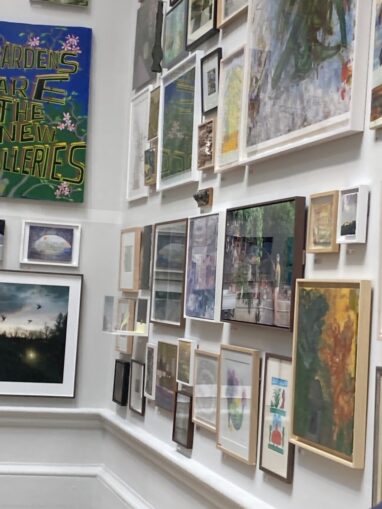
London is still our capital with a wealth of artistic and architectural gems to explore so I like to visit a few times a year. So.. Mr A and I went to town on the hottest day of the year to visit the Royal Academy and see the Summer Exhibition. The Summer Exhibition is an open art exhibition held every summer. It is the oldest open art exhibition in the world, starting in 1769 and always held at the Royal Academy. At the first Exhibition there were 156 works by 56 artists. Historical and biblical scenes featured in earlier years but the Exhibition has expanded massively and what is called art has changed so much since then.
We started out by getting breakfast at one of the old green cabman’s shelters at Charing Cross. These are about the only places now to get reasonably priced ‘proper’ food in central London. We ate our bacon butties in Whitehall Gardens, a lovely little oasis with statues and monuments to military heroes and memorials to the fallen. Refreshed, we walked to the Royal Academy via Parliament Street, taking in more statues including one of Alanbrooke; this one has been on my list for some time.
By the time we got to the Royal Academy we were perspiring a little so retired to the café for refreshments, including free chilled water. We came to see the Exhibition last year and I noticed that there were many works that seemed to have a nostalgia for British life in between the lefty agitprop (such as a stamp with Diane Abbot’s face), and a load of other execrable stuff. My favourites at last year’s exhibition were a photo of a party of white working class people in the 1970s that may as well have been from a foreign country, and the massive painting by Tracey Emin of the crucifixion; her painting was my stand-out of the Exhibition. It was so astonishing to see a religious subject, unusual in modern collection of artworks, and in complete contrast to the early days of the Exhibition where biblical scenes were a staple.
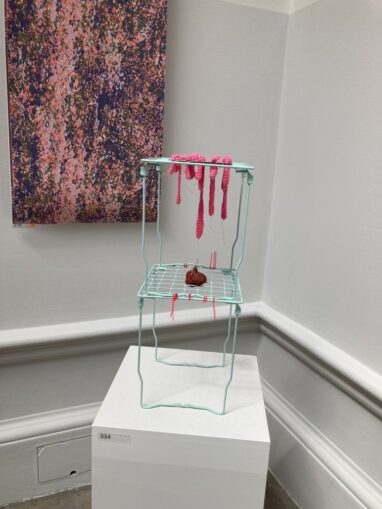
The Summer Exhibition is massive with guest curators choosing the artworks to be included each year. This year’s exhibition was curated by ‘conceptual artist’ Ryan Gander. Submissions are from established artists and new artists in an open competition. There were 18,000 entry forms for sale and all were sold. Just under 2000 exhibits were selected. The theme of this years exhibition was ‘connectedness’ apparently exploring the associations between different artworks, highlighting how diverse pieces can relate to one another, even if they appear disparate .
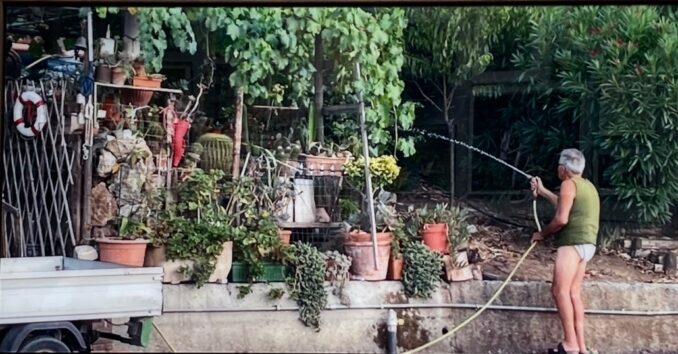
When you first go into the exhibition you are overwhelmed by the sheer amount of exhibits. I rather liked the first gallery focusing on domestic gardens and nature often elevated to fantasy. I think this a theme echoed from last year and extends into the other galleries too where there is an emphasis on the domestic settings and pets. This includes a wall of cat pictures, a stuffed Palmerston (is it the actual stuffed dead Whitehall cat?) and a massive sculpture, Tailchaser, of a cat showing its bits. Maybe with modernity being so awful we retreat into a small domestic realm to retain some sanity. My favourite was a photo of a man gardening, ‘Hot Pants’ by Nonie Bennett
There were also exhibits with a nostalgic view of the past; a particularly arresting exhibit was an iPad covered in bubblewrap by Seren Metcalf, ‘The Familiar Voice’, with a fella doing a karaoke of Wonderwall . It reminded me of many pub sing-songs of the type I had when young. I loved this but it made me quite sad for the white working-class community life we have mostly lost. There was also history of a different kind with some execrable student level old-fashioned agit-prop including a massive rainbow arch at the entrance, Blair depicted as a snake, a risible piece saying ‘disarm’ that costs £36,000 and something called ‘The Whiteness was not Consensual’, apparently price on application. Just awful.
There was, of course, a lot of complete nonsense to be seen. Favourites include a plastic bottle called ‘I Pollute Therefore I Am’, £10,000 and bits of rubbish put together called ‘Infection 1’ that went for £7,500. For sheer cheekiness was a small, torn bit of cardboard with a few bits of tape stuck to it called ‘Sing my Land’, but at £65 plus entry fee I think the artist may be just taking the P.
Tracey Emin had 3 exhibits and they were arresting as usual. The largest was a painting of a nude with words relating to the impact of her own illness (words not to be repeated in polite company). Not everyone is a fan, but I think her work shows life as a Western woman living at the end of the 20th century into the 21st; a focus on oneself, a lack of life guardrails and destruction of your own children. Her work is extremely skilful, she really knows how to draw and is so original; much more than just the unmade bed. Emin has cancer and her most recent work I think shows her look beyond her life to death and the spiritual world. I loved her Crucifixion and this year the nude of herself focuses on the impact of her illness and mortality. There is an exhibition of her work until 31st August at Tate Modern if you fancy it and I think her work is worth a second glance.
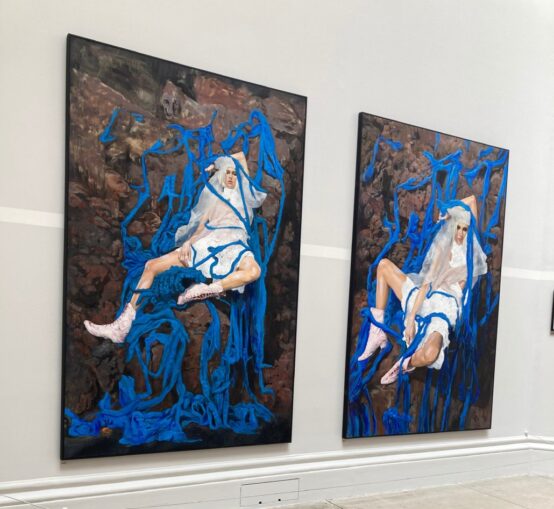
My favourite exhibits were large and expensive, 2 paintings at £180,000 a pop by Paulina Olowska, depicting the same woman, one labelled ‘The Goddess’, and the other, ‘The Witch’. I am not sure what the artist’s intention was, maybe to reclaim the archetypes, but these archetypes still resonate as we women are strange, mercurial creatures. These paintings capture female beauty too and in modern day art this is rarely done well.
There were some pictures depicting the awful world of the modern Yookay, for example a depiction of one of our awful block of flats in Glasgow by Alex Currie. I would not fancy having that on the wall. However, I am not sure exhibited modern art does that good a job of representing or reflecting on modernity. I think the Twitter/X account ‘YOOKAY AESTHETICS’ @MythoYookay does a great job of this and the vignettes of YooKay life roll out hour after hour; that’s artistic output for you.
All in all there was scant evidence of a huge body of talented artists living and working in Britain that reflect the modern world or a modern art movement but maybe they just do not apply, or are not chosen, to show at the Exhibition or maybe lost among the numerous exhibits. The philosopher Evola in his revolt against the modern world did not reject the abstract but wanted to explore more esoteric subjects but in the Exhibition there was a focus on the temporal. There are artists out there who wish to create interesting countercultural pieces but few are represented here. If you are interested in this, Alexander Adams’ substack is a good place to start; his book ‘How to Start a Dissident Art Movement’ proposes Modernism and vitalism as routes for a vigorous future art movement. However at the Exhibition you can have a nice glass of champagne while taking in vast numbers of art works of dizzying variety and quality. I really enjoyed it.
After the Exhibition we followed up with a tour of local pubs and cold beers. I would recommend the Coach and Horses in Greek Street. Proper ale on cask and keg and still has a locals vibe before we headed off after a great visit.
The Summer Exhibition runs at the Royal Academy until August 23rd.
© text & images @Alurka 2026