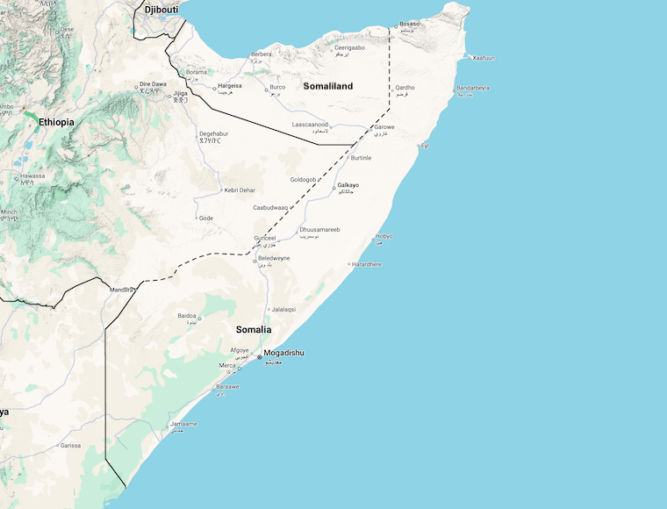
© Google Maps 2026, Google licence
Americans know Somalia from the film “Black Hawk Down” based on the U.S. intervention of 1993.
The U.S. had armed Somalia’s strong man, Siad Barre, as a counter to Ethiopia’s Marxist government, but with the collapse of the Soviet Union in 1991, Washington abandoned him, and he fell.
The U.S. State Department decided to do clan politics, to pick champions. It ignored the attempt of businessmen and intellectuals to coalesce and form a government. In one damning case, just as civilian leaders were holding such a meeting, the U.S. swooped.
Two of Somali leader Mohamed Farrah Aidid’s lieutenants were present during the October 3-4, 1993, meeting – the U.S. had judged him an enemy – so the U.S. decided upon mass elimination.
In an angry communal response, Somali militia shot down two American UH-60 Black Hawk helicopters. U.S. troops tried to recover the crews of both helicopters, but a one-hour operation turned into an overnight battle resulting in the death of 19 soldiers.
Somalia is one of those cases where, if the U.S. had set out purposely to destroy a country – needlessly sacrificing its own soldiers – it amounted to the same.
Operation Restore Hope took sides in local rivalries, killed civilians, turning them against the U.S. and created a refugee crisis that Americans look upon in wonder:
The current $9 billion government fraud scandal in Minnesota, involving the Somali community, in which money finds its way back to Somalia to fund those very same warlords.
A Somali proverb, loosely translated, me against my brother, my brother and I against my family, my family against our clan, the clans against the country, our country against the world.
If there had been a nefarious plan to destabilise then break up Somalia – financed in part by corruption in U.S. party politics and state and federal welfare programmes – and peel off Somaliland as a client state on the Red Sea…
Stranger things have happened. If you recall Iran-Contra, the U.S. armed its supposed enemy in Tehran, paid for by a cocaine-trafficking network in Latin America, while creating new markets for crack cocaine in American inner cities.
Of course, the complexity goes deeper…
Ethiopia, supported by the US, invaded in 2006 to oust the Islamic Courts Union (ICU), but this intervention only further antagonised the people, who turned to the more radical Al-Shabaab and other associated affiliates.
Türkiye has more recently poured military and medical aid into Somalia, with mixed effects – bringing some stability with the inevitable shady business dealings.
Yet more than two decades later, in October 2017, two truck bombings took place in Mogadishu, killing almost 600 people and injuring half as many again.
Last year Israel had discreetly approached Somaliland, which is situated across the Gulf of Aden from the Yemeni city of Aden, with the proposal of setting up a military base in Somaliland to target and attack the Yemeni Armed Forces.
Israel’s interest in Somalia coincided with a U.S. delegation arriving in Somaliland. The evidence of international collusion is inescapable.
U.S. Senator Jim Risch, ranking member of the Senate Foreign Relations Committee, said it was an opportunity for the U.S. to abandon its “failed” One Somalia policy and adopt a “more pragmatic” approach to Somalia.
Ethiopia had signed an MOU to lease a stretch of coast giving landlocked Ethiopia access to the Red Sea. Somaliland has the port of Berbera. In response, Somalia said it may support Ethiopian rebel groups.
Regional influence
Türkiye also pursues its influence in Somalia. Its relations with Somalia date from the Middle Ages when they jointly confronted the Portuguese colonies in Southeast Africa.
In 2024 Türkiye helped Somalia and Ethiopia settle an argument over Somaliland, which broke from Somalia three decades ago. Ethiopia, seeking access to the sea, had leased 20 kilometres of coastline to build a naval base. In return, Ethiopia was expected to recognise Somaliland’s independence.
In the same year it signed an oil deal with Somalia to explore and extract from three sites along Somalia’s coast.
Some African nationalists say, however, that Istanbul is misleading East Africans into giving up their interests.
Imperial memories
In the background is a grab for resources as powerful forces grapple with the transformation of the monetary system.
The tentacles reach into Africa, where the British are increasingly vocal on Somaliland. Former imperial powers are eyeing Africa once again – don’t be misled by the French exit from some of its former colonies.
African countries are trying to reclaim their resources. Senegal President Bassirou Diomaye Faye demanded France close military bases. Chad also ended military cooperation with France.
New order
There’s something of a shell game being played in Somaliland.
Israel became the first UN member to recognise it as an independent state on December 26. Somaliland thanked Israel for recognition, while Somalia condemned it, saying it should instead recognise Palestine.
Israel is negotiating to build a military base in Somaliland, but this has not been confirmed officially.
The financial muscle behind the deal is the United Arab Emirates which will revamp its Berbera port. The British government is also investing, primarily through the Berbera Trade Corridor Development Project.
The Israeli announcement recognising Somaliland’s sovereignty has triggered an uproar within what’s left of the Somali community in the US, most of it concentrated in Minnesota. Yet amid the debate, one prominent voice has been conspicuously absent. Congresswoman Ilhan Omar, long regarded as a leading figure and de facto spokesperson for the Somali American community, has remained silent.
The likelihood lies in the internal dynamics of the Somali community in the US, which forms the backbone of Omar’s electoral base, as well as in her own controversial family history, tied to one of the darkest chapters in Somalia’s past.
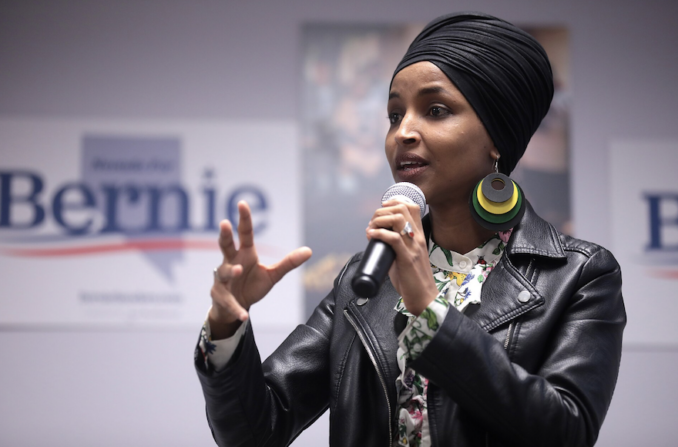
U.S. Congresswoman Ilhan Omar,
Gage Skidmore – Licence CC BY-SA 2.0
Omar’s father, Col. Nur Omar Mohamed, was directly involved in the genocide against members of the Isaaq clan in northern Somalia. That same clan later went on, in the aftermath of the civil war, to establish the Republic of Somaliland. The genocide was carried out under the rule of Somali dictator Mohamed Siad Barre, who led an authoritarian military regime and routinely executed his opponents.
Ilhan Omar’s father, based on government directives such as the notorious “Letter of Death” attributed to General Morgan, advocated a campaign of obliteration and extermination of ethnically Isaaq civilians who form the absolute majority of the population in Somaliland – demonstrating that genocide was national policy, not the act of rogue units.
Col. Nur Omar Mohamed was one of the commanders in the field during the genocide. His close ties to the president and to the ruling clan enabled him to evade accountability. Given his rank, authority, membership in the ruling Darod clan, and more than 10 years of advancement through the Somali military hierarchy to the rank of colonel, placed him directly within the chain of command during, and at the height of, the Isaaq genocide. Based on his position, loyalty to the regime and role in the army, he had extensive knowledge of, and involvement in, the planning, conception, management and execution of the genocide.
Many survivors of the genocide, along with members of other ethnic groups who suffered under Barre’s bloody rule, now live in the US and form part of Omar’s electoral base. With the ongoing war in Iran, the prospect of reopening deep wounds of the genocide in the late 1980s and early 1990s may be reason enough for Ilhan to forgo another confrontation with Israel and opt, at least this time, for silence. Not least given her role in the Minnesota fraud.
It is increasingly becoming apparent a more accurate reinterpretation of her personal history is the daughter of a genocidaire and war criminal, who lived a gilded lifestyle as a child of the regime elite who was potentially a beneficiary of genocide, but once in the West, reinvented herself as a liberal refugee victim.
In addition to Israel’s recognition of Somaliland, Saudi Arabia, Egypt and Djibouti are structurally invested in a self-governing Somaliland that already operates as one.
They may avoid the word recognition, but their planners, port authorities and crisis rooms treat it as separate: a coastline to stabilise, a port to sustain, an airfield to preserve, an administration to trust. Israel did not create this reality. It forced it into daylight. Hence the recent request.
Further, just before the war in Iran, Somaliland has offered the US exclusive access to key mineral deposits and the possibility of hosting American military facilities, as the self-declared republic intensifies efforts to secure international recognition amid a shifting geopolitical landscape in the Horn of Africa. Somaliland’s outreach to Washington comes as alliances in the Horn of Africa undergo recalibration, driven by Red Sea security concerns, intensifying competition for critical minerals and broader Middle East rivalries.
Given Somaliland holds large deposits of lithium and coltan this would fit in with the US pivot from aid to development and business, and potential formal recognition from the US would act as a further pivot to strengthen security in the Horn of Africa. It would also strategically recalibrate the US One Somalia policy.
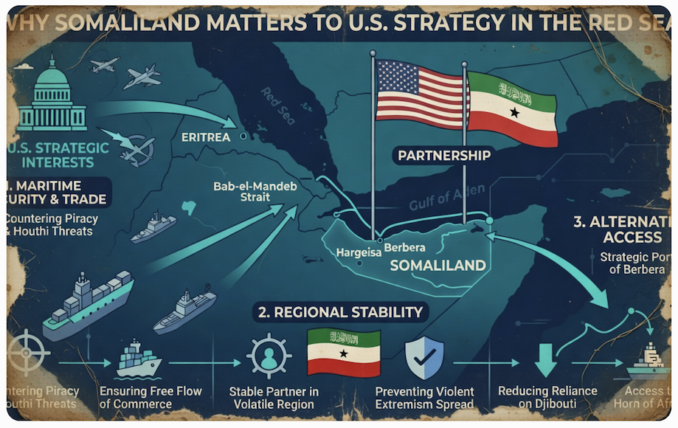
Image generated using GROK AI
It would also act as a direct counter to Somalia which is propped up primarily by China and Turkey. Given the Somali Government recently approved a new permanent constitution that delays scheduled 2026 elections and extends the Somali president’s term against opposition objections, US recognition of Somaliland would act as a large geopolitical counter lever.
Given Somaliland occupies a strategic position along the Gulf of Aden, opposite Yemen, the maritime corridor has gained renewed security significance amid tensions in the Red Sea together with the Iran war. Recent attacks by Iran’s Yemen proxy Houthi movement on Israeli-linked targets has drawn global attention to the region’s vulnerability and its importance to international shipping lanes and marine insurance support this.
The UAE has also emerged as a significant partner. Emirati firms have invested in infrastructure and port development in Berbera, a strategic coastal city along the Gulf of Aden. The port is seen as a potentially key logistics hub linking East Africa to Gulf markets.
Somaliland, maintaining diplomatic ties with Taiwan and hosting representative offices of several Western countries as well as Djibouti, Kenya, and the UAE, presents a strategic opportunity for the U.S. to its credit.
Somaliland has its military, flag, currency, and functioning institutions, making it a distinctive and stable entity in a region often plagued by instability. Following the November 13, 2024, presidential and political association elections, which were widely regarded as free, fair, and peaceful by international observers, Somaliland elected its sixth president and reaffirmed its commitment to democratic governance. This election bolstered hopes for global recognition, a goal that Somalilanders have tirelessly pursued for decades.
Notably, recent developments in the United States suggest a potential shift in policy toward Somaliland. In December 2024, Congressman Scott Perry of Pennsylvania introduced a bill in the House Foreign Affairs Committee, advocating for U.S. recognition of Somaliland as an independent state. Additionally, reports indicate that Trump may be more receptive to this idea, given his administration’s interest in countering China’s growing influence globally.
Despite ongoing geopolitical tensions in the Horn of Africa, marked by maritime and border disputes and Somalia’s relentless efforts to obstruct Somaliland’s independence aspirations, recognising Somaliland would yield significant strategic economic advantages for the U.S., and with US deployment in N and NE Kenya, would increase both security and economic development in the region.
Formal recognition would not only solidify security cooperation between Somaliland and the U.S. but also provide a crucial foothold to counter China’s influence in the region. By becoming the second country, after Israel, to recognise Somaliland, the U.S. would reshape the geopolitical dynamics of the Horn of Africa, while advancing its strategic interests in line with its National Security Strategy.
© AW Kamau 2026