
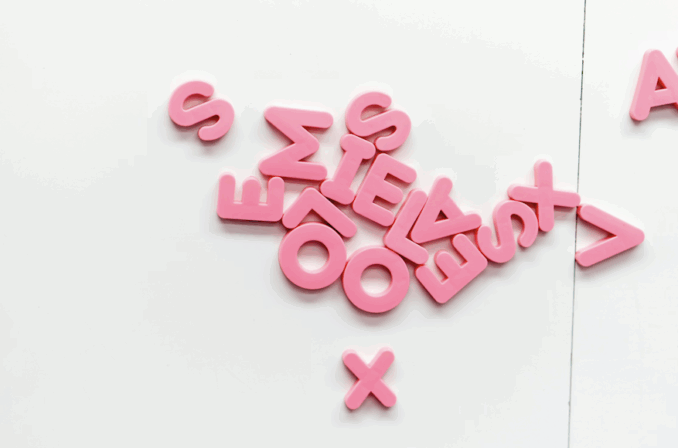
Letters,
Jason Leung – Unsplash Licence
At Going-Postal in general and QT Review in particular, we pride ourselves that nobody reads the comments, nobody reads the articles, and at least one proofreader (me) can barely read and write.
I’m often pulled up on my spelling and have been meaning to write an article about it. A kind of victimhood critique based upon an it’s-not-my-fault, something-is-going-on-inside-my-head narrative. I’m indebted to Puffin Lord Hugh for prodding me in that direction by sternly mulling my thick spelling below the line following QT Review Dover published the Friday before last. Lord Hugh (properly) noted, ‘Kieran MULLAN, Hedda STERNE, Charlie ELPHICKE, Daniel ZYLBERSZTAJN’.
Righly so, and while making the alterations, I realised an opportunity to get stuck into that cathartic/diagnostic article. As I share my reply to Lord Hugh, let’s begin the analysis with the big clue that all of the misspelt words were proper nouns.
Good point lord Hugh. if i type and write fresly to coems out like this. therefroe i use the spellchecker, agrammerly, auftocrit anmf chatgtp to policy it up. Howevr, they daont fo proper nounds a s well as just anout anyhtign can be a proper n oun. i will work on. it anf het it dorted out. it can take me 15 to 20 minuted to spell oen word if i dont ahve the technolofy. i can feel an articel coming on!
Translation:
Good point Lord Hugh. If I type and write freely it comes out like this [see above]. Therefore I use the spellchecker, Grammerley, Autocrit and ChatGPT to polish it up. However, they don’t do proper nouns as well, as just about anything can be a proper noun. I will work on it and get it sorted out. It can take me 15 to 20 minutes to spell one word if I dont have the technology. I can feel an article coming on!
Yes, even when translating one letter at a time, I managed to spell Grammarly wrong. When I came to look at my corrected text, I noticed another clue. A proportion of the mistakes are transposed letters, and another batch is caused by near misses on the keyboard or by hitting two keys at once. We shall return to the spelling, but first, a look at the typing.
Typing
According to the Temp, common causes of such mistakes include cognitive factors such as anticipatory typing, where the brain processes words faster than the hands can type, leading to preemptive letter movements. Fatigue or lack of focus also increases the likelihood of mistakes, and pressure on working memory can make it harder to maintain the correct order of letters.
Technical issues may contribute as well, including incorrect keyboard or language settings— such as using a different regional layout — and hardware limitations in cheaper keyboards that can transpose letters when typing quickly. Learned habits play a role too, since typing familiar words at high speed can result in automatic but error-prone movements. Common fixes include slowing down, focusing, checking language settings, or even using a better keyboard.
Not quite the neurological condition I was hoping for – one worthy of a PIP, Motability sports car and an attendance allowance for Mrs AWS. When I do QT Review, I’m typing while listening and itching to get to bed. It being broadcast in the evening, I’m also tired, and so muddled between eye, brain, hands and keyboard that I’m oft reduced to putting my left palm hard to the desk while typing one-fingered with the index digit of my right.
However, while heeding the advice to slow down and stay focused, most of the problem is hidden from readers, thanks to the spell checker et al. But what about those troublesome proper nouns?
Proper nouns
Struggling to spell proper nouns is common because they often break standard spelling rules and lack predictable patterns. Many regular words follow phonetic rules, but proper nouns frequently do not, as seen in names like “Siobhan” or place names like “Leicester,” where the spelling doesn’t match the pronunciation. Their spellings are often arbitrary as well — people choose how to spell their own names, businesses invent unique brand names, and historical locations develop spellings that don’t follow linguistic rules, leaving memorisation as the only reliable method.
Proper nouns also come from a wide range of languages, each with its own spelling conventions, which adds to their inconsistency and unpredictability. Because specific proper nouns appear less often in everyday reading, you get fewer opportunities to reinforce their spellings in memory. In addition, the required capitalisation of proper nouns can subtly affect how the brain recognises and processes them, making their spellings slightly harder to retain compared to common words.
I’ve certainly never typed Zylbersztajn before – and never want to again. Still, a solvable problem, especially when asked ChatGPT informs me it can do proper nouns. I shall try harder.
As for taking 10 to 15 minutes to spell one word.
Raconteurial drawback
Puffins have commented on my raconteurial style. Meaning I write as I talk. The downside of this is I spell as I talk, with not only phonetic spelling, but also phonetic spelling based on my accent rather than the Queen’s English.
Yes, a person’s accent can make spelling difficult, particularly during the early stages of literacy development when individuals rely heavily on phonics (sounding out words). Standard English spelling often does not align perfectly with all regional pronunciations.
Accent plays a noticeable role in spelling because many people learn to write by matching letters to the sounds they hear themselves say. When someone’s pronunciation differs from the standardised form, their spellings may reflect their personal accent rather than conventional orthography.
Regional differences in vowel and consonant sounds can influence this: for instance, rhotic speakers of American English might omit the written “u” sound in words like “hurt,” while non-rhotic Southern British speakers might be inclined toward spellings that reflect their own pronunciation.
Similarly, speakers in Northern England use a short “a” in words like “bath” and “grass,” which helps them avoid errors such as inserting an “r,” something more common among speakers whose accents use an “ar” sound. Homophones can also vary by accent, leading to additional confusion, and all of this is layered on top of a standardised spelling system that was fixed centuries ago and aligns with no single modern accent. As a result, every speaker, regardless of how they pronounce words, must learn the same conventional spellings.
Although accent can introduce some difficulty, the experts suggest its overall impact on spelling ability is usually modest. Strong spelling skills depend more on explicit, systematic phonics instruction based on the standard written form of English.
Teachers can help students manage accent-related spelling issues by explaining the differences between standard pronunciation s— such as those found in dictionaries using Received Pronunciation or General American — and the student’s own accent, and by teaching the multiple possible spellings of a single sound along with the rules that determine when each is used.
As Puffin’s favourite read The Influence of Regional Pronunciation Variation on Children’s Spelling and the Potential Benefits of Accent-Adapted Spellcheckers puts it:
A child who is unfamiliar with the correct spelling of a word often employs a “sound it out” approach: breaking the word down into its constituent sounds and then choosing letters to represent the identified sounds. This often results in a misspelling that is orthographically very different to the intended target.
Sometimes my spellchecker doesn’t recognise my words at all, so I have to alter the letters and/or order of letters several times before it catches – resulting in (what seems like) ten to fifteen minutes to spell one word.
Some examples of my pronunciation:
- Bew-rock-racy
- Ve-ick-el
- Air-ee-al
- Art-ick-el
- Cheque-oh-slow-vakia
- Nuke-you-laa
- Air-oh-plane
- Amb-lee-ance
What I’ve found is that remembering the first three letters of some words allows the rest of the letters to flow accurately: A-M-B ulance, C-Z-E choslovakila, V-E-H icle, A-E-R oplane and N-U-C lear. But the others, I just can’t manage.
Is there more going on between my ears than not concentrating, typing too fast, raconteurial spelling and being unfamiliar with some proper nouns? Perhaps.
Memory loss
Memory loss can have a significant effect on both spelling and typing because these skills rely heavily on the brain’s ability to store, retrieve, and coordinate information. Spelling depends on long-term memory for familiar word patterns, rules, and visual representations of words.
When memory is weakened, even common words can feel unfamiliar, making it harder to recall correct letter sequences or recognise when something “looks wrong.” This often leads to increased spelling mistakes, hesitation while writing, or reliance on phonetic approximations rather than standard spelling.
Typing also becomes more difficult because it draws on procedural memory — the automatic, practised motor patterns that allow your fingers to move quickly and accurately across the keyboard. Memory loss can disrupt this automaticity, causing you to mistype letters, reverse their order, or forget where certain keys are located.
You may also lose track of what you intended to write mid-sentence, resulting in incomplete words, repeated segments, or inconsistent phrasing. In combination, these challenges can slow down writing, increase frustration, and make tasks that were once effortless require conscious, deliberate effort.
Hmmm.
I shall type more slowly, try to concentrate and check all the proper nouns during my future articles. If I’m still struggling, it might be worth looking into memory loss, especially due to my age, family medical history, and to several thumps I’ve had to the head.
Fascinating stuff. Thanks, Lord Huge! (Oops, Hugh)
© Always Worth Saying 2025