If you grew up anywhere near Newcastle, you were probably taken round the Hancock Museum at some point and spent most of the visit with your nose pressed against a glass case of stuffed animals (this author included). It is named after two bachelor brothers: one won a Royal Medal for sea slugs and the other was “the best stuffer of birds in the kingdom”. Neither of them lived to see it named after them.
Bridge End
Albany Hancock was born at Christmas 1806 and his brother John in February 1808, both at Bridge End, the Newcastle end of the old Tyne Bridge, where their father kept a saddler’s and ironmonger’s shop. He died in 1812, when Albany was five and John four, and the family moved to a house beyond the Windmill Hills in Gateshead, which went by the nickname ‘Botany Bay’.
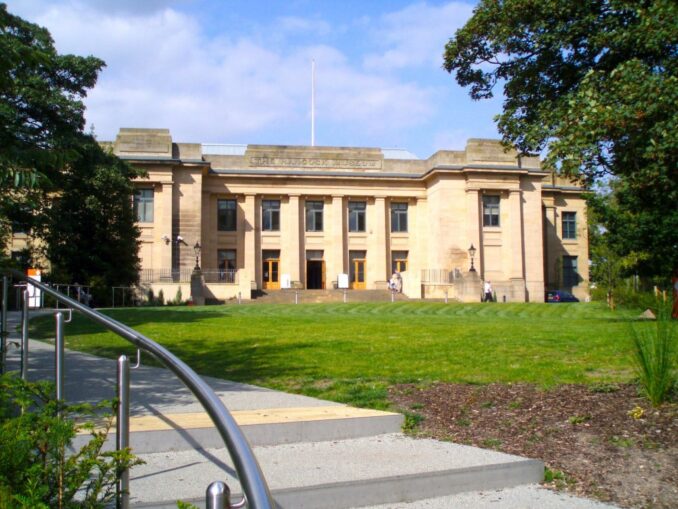
TubularWorld, CC BY-SA 3.0, via Wikimedia Commons
According to John’s memoir, the house soon “became a real museum”, with “the encouragement and indulgence of his mother and sisters”. I do wonder how enthusiastic their mother really was about all the dead birds.
They also had a famous friend in Thomas Bewick (remember him?), whose Newcastle workshop John “was fond of frequenting”. A Bewick biographer later called John “the last surviving friend of Thomas Bewick”.
Albany and the law (briefly)
Albany qualified as a solicitor and in 1831 took an office above his friend Joshua Alder’s shop in the Side, where, in the words of his memoir, he “awaited practice for two years”, which is a polite way of saying he had no clients. So he gave up the law and threw in his lot with the man downstairs.
Sea slugs (the Royal Medal kind)
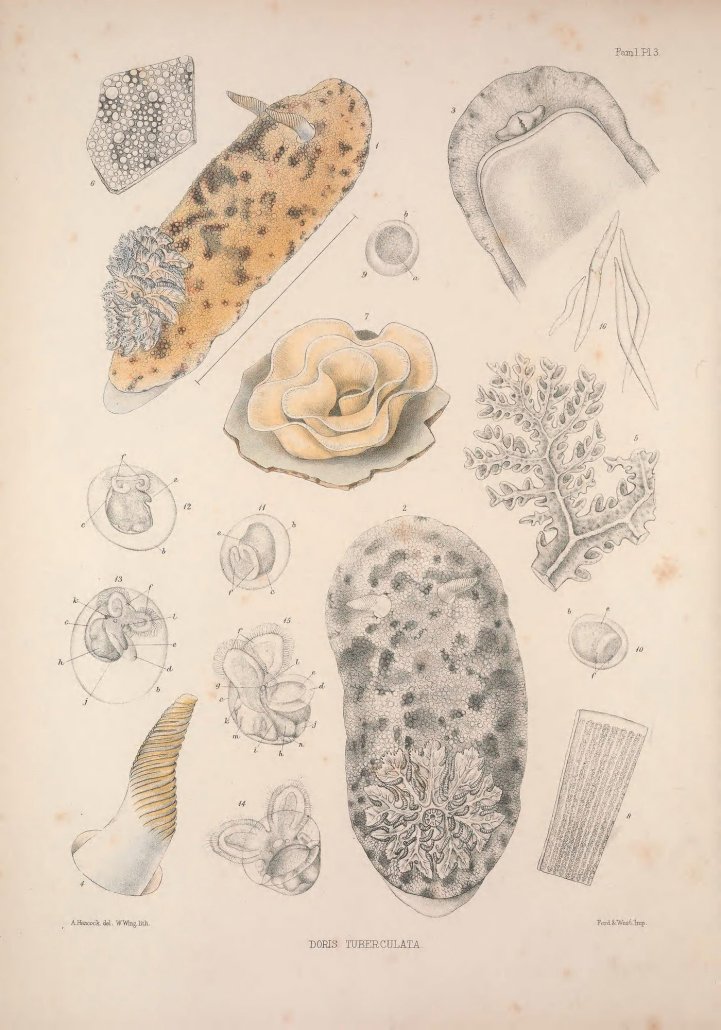
Alder and Hancock’s big project was sea slugs, or nudibranchs if you want to sound educated. As the two men explained, “the Nudibranchiata are as perishable as they are beautiful”, and once pickled in spirits they turn into “the shapeless and colourless mass”. You can observe a similar phenomenon take place at the Bigg Market every Saturday night. So they had to be drawn alive. The slugs, that is.
Their Monograph of the British Nudibranchiate Mollusca came out in parts over ten years, and “most of the drawings of the species and the whole of those of the anatomy were by Hancock alone”, which is not bad for a man who had never had a drawing lesson in his life. The sea lemon in particular is described as “a very sluggish animal” and “an unshapely and unattractive animal”.
Joshua Alder, Public domain, via Wikimedia Commons
Albany also found a new burrowing barnacle and lent it to Charles Darwin, who wrote back: “I am almost driven mad by its generative system… Can you forgive me when I tell you that I have cut up all the specimens you lent me?” Lending things to Darwin, it turns out, was much like lending things to anybody else.
Darwin later backed Albany for a Royal Medal, which Albany got in 1858. He also turned down an invitation to become a Fellow of the Royal Society, and “His diplomas were carefully put away, so as not to attract attention.”
John and the birds
John, meanwhile, found the family business “irksome” and left it to his elder brother Thomas. In 1829 he became the first person in England to point out the differences between the Whooper swan and a new, smaller swan, only for his own taxidermy teacher, R. R. Wingate, to read a paper on it in which, as John put it 45 years later, “by some unaccountable inadvertency my specimen was not alluded to”. The bird was named after their friend Bewick, and John’s revenge was one very polite sentence in a book.
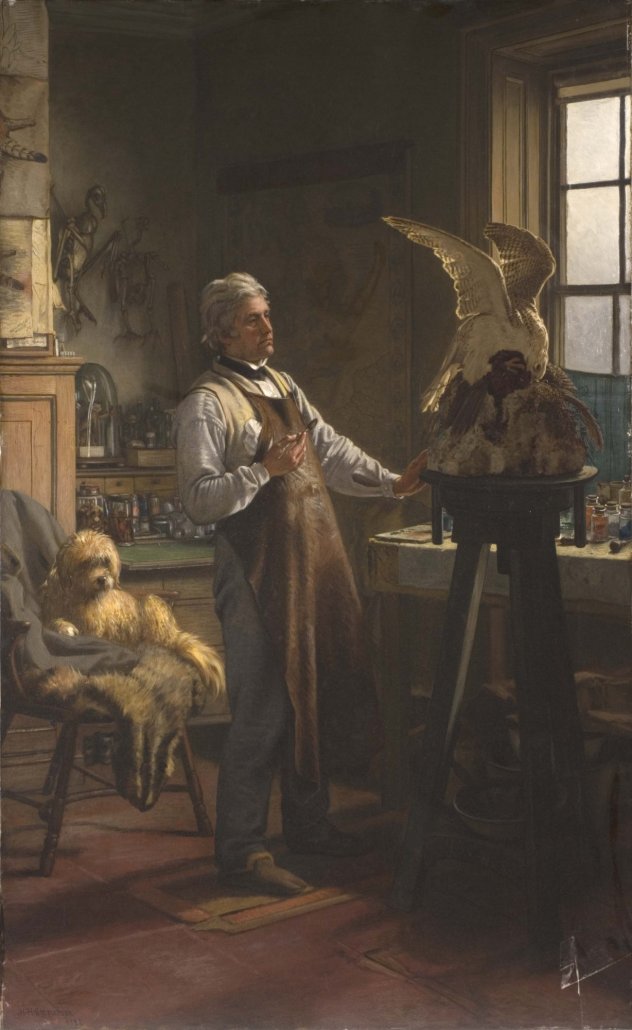
What made his name was the stuffing. In 1849 the sporting writer Charles St John called him “the best stuffer of birds in the kingdom”, and John claimed that if you plucked a dead bird and shook the feathers up in a bag he “could and would, if necessary, place each feather in its proper place”.
Henry Hetherington Emmerson, Public domain, via Wikimedia Commons
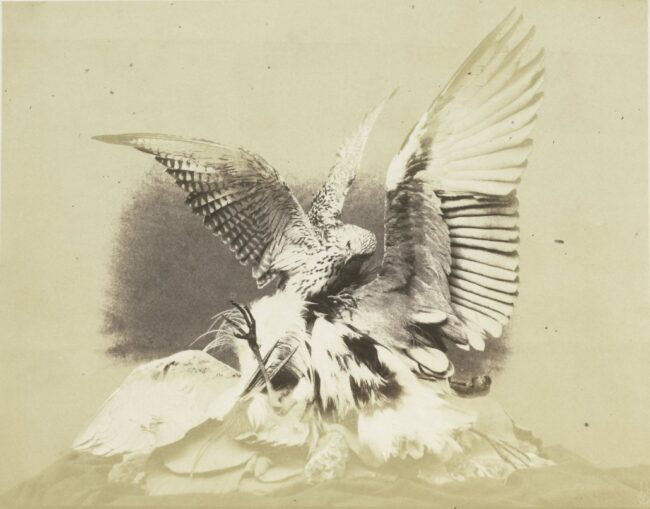
One of the groups he showed at the Great Exhibition of 1851, “The Struggle with the Quarry”, has a gyrfalcon taking down a heron, and the pair are still going at it in the museum today. He was a working falconer too, and flew merlins “on the Newcastle Town Moor”.
Rijksmuseum, CC0, via Wikimedia Commons
He also enjoyed a joke. When a house guest was desperate for a chaffinch’s nest and nobody could find one, John got up early, collected “moss, spiders’ webs, hairs, and lichens” and made one. The guest was delighted, and the memoir adds that “John always enjoyed a joke, and this was one of his.”
The museum
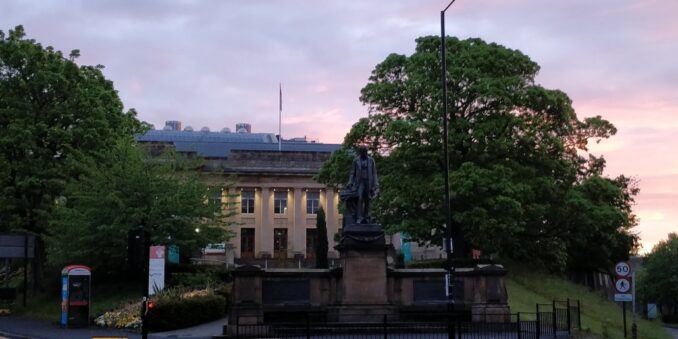
By the 1870s the Natural History Society’s museum (complete with a walrus and a polar bear John had stuffed in 1833) was bursting, and when Albany died in 1873 John proposed a new one in his brother’s memory.
Lord Armstrong gave £10,000 of the more than £40,000 it cost, and the Prince and Princess of Wales opened it in 1884, “by the express desire of Lord Armstrong”. When it got electric light, Joseph Swan “very kindly presented the lamps”. Swan also took the photograph at the front of John’s memoir, which, given John’s views on photography, I suspect took some persuading.
Voello, CC BY 3.0, via Wikimedia Commons
John died in October 1890 and was buried with Albany in Jesmond Old Cemetery. Among the mourners, his memoir records, were “five octogenarians”. A year later the Society voted unanimously that it “be henceforth known as the Hancock Museum”, and since 2009 it has been the Great North Museum: Hancock, so the brothers are still on the sign, just after a colon.
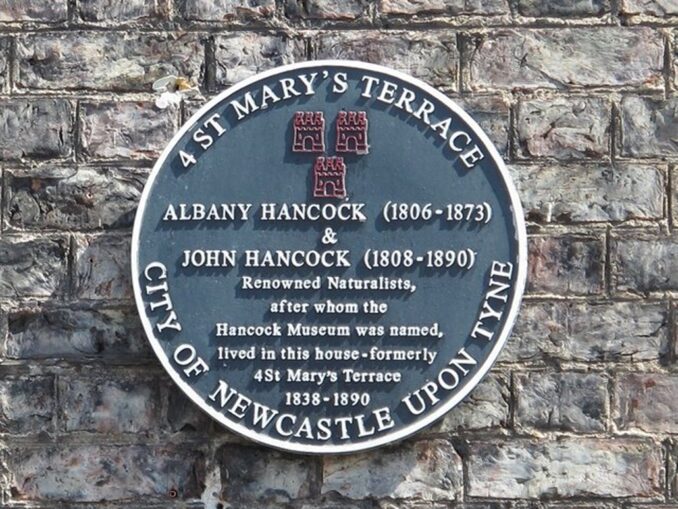
Blue plaque re Albany & John Hancock, St. Mary’s Terrace, NE1 by Mike Quinn, CC BY-SA 2.0, via Wikimedia Commons
So, to summarise
So, two bachelor brothers from Bridge End, one who drew sea slugs and one who stuffed birds, gave Newcastle its natural history museum, and 135 years later they are still on the sign, albeit just after a colon.
© Paranoid Android 2026