
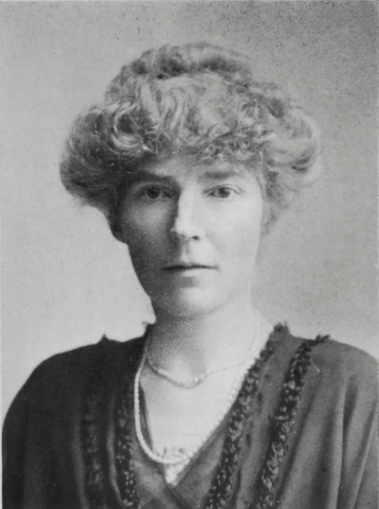
This is the first article since the railway series went into the sidings, and we are now well overdue an article on the fairer sex. So, this week we bring to you a lady who spoke six languages, gained a 1st from Oxford before it awarded women degrees, climbed the Alps in her underwear and who drew a country’s borders, picked its king, wrote its antiquities law, and built its national museum from scratch.
Historia/REX/Shutterstock.com (according to Brittanica.com), Public domain, via Wikimedia Commons
Gertrude Margaret Lowthian Bell was born on 14 July 1868 at Washington New Hall in County Durham, into money and coal smoke. Her grandfather, Sir Isaac Lowthian Bell, had turned the family ironworks into one of the great industrial fortunes of the North East. Bell grew up with everything a clever Victorian girl could want, albeit in a society that wasn’t quite ready for high-achieving women.
A first, and no degree
At 17 she went up to Lady Margaret Hall, Oxford, to read modern history. She finished it in two years rather than three and came out with a first, the first woman ever to manage that in the subject. Oxford, however, declined to actually hand her the degree. Women weren’t awarded degrees there until 1920, by which point Bell had considerably bigger matters to deal with.
The story everyone tells about her finals is that she corrected one of her examiners on a point of geography, to his face, in the middle of the viva. Whether or not it happened exactly like that nobody can say for sure, but the fact this story exists gives it some credence, to this author at least.
Forty-eight hours on a rope
Before the desert, there were the Alps. Between 1899 and 1904 Bell threw herself at the Bernese Oberland and recorded around 10 new routes or first ascents. One peak, the Gertrudspitze, still carries her name. She climbed La Meije and Mont Blanc. She also climbed in her underclothes, having worked out that a heavy Edwardian skirt was a menace on a vertical rock face, then tied it back on at the bottom so that nobody fainted.
In 1902 she tried the Finsteraarhorn by a route nobody had yet managed and got caught near the top by a storm. Snow, hail, lightning, the lot. She and her two guides roped themselves to the mountain and hung there for roughly 48 hours while it raged around them. She came off the hill with frostbite. The next season she went straight back to the Alps and carried on.
Six languages and a great deal of sand
Bell read and spoke Arabic, Persian, French, German, Italian and Turkish. In 1897.
She published an English translation of the Persian poet Hafez that is still quoted as one of the finest ever made into the language.
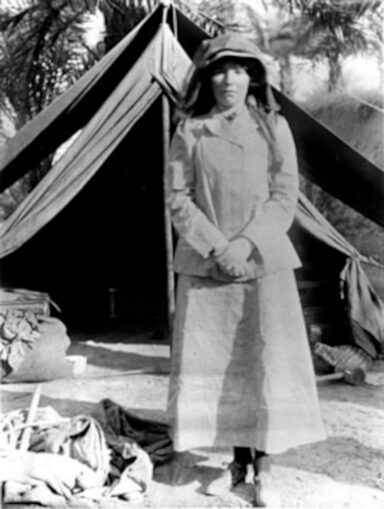
She used those languages to ride, with hired guides and a baggage train, deep into the Ottoman Empire and the deserts of Syria and Arabia, at a time when respectable Englishwomen were expected to stay home and pour the tea. She sat in the tents of sheikhs and took their measure. She mapped wells and ruins that appeared on no British chart. And she wrote all of it down, in letters and diaries that ran to thousands of pages.
picture copied from the Gertrude Bell Archive [1], Public domain, via Wikimedia Commons
The only woman in the room
When the First World War came, that knowledge turned into a weapon. In 1915 the new Arab Bureau in Cairo, the nerve centre of British intelligence in the Middle East, brought Bell in. She was the only woman on its books, and by most reckonings the first woman British military intelligence ever employed. To the Arab leaders she dealt with she was the Khatun, a title of real weight, sitting somewhere between lady and queen.
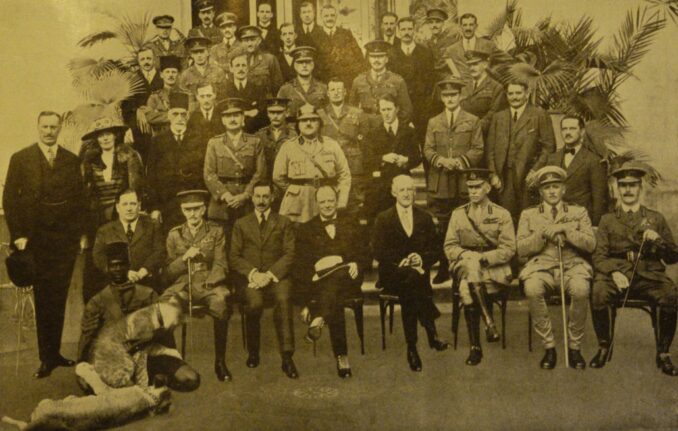
From 1916 she was Oriental Secretary to Sir Percy Cox, Britain’s chief official in the region, and from 1917 she did the job from Baghdad, as the person who actually understood the tribal map. In March 1921 (a year after finally getting her degree), when Winston Churchill summoned every senior Middle East hand to a conference at the Semiramis Hotel in Cairo, roughly 40 delegates came. Bell was the only woman invited.
See page for author, Public domain, via Wikimedia Commons
Lawrence and Gertrude
At this point in the article you may be thinking of another well-known Arabian adventurer by the name of Lawrence, and whether he fits into this story anywhere?
The answer is yes: the two first met in 1911, when Bell called in at the dig where a 22-year-old Lawrence was excavating at Carchemish and informed the party that their methods were prehistoric. Lawrence, by his own account, retaliated with a deliberate barrage of erudition, on everything from Hittite architecture to telephoto lenses, until after an hour and a half “she was quite glad to have tea”. Bell wrote home that she’d met “an interesting boy, he is going to make a traveller”.
Bell handed him much of the intelligence he worked from, knew the tribal politics at least as well, and stayed in the region for years after he had gone home to write about himself.
Lawrence is the one history remembers. He got the white robes, the memoir, the Peter O’Toole film. Bell did not.
Drawing the borders
At Cairo the plan that carried the day was largely hers: take Faisal, the Hashemite prince the French had just turfed out of Syria, and make him king of a brand new country called Iraq. Back in Baghdad, Bell ran the coronation, coached the new king on his own subjects, and argued, successfully, that Iraq’s northern border should take in the oil province of Mosul.
Then came the maps. She reported home, in a letter to her father, that she’d had “a well spent morning at the office making out the southern desert frontier of the Iraq”.
[Editorial note – I tend not to achieve as much in a morning at my office]
The frontiers she worked on, with Syria, with the new emirate of Transjordan, and with Ibn Saud’s Nejd, are, give or take a few scars, the borders you see on the map today. A century of Iraqi history, the proud bits and the catastrophic ones alike, runs through lines an ironmaster’s granddaughter from County Durham helped rule onto a chart.
The Museum
Bell’s last great project was a museum. She had watched European expeditions strip the ancient sites of Mesopotamia and crate the finds off to London and Berlin for decades, and she decided that Iraq would keep hold of its own past.
In 1922 she was made Iraq’s honorary Director of Antiquities, and she wrote the country’s first antiquities law, passed in 1924, which forced excavators to share their finds with the Iraqi state. Then she badgered, charmed and dinner-partied the Baghdad establishment into paying for a national collection. The Iraq Museum opened in June 1926. It still holds some of the oldest human artefacts on Earth, in the years when they haven’t been looted in wars she didn’t live to see.
The contradictions
Some of you may think Bell would have been the obvious poster-child for the burgeoning suffrage movement. You would be wrong. Bell didn’t think women should have the vote. She was a founding member of the Women’s National Anti-Suffrage League and ran its northern branch, and she thought the suffragettes were doing their own cause harm. A woman who climbed mountains in her underwear, ran agents, and told Churchill where to put an international border also put her name to the argument that her own sex couldn’t be trusted with a ballot paper.
John Singer Sargent, Public domain, via Wikimedia Commons
Her private life was no neater. Bell never married. The great love of her life was Charles “Dick” Doughty-Wylie, a married army officer. The affair ran mostly through letters, the two of them circling something neither could quite have. He was killed leading a charge at Gallipoli in 1915. Bell buried herself in work, and by the evidence of her own letters never really came back from it.
Baghdad, 1926
By 1926 her body was giving out. Decades of cigarettes had wrecked her lungs, the Baghdad summers were brutal, and her influence was fading as Iraq edged toward governing itself. On the night of 11 July, two days short of her 58th birthday, she took an overdose of sleeping pills and died in the early hours of the morning. Whether she meant to has never been settled.
She was buried that same afternoon in the British cemetery in Baghdad, her coffin carried by British officers through crowds of Iraqis who had come to see off the Khatun. The woman from Washington, County Durham was laid to rest inside the country she had drawn.
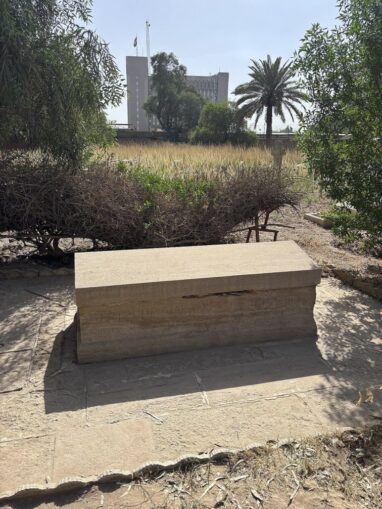
BMarinca, CC BY-SA 4.0, via Wikimedia Commons
What’s left
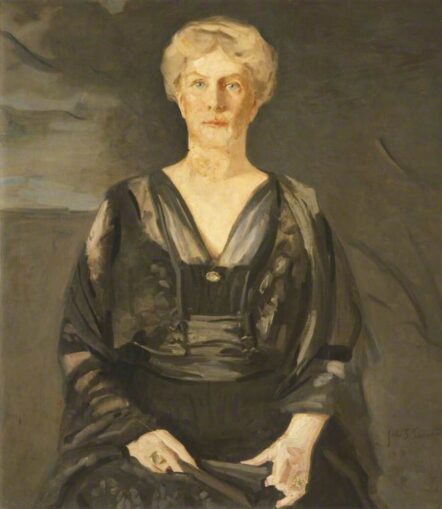
The archive she left behind lives at Newcastle University, an institution that began life as Armstrong College, named for a man this series has already met. More than 7,000 photographs, around 1,600 letters and 16 diaries, one of the richest first-hand records of the early 20th-century Middle East anywhere in the world; UNESCO added it to the Memory of the World register in 2017. Sargent painted her, and Lady Margaret Hall still hangs the portrait. In 2019 entomologists named an entire genus of bee, Belliturgula, after her.
Hollywood did eventually turn up, mind. Werner Herzog made Queen of the Desert in 2015, with Nicole Kidman as Bell, and it flopped so thoroughly it barely reached the cinemas. Some scores never do get evened.
And then there’s Iraq, which is the larger and far more troubling monument. You can argue all day about whether those borders were wise, or whether any foreigner had the right to draw them at all, and people do. What isn’t in question is whose hand held the pencil.
Lawrence got the film. Bell got the country.
© Paranoid Android 2026

![picture copied from the Gertrude Bell Archive [1]](https://commons.wikimedia.org/wiki/File:BellK_218_Gertrude_Bell_in_Iraq_in_1909_age_41.jpg)

_-_Gertrude_Bell_-_PCF38_-_Lady_Margaret_Hall.jpg)
