
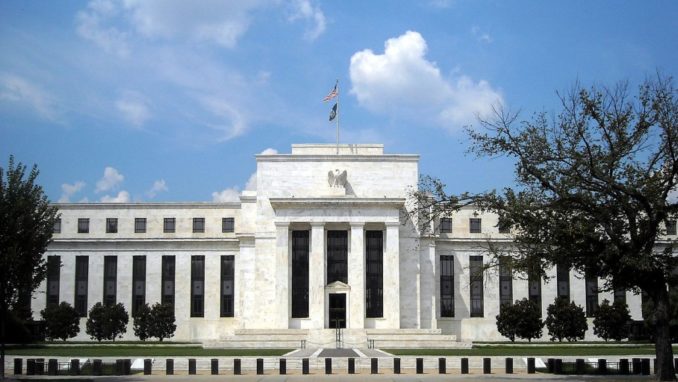
AgnosticPreachersKid, CC BY-SA 3.0, via Wikimedia Commons
Two mistaken lessons from the ‘20s and ‘30s haunt us today
Prior to 1913 there was no central bank in the US, and yet the US enjoyed tremendous economic betterment in the post Civic War years in which gold was money. Nevertheless, the US did experience periodic banking crises. These were caused by excessive bank credit expansion, whereby banks made loans well in excess of their gold reserves. There was no mechanism beyond market discipline to curb the expansion of banks’ credit money; i.e., money created beyond the banks’ gold reserves. During these excessive credit expansions, the market would become nervous that not all banks could honor their commitment to redeem deposits on demand for gold. Bank deposit customers would line up to withdraw their funds from banks that were rumored to be short of gold, thus the so-called “run on the bank”. In response the large East Coast banks gathered in secret at Jekyll Island, Georgia to agree to lobby the US government to create a central bank that could bail out such weak banks rather than form their own consortiums, as they had done in the past, to do the same at their own risk. See “The Creature from Jekyll Island” by G. Edward Griffin.
The Federal Reserve Bank Act of 1913 founded such a bank. It empowered the central bank to lend reserves but only on a temporary basis and only to banks that would pledge solid assets as collateral. The purpose of this original remit was not only to reduce periodic banking crises, but also to protect the purchasing power of the dollar. To that end it required all member banks to hold at least forty percent of their deposit base in gold that could be redeemed on demand. Only much later, under the Federal Reserve Bank Reform Act of 1977, was the central bank given a second mandate of pursuing low unemployment. But before we proceed further, let us look at how the Fed and the Bank of England created two fallacious myths with which the world still struggles.
Gold Manipulation and Credit Expansion Led Both the US and England to Economic Disaster
The US was the only WWI belligerent which did not abandon the gold standard. The dollar was “good as gold” until Fed Chairman Benjamin Strong embarked on an easy money policy during the 1920’s in an attempt to help his cohort at the Bank of England, Montague Norman, reinstate the pre-war pound/gold relationship after the Bank had inflated the currency by roughly double during the war. The Bank should have devalued the pound by doubling the exchange rate to gold. Instead it adopted extreme deflationary measures that caused serious economic distress in England. England suffered nationwide strikes in the 1920’s that paralyzed the nation and split the country into two main groups, business under the Tory Party and the working man under the Labour Party. This misunderstanding that business and labor are enemies exists to this day. The US credit inflation during the so-called Roaring Twenties caused first a stock market boom but then the inevitable market crash of 1929. Rather than allow prices to fall, first Hoover and then FDR tried to hold prices at artificially high levels by cartelizing the economy. The Great Depression of the 1930’s followed.
Learning the Wrong Lessons
These gigantic mistakes have never been properly understood by the general public. The Roaring Twenties economy seemed to justify credit expansion by the Fed in America, and social unrest in England seemed to validate the idea that tying one’s currency to gold hampered economic growth and harmed mostly the working man. This mistake was enshrined in law here in America: the Federal Reserve Reform Act of 1977 requires the Fed to promote full employment as an equal remit to protecting the purchasing power of the dollar. It is not a coincidence that this major reform occurred only six years after the US suspended the 1944 Bretton Woods Agreement which required the US Treasury to redeem gold at thirty-five dollars per ounce. The world had swallowed J. M. Keynes’ macroeconomics that, among other fallacious theories, blamed economic recessions on a shortage of money and that printing fiat money in vast amounts would drive down interest rates and spur economic growth. (Sound familiar?)
The Fed Has Only One of the Four Tools Required to Encourage Full Employment
The original Federal Reserve Act’s dictums of lending reserves only on a temporary basis and only after taking high quality collateral should be reinstated. Furthermore, the Fed should require that banks maintain forty percent base money reserves to deposits which currently is at zero! Its additional remit from the 1977 Reform Act to ensure full employment has failed spectacularly, not from lack of trying but from its institutional incompatibility with the tools to do so. The Fed does have the tools to ensure that the dollar remains sound and that the banks do not create excessive credit. We do not need to repeat the errors of the 1920’s by expanding base money and allowing banks to extend credit money in order to create a temporary boom. Ideally reserves should be only gold, which cannot be created out of thin air by the Fed. It’s high time to shed these myths that adherence to the gold standard caused the Great Depression and that expanding bank credit is the cure. Sound money is one of the four pillars of a vibrant economy. The other, over which the Fed has no control, are limited government (modest government spending), few and easily understood regulations, and low and simple taxes (preferably a flat tax).
© Patrick Barron 2026 Website