Zde, CC BY-SA 4.0, via Wikimedia Commons
Who are we, and where did we come from? Might our ancestral languages hold the key?
More years ago than I care to remember, as a teenager I came upon an old book published in 1944 called The Loom of Language, written by Frederick Bodmer and someone who rejoiced in the name of Lancelot Hogben. Its title didn’t mean, as I initially thought, that it was about the time when language first began to loom up over the horizon, and humans began to express themselves in systematic ways: it referred to the way European languages were woven together, as if on a loom. It ‘lit up the dim pathways of prehistory’, as the blurb had it, and also lit up an interest in me about the very earliest languages of Europe and their relationships to each other that continues to this day. Scholarship moves on, of course, and one of the latest books to cover this field is Laura Spinney’s (although the pace of change is so rapid now that this volume itself is probably going out of date even as we speak).
It might be as well to begin by saying what this book is and what it is not. It’s a book for the general public, covering the ancient origins of the Indo-European languages, principally Proto Indo-European (PIE) – the ancient mother language which has been reconstructed through theoretical linguistics – together with a look at the people who might have spoken it and their culture. The Indo-European language family is the largest in the world, and Laura Spinney is a best-selling science writer so, as you would expect, it is a fascinating and well-written tome. What it is not is an academic treatise. The book has been criticised by some specialist reviewers for inaccuracies and over-simplifications: Spinney claiming that the Indo-Iranian Hurrian people of Mitanni spoke and wrote Sanskrit is one example, and assuming that myths can be derived from one another chronologically simply by virtue of their content is another (Spinney suggests, for instance, that the myth of Catherine the Great having sex with a horse may derive from ancient Indo-European practices which did indeed involve strange horsy rituals. Whether these two are related as some sort of folk-memory seems impossible to prove). Such are the perils of entering a highly-charged and controversial field. Yet the book has proved tremendously popular. With that in mind, let’s dive in.
The idea that the languages now spoken by half the modern world, nearly three billion people, might have come from a common beginning isn’t new. It wasn’t even new in 1786, when its most famous proponent (William ‘Orientalist’ Jones) suggested that Sanskrit, Greek and Latin might have a common root, and furthermore, that they might all also be related to Gothic, the Celtic languages and Persian. The word for daughter, for example, is very similar in English, Sanskrit, Greek, Armenian and Lithuanian: daughter, dúhitr, thugátēr, dustr, duktė. From here, scholars have been able to deduce the original PIE word *dhugh2ter. The h2 symbol represents a guttural sound: the asterisk shows it is a theoretical reconstruction. What is new is the corroborating evidence since offered by modern archaeology and, more especially, the study of ancient DNA – which has really taken off since around 2010.
Spinney divides her story into several parts. Firstly, a survey of the history of this whole area of study (or ‘Ariomania’, as she calls it, because Indo-Europeans used to be called ‘Aryans’), followed by eight sections covering 1: the background and purported homeland, 2: PIE itself, 3: Anatolian (the language of the first farmers), 4: Tocharian (spoken by those PIE speakers who migrated thousands of miles eastwards into parts of China), 5: the Celtic/Germanic/Italic nexus, 6: Indo-Iranian and 7: Baltic/Slavic. The eighth chapter covers Albanian, Armenian and Greek. In this way, all the daughter languages of PIE have been covered, after which we have the summing-up; a concluding part which, as is obligatory these days, wags the finger about how migration has always been with us. ‘The most successful language the world ever knew was a hybrid trafficked by migrants’, she declares. ‘It changed as it went, and when it stopped changing, it died. The past is a lighthouse, not a port (Russian proverb)’.
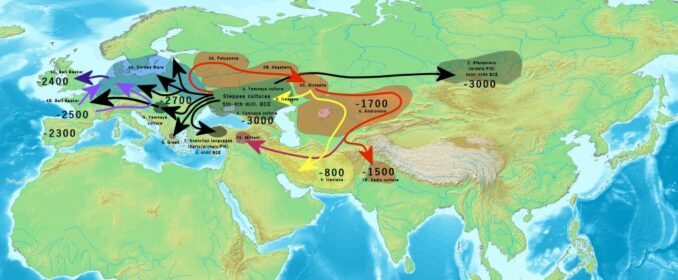
Background: Map created from DEMIS Mapserver, which are public domain. Koba-chanDrawings: पाटलिपुत्र, CC BY-SA 3.0 <http://creativecommons.org/licenses/by-sa/3.0/>, via Wikimedia Commons
Hmmm. Someone is conveniently discounting the downsides of those violent migrations along the way, methinks – and as for ‘successful’, well that can be defined in all sorts of ways. In addition, how many things should we allow today just because they were common in the past, if that’s the criterion? Gibbets for traitors? Hangings? Drawings? Quarterings? Hang on, she’s beginning to win me over …
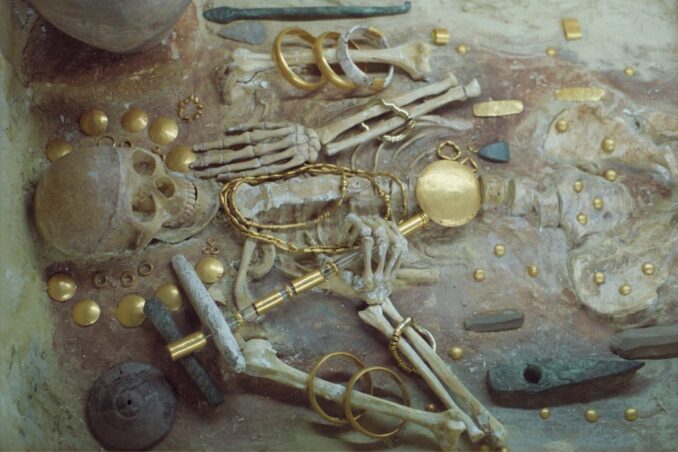
The selling point of the book is not, thank God, its woke lecturing. It is the combination of travelogue (as Spinney travels around and meets researchers, past and present), allied to its condensation of a very complicated subject into a page-turning narrative at times akin to a thriller. Spinney’s descriptions of finds like the Chalcolithic (Copper Age, so pre IE) Varna treasures discovered in Bulgaria (copper weapons, worked flint and antler tools, gold diadems, beads, sceptres, figurines, knuckle-bones covered in gold for gaming, all from c.4,500 BC) are jaw-dropping. Varna, known as the world’s first goldsmithing site, sits strategically on a coastal location and has been a major hub of economic activity for millennia. The golden finds in its ancient necropolis predate the famous gold artifacts of Mesopotamia, Egypt, or the Indus by hundreds of years: early Europeans were clearly pioneering metallurgical techniques at this time. The juxtaposition of going through modern rusty gates and security cameras to gain access to the scruffy industrial estate which now houses the Varna site (discovered fifty years ago by a workman digging a ditch for a high-voltage electricity cable) is stark. Although archaeology suggests that centres like Varna were overcome by mace-wielding Indo-European invaders, Spinney’s previous work on the history of disease leads her to wonder whether the high degree of population replacement across large parts of Europe in the Late Neolithic/early Bronze Age may have been due to pathogens as well as brutality.
Heroes and villains, if that is not too dramatic, swap and change. The late Lithuanian archaeologist Marija Gimbutas, derided at first as an eccentric but famous to many students for her ‘Kurgan hypothesis’ first put forward in 1956 – the idea that the steppe herders of the Pontic Caspian region’s patriarchal, warlike society spread far and wide destroying a largely peace-loving, matriarchal Neolithic farming population as they went – has been largely vindicated in the first part of her analysis but not in the second. Her main intellectual opponent and friend, Colin Renfrew (now Lord Renfrew) thought on the other hand that PIE had reached Europe on a ‘wave of advance’ theory from Anatolia. DNA research from Harvard, showing a genetic link between the steppes and Anatolia, has provided a third theory: that Anatolian and Indo-European were sister languages, rather than mother and eldest daughter. The pieces of the puzzle continue to shift and break up, before coalescing again into a different pattern. Many of the historical things we take for granted as ‘inevitable’ – the father being the head of the family, patrilinear descent, the idea of chariot-using war bands and their great martial glory being passed down forever afterwards in epic oral poetry (think Icelandic sagas and Homer), the concept of a male sky god – may possibly date back to these prehistoric beginnings.
Everyone will obviously have their favourite part of the book, but for me it has to do with a long-standing interest – the Tocharian section, covering the four-thousand year old mummies of Urumchi (Ürümqi) in what is modern Xinjiang, the westernmost province of China. Previously known as Chinese Turkestan, the area was once called ‘the pivot of Asia’ and is close to two branches of the Silk Road.These intriguing desiccated remains unearthed in a desertified place, the Tarim basin, were found wearing checked fabric which looks very like early tartan weave similar to the Celtic textiles found at Hallstatt, Austria. The area is part of the Taklamakan Sand Sea, the second largest sand desert of the world. Precipitation in the basin is negligible. However, evidence suggests it may have been a more hospitable environment at one time – a freshwater landscape, with rivers and lakes.
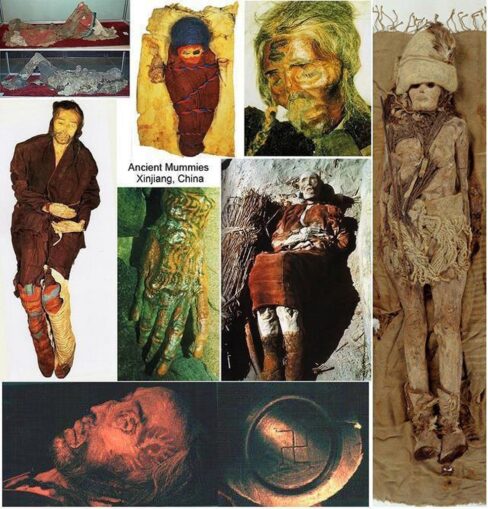
Yokarniybabai, CC0, via Wikimedia Commons
The Chinese had always regarded the area and its inhabitants as beyond the pale – a wasteland filled with heavy-drinking, decadent barbarians. Yet the Tocharians had a spiritual side as well, later ones being early converts to Buddhism, using the ephedra plant as their medicine and possibly recreational drug (it is a candidate for ‘soma’). They were typically very tall – lanky, even – with fair hair, light-coloured deep-set eyes and long noses. While they were long suspected to have been ‘proto-Tocharian speaking pastoralists’, genetic analysis has finally found they were physically not descended from incomers at all, but were actually remnants of a locally isolated population – a last vestige of the hunter-gatherers who had inhabited eastern Eurasia including Siberia since before the height of the last ice age, some 10,000-26,000 years ago. This Pleistocene gene pool, known as ANE (Ancient North Eurasian) is likely to be what gave subsequent Europeans their “Western features”. The Finns are a modern exemplar of this ANE type.
At this point it struck me that, if Western features were already present at 26,000 BC, ie the supposed transition from blik African ‘migrants’ to Northern Europeans was already complete, why were we recently being presented with a blik ‘Cheddar Man’ at a much later datum point of 8,000 BC, then, eh? (Rhetorical).
Laura Spinney’s background reading is wide-ranging and the references, including the bibliography, in the book are great. One praiseworthy feature of the work is its maps, which precede each section and allow a clear understanding of the (enormous) geography involved. If you can’t tell your Dnieper from your Dniester, Don or Danube (an in-joke where this book is concerned, as the derivations are discussed), these will certainly help.
Tl;dr: the Indo-European homeland is very probably the Pontic-Caspian steppe. Archaeology, linguistics and DNA are all now pointing in this direction. (It should be emphasised that this an ongoing and fast-moving debate, however, and not all scientists will agree). From here, nomadic pastoralists fanned out to cover lands from Scotland and Iceland to parts of Central and Southern Asia – some say as far as the banks of the Yellow River. Encountering speakers of other languages as they went, they adapted their own language in a long drawn-out game of Chinese whispers until the related languages became mutually unintelligible. Language isolates such as Hungarian, Finnish, Estonian and Basque were cut off from this process, remaining as living relics of the pre Indo-European era. With their long-distance trails, exploratory nature, wheeled vehicles and horses, any resemblance between the first Indo-Europeans and the waggon trains of the Wild West pioneers is probably no coincidence: the American ones were simply the latest iteration of an adventure story spanning thousands of years.
© foxoles 2026
P.S. If you are interested in looking into this further, I’d recommend starting with a couple of older books: The Search For the Indo-Europeans by J.P. Mallory and David Anthony’s The Horse, The Wheel and Language. Textile specialist Elizabeth Wayland Barber’s The Mummies of Ürümchi is a bit out of date, being from 1998, but a great read nonetheless. Mallory has also just published a new book on the Indo-Europeans that I haven’t had a chance to look at yet and he has also co-written a book on the Tarim mummies with Victor Mair.