I’ve been meaning to tell you this for a while, but real life keeps interrupting. One’s pen’s been distracted by a diminishing Navy, war in the Gulf, Question Times, Holy Week and even the installation of a new Archbishop of Canterbury. Not to worry. QT takes an Easter break, the Navy limps on, Mr Starmer keeps us out of the latest Gulf War, Holy Week pauses for a day as Jesus lies stone cold in the tomb.
In the space provided, shall we continue our Railway Review Cook’s tour of the north coast of South America? I think we should. Previously, we have visited the mineral railways of Brazil’s Amapa province, ridden the streetcars of Paramaribo and chugged through British Guiana’s sugar plantations all the way from the mouth of the mighty Demerara River to the mightier mouths of the Essequibo. This time, we shall visit a territory two-thirds the size of England but with no railways. Or so one might think.
As further proof of the utility of mild eccentricity, besides our own sprouting children, all visitors to our modest Debatable Lands home, of any race, creed, nationality or colour, are measured against a wall in an alcove in the kitchen. For obvious reasons, Scandinavians are closer to the ceiling; the Chinese find themselves nearer to the floor. A hanging picture hides the measurements of the disliked Southern Irish. All visitors are recorded there except one.
A part-Amerindian from St. George’s on the Brazilian border was taller than the alcove and had to leave his measured mark around the corner in the kitchen proper. Besides being an impressive two metres and a half an inch, his family name was Petit. It’s that Gallic sense of humour again. For St George lies on the French side of that border with Brazil. As every Puffin knows, French Guiana is a department of France, all of whose departments are equally French. Therefore (pub quiz alert), the Republic’s longest frontier isn’t with Spain, Germany, Switzerland, Belgium, Italy, Luxembourg or Monte Carlo but with Brazil.
Upon happening upon his ancestry while falling into conversation regarding his unusual height, my old maps and charts were liberated to the kitchen table. While pointing to his natal settlement on the mighty Oiapoque River, in passing he told me something I knew not. There is a railway in French Guiana – of sorts.
Upstream from the childhood home of our house guest lies a Chemin de Fer de Portâge. Now, I hear the uninitiated enquire, what is a Portage Railway?
A Portage Railway is a short railroad built to carry cargo over land between two waterways. It bypasses obstacles like rapids, waterfalls, or elevation changes, enabling continuous transport where direct water travel is impractical or impossible.
Following further investigation, our friends at International Steam inform us that at Saut-Maripa, twelve and a half miles upstream from Saint-Georges-de-l’Oyapock (the border town with Brazil), and 114 miles from the Guyane capital Cayenne (population 62,000), a one and a quarter mile 2ft gauge portage railway in the past allowed boats to overcome the rapids by transferring excess loads onto hand-powered flat wagons.
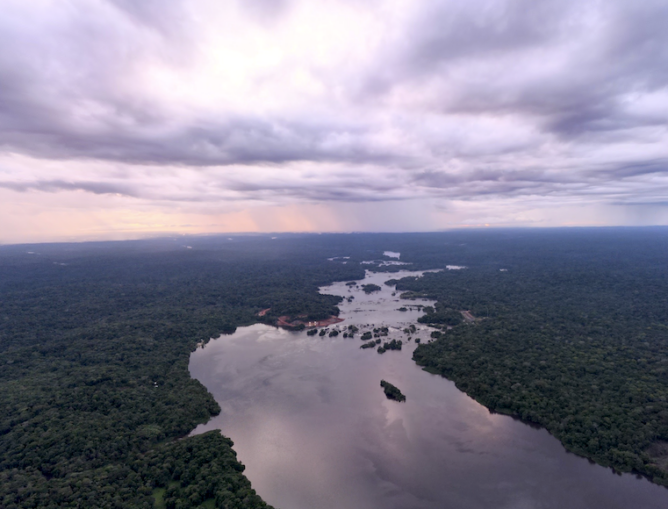
© Google Street View 2026, Google.com
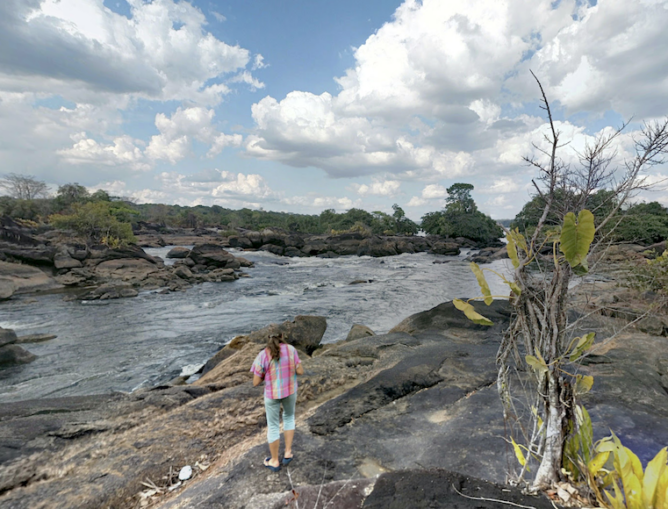
© Google Street View 2026, Google.com
The railway is no longer operational and the wagons have been removed, although the tracks are still intact. The turnoff to the rapids lies one and a half miles before St-Georges along the N2, after which a 12 mile unpaved road leads to the railway’s upstream end. At this point, there is (was?) a base camp for the French Army’s 3rd Foreign Infantry Regiment (3e REI), responsible for monitoring and patrolling the Oyapock River, which forms France’s extensive border with Brazil. The downstream section can be accessed either on foot or by boat. Along the route, the railway passes by the entrance to a small Electricité de France hydroelectric facility powered by a ‘race’ bypassing the rapids.
All of which can be made out on the aerial photograph below:
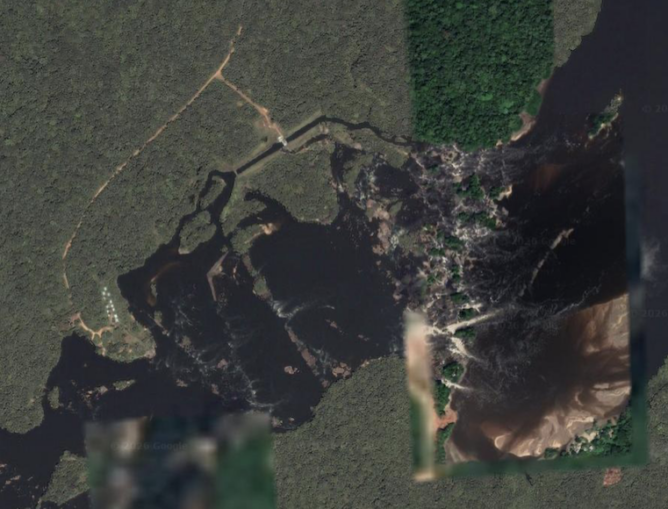
© Google Maps 2026, Google licence
Photographs of the remains of the railway can be seen here and here.
The actual Saut Maripa (saut means “jump” in French) has a reputation for being both the most beautiful and the most dangerous in French Guiana. The impressive flow is most evident in the dry season, thanks to the protrusion of rocks through the surface. In the rainy season, the river is wide and fairly silent.
According to the guff, in pidgin French, local canoes known as pirogues still stop at the portage railway slipways, with the rail route being used by foot passengers walking between the two. Via my bad French — more pidgin than the pidgin — I suspect references to what I would translate as discovery trails and exploration trails suggest that the huts once used by the 3e REI are now a tourist resort with cabins.
Among the rapids are “polissoirs”, polished stones thought to be rock engravings made by ancient indigenous peoples. A more recent memorial sits nearby to commemorate Captain Lavergnat, Gendarme Vincent, and Gendarme Vautelin, who lost their lives in a fatal pirogue accident while navigating the rapids on 21 February 1995.
The memorial consists of a three-sided shelter with a pitched roof, within which various plaques have been mounted remembering both the three victims and the three spouses and five children who were bereaved.
On that resonant note — of what the French call “the victimhood of duty” – may I take this opportunity to wish Puffins a happy, spiritual, and reflective Easter.
© Always Worth Saying 2026