Image by Poppy Thorpe, from Pixabay.
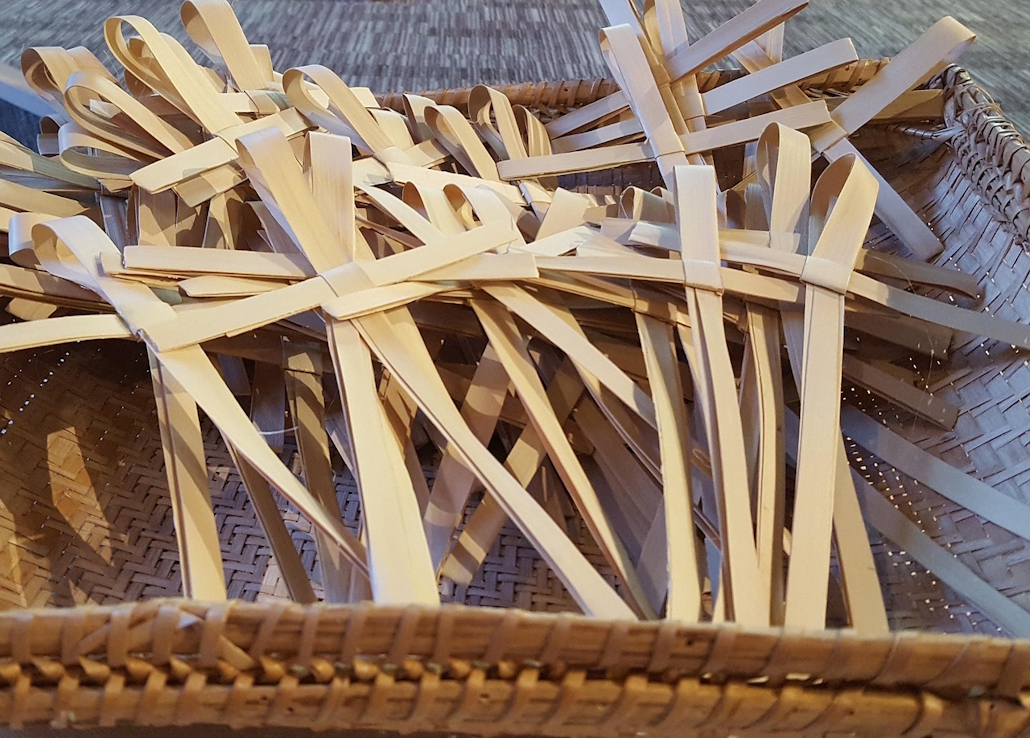
It’s a tradition in the Catholic church that on Palm Sunday, the Sunday before Easter, worshippers are given little crosses made from palm leaves. They commemmorate Jesus’ entry into Jerusalem, when followers strewed palm leaves on the ground to make a carpet for him. You are supposed to keep the cross till the nest year’s Ash Wednesday and then burn it to make ashes, which are used to daub a cross on your forehead to mark the beginning of Lent.
Now you might think that the following has nothing to do with that, but read on. In Rome there are eight ancient Egyptian obelisks looted by the Romans from Egypt after it fell under their rule, as well as another five made in Egypt at Roman orders and shipped across to be put up in places of interest, and a further five made in modern times. The Romans, old and new, certainly like these spiky monuments.
Much the most famous of the ancient obelisks is the big red granite one in front of St Peter’s, 25 metres tall. It is not in fact the largest: that is the 32 metre one in front of the Lateran Palace. But it is a serious piece of stone, weighing about 327 tonnes. Uniquely among the ancient obelisks it isn’t carved with hieroglyphs; it’s not known whether the Romans had them ground off, or whether the Egyptians had not yet got around to adding them. The plainness makes it suitable for putting in front of the most important cathedral of the Catholic church: you would not want any symbols of an old pagan religion here.
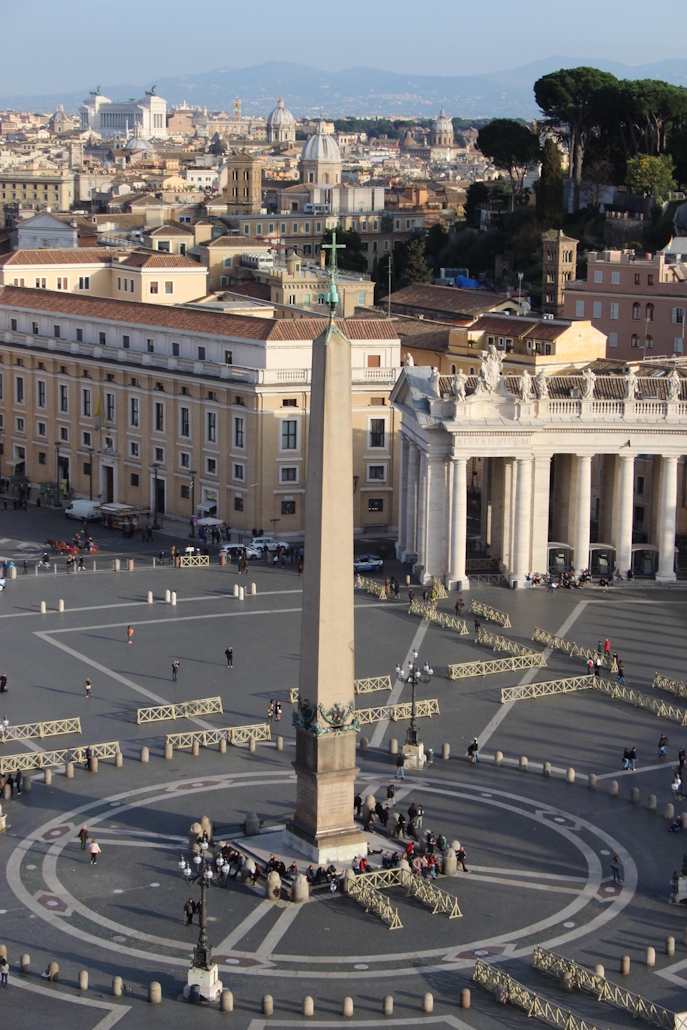
Image by Darius Lebok, from Pixabay.
According to Piny, the obelisk was originally erected at Helipolis on the Nile. It was brought to Rome in AD 40 under the quixotic reign of Caligula, one of the crazier emperors, to serve as a spina or turning point of the chariot race cource of the Vatican circus. (Those of you who have seen Ben-Hur will be familiar with the layout: you race down one side of a long straight barrier, round a sharp curve at the end where crashes are eagerly awaited by the spectators, and up the other side — a bit like the Indianapolis 500.)
And there it stood even after the fall of Rome. Being made of granite, it was of no interest to the medieval lime burners who demolished and burnt the fine marble and limestone of the ancient buildings to make lime for mortar. It was topped with a bronze globe that was reputed to contain the ashes of Julius Casear, though when this was examined later it was found to contain nothing but a little ordinary dust.
In 1586 the grandiose Pope Sixtus V — the one who made Michelangelo’s life an agony and an ecstasy — was remodelling the Vatican, and he wanted a point of interest for the huge piazza he was having made in front of the newly rebuilt St Peter’s. So it was time to move the obelisk to a new location 260 metres away.
Sixtus was a showman — look at the gaudy Sistine Chapel he commissioned — and he wanted to make the moving of the obelisk an occasion. It was loosened from its base and let down from its original site on ropes, and encased in wood to protect it from damage. But Sixtus decreed that the erection of the obelisk was to be carried out in a single day.
Cranes of the time had little power and couldn’t be particularly tall. They were wooden arms with the haulage powered by men stepping up a treadmill — quite inadequate for the task. But the mechanics of pulleys and ropes were well understood thanks to sailors, and the power of men and horses digging their feet into the ground could be used as long as there were enough of them.
Sixtus commissioned the architect Domenico Fontana to design a device which would triumphantly raise the prone obelisk to the vertical in front of an admiring crowd, which the vain pontiff supposed to symbolise the triumph of Christianity over paganism. It took Fontana thirteen months to complete his plan, which required a huge wooden frame as tall as the obelisk and a complex network of 45 winches with ropes hauled by 800 men, many of them sailors, and 160 horses. The day was set for 10 September 1586.
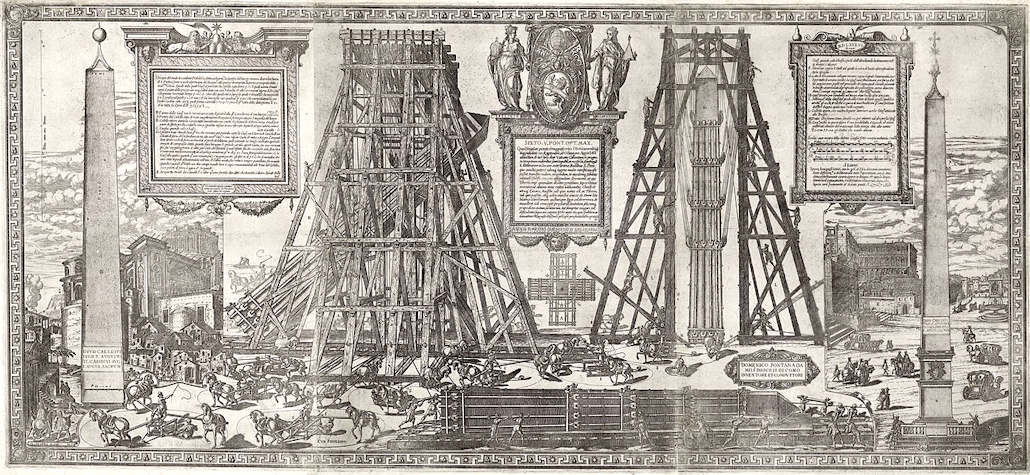
Engraving by Natale Bonifazio da Sebenico, from Wikimedia Commons, public domain.
A huge crowd gathered to watch. The men and horses strained and clawed their way across the ground. The obelisk gradually rose — and then, within a couple of degrees of the vertical, stopped and wouldn’t drop into the socket in the base prepared to hold it. Fontana had not allowed enough margin for the stretching of the ropes under load. The machine had done all it could, and was at the end of its travel. If hauled any further the ropes might snap.
The pope had decreed that all should watch in silence. But among the audience there was a Ligurian sailor, Captain Benedetto Bresca, who knew a thing or two about ropes. He yelled in his Ligurian dialect ‘Agua ai cordi!’ — ‘Water on the ropes!’ (In standard Italian it would have been ‘acqua‘.) The sailors in the work understood what he meant, and a bucket chain was organised from the nearest fountain. Water was poured on all the ropes.
And as the hemp ropes dried in the autumn sunshine they shrank, and with creaking and cracking the obelisk rose to the vertical and crunched into its socket, to cheers from the crowd.
Pope Sixtus sent for Captain Bresca, who might have disobeyed his rule of silence but had undoubtedly saved the day, and asked him if there was any favour he could do for him. The captain said that he was in the business of importing palm fronds to make Palm Sunday crosses. The pope therefore granted him the monopoly of supplying palms to make these crosses for the use of the Vatican. And from then on, every year, he took his boat up the Tiber laden with palm fronds and flying the papal flag as a sign of his precedence. The palms were made into crosses by Camaldolese nuns in the Vatican.
That right has passed down to his successors, though the method has changed. Now 3000 palm crosses for the Vatican are woven in Sanremo and Bordighera in Bresca’s native Liguria. some of them large and elaborate, and delivered ready made every year. A specially large one formed of three strands symbolising the Father, the Son and the Holy Spirit, is delivered to the pope himself.
© Tachybaptus 2026