
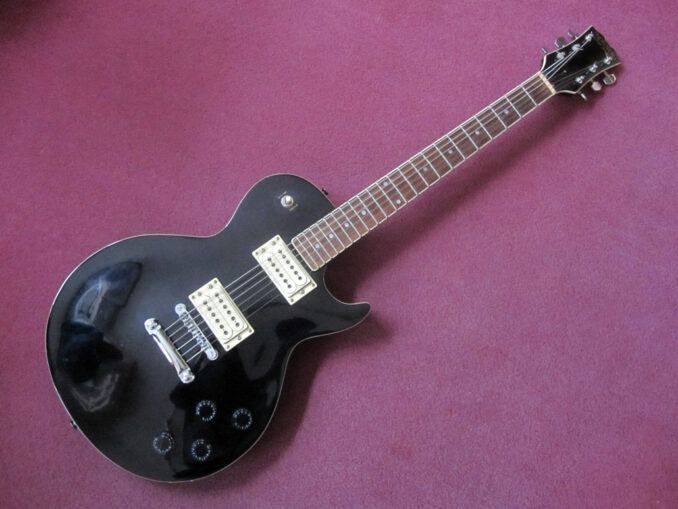
In Part One of this two part series about launching a career as a guitar superstar, we considered how to assess whether or not you have any musical ability, and looked at what is involved in choosing and acquiring a guitar.
If you’ve progressed to the point where you’ve actually got a guitar, it’s time to get down to playing music! All ready to go? Here’s the last thing to take onboard before you do:
Practising – Don’t Annoy the Wife or Neighbours!
While you may think you are making music when you first start strumming and plucking, others may take a different, and rather dimmer view, so do give some thought to when and where you practise.
Do you really want to annoy your wife, or husband, for that matter?
If your house has thin walls, or God forbid, they are made of lath and plaster, or wattle and daub, you will almost certainly end up annoying the neighbours too, so spare a thought for all your innocent victims.
Remember, a solid body electric guitar makes virtually no sound when played ‘unplugged’, so using one of these would enable you to maintain a harmonious relationship with your wife, and the neighbours.
But before you say learning on an electric is simply not on because you won’t be able to hear what you’re playing, there is a solution:
Purchase some headphones and a small electronic device known as an audio interface, or digital audio interface – previously known simply as a pre-amplifier.
You can plug your guitar and a pair of headphones into it, and there may be other inputs for more instruments, or for a microphone as well.

Normally powered by your computer via a USB cable, mains-powered versions are also available, and with an electric guitar/headphone/audio interface set up, you can practise quietly, to your heart’s content, for as long as you want, and everyone should be happy.
Computer-connected interfaces also enable you to record your playing – you could use the excellent free audio editing and recording programme called Audacity to do this, and with the right configuration and settings, you could even record one-man band, multi-tracked music, and outdo the likes of Mike Oldfield. But that’s something for the future at this point.
If you chose an electric guitar, and purchased an amplifier as well, a top tip: ALWAYS remember to set the volume knob to zero BEFORE turning the amp on and off, and when plugging in, or unplugging your instrument.
Operating the on/off switch with the amp volume set at maximum WILL result in a nasty, noisy surprise. If you accidentally hit a string at this setting, or even worse, knock the guitar over, and it lands noisily on the floor, you may even end up with a shattered window.
A Final Point on the ‘Noise’ Issue
To underline the point about annoying noise, here’s a personal anecdote….
Some years ago, I lived with a violin and piano teacher. She’d just purchased her first home – a small house in the middle of a terrace. After school, and on Saturdays, pupils came to the house for lessons.
That house wasn’t the most ideal home for a music teacher. Although her upright piano wasn’t placed directly against the party wall, there’s no doubt the neighbours had to enjoy all the practising, endless repetition of difficult phrases, and off-note violin sounds emanating from their neighbour’s house, whether they liked it or not.
I used to come home in the evening to ‘enjoy’ the sound of screeching for a few hours, but fortunately always found somewhere else to be during the day on Saturdays – you can only blot out so much, after all.
There was only one solution, and I set about persuading her to try and find a more suitable property. We soon did, moving from a small terraced house to a slightly larger end-terrace house which had a ground floor alleyway between itself and the neighbour’s house.
This provided more than adequate sound separation. Problem solved. (This was over 40 years ago, and as far as I know, she still lives and teaches there today).
If you practise in a quiet and sensitive manner, and STILL get complaints, just say “At least I’m not learning the violin, but you may compel me to do so”, or words to that effect, and the complaints should come to an end.
Tuning The Guitar
If you don’t know the sound or ‘pitch’ of the notes you have to tune a guitar to, and don’t have a piano, or any other instrument to hand that can give you an accurate note, or reference point, then invest in a tuning fork, or one of the cheap little electronic tuning devices you can now buy for about a tenner.

Some of these digital tuners clip onto the headstock (top of the guitar), and I have no doubt various smartphone apps are now available that generate the necessary reference notes. It goes without saying that a badly tuned guitar sounds horrendous.
Left Hand & Right Hand
The hand that works the fretboard does the real business in guitar playing. The other hand basically controls the rhythm, and you can strum slow or fast, gently, or hard, aggressively or softly – usually using a plectrum, gripped between thumb and forefinger, although the fleshy thumb tip, or a fingernail can also also used.
Fingerpicking (or fingerstyle guitar) is another ‘other hand’ technique.
Individual strings are plucked directly with fingertips, nails, or picks fitted over fingertips, creating more complex, multi-layered melodies. But forget that technique for the time being.
Have A Feel of Your Instrument & Start Fingering (Not Filth)
Everything’s in tune, you’re ready to go, so how to start? I’d say familiarise yourself with the guitar, see what you can discover, and get a feel for the thing before you open any guitar tutorial.
Once tuned up, try pressing every fret of every string, while simultaneously plucking the string over the soundhole (or between the pickups in the case of an electric guitar) with a plectrum, fingernail, or thumb, using your other hand. This will familiarise you with the notes, and the sound of your instrument.
Then try the same thing, but this time don’t press every fret, mostly press every other fret, and listen.
Maybe you shouldn’t have missed that fret, and should have missed the following one instead? Now you are training your ear, and are beginning to learn scales.
Maybe try playing random notes all over the fretboard, which will help develop a knowledge of the relationship between notes.
Once you’ve got an appreciation of most of the notes, and where they are, and you’ve given your fingers a bit of a stretch, and a little bit of training, it may be time to consider playing more than one string at a time – in other words, to play a chord.
This is where you’ll need some help, because as a total beginner, you’ll have no idea where to press on the fretboard to produce a harmonious, multi-note sound, so it’s time to turn to your Learn to Play Guitar book.
Turn To The Good Book
There are plenty of guitar tutor books out there, the most famous being Bert Weedon’s Play in a Day: Guide to Modern Guitar Playing, which was studied by the likes of Eric Clapton, Mike Oldfield, Paul McCartney, Steve Hillage, George Harrison, John Lennon, Sting, Brian May, Pete Townshend and dozens more – including myself.
But whichever tutor you choose (or internet course, or smartphone app), you’ll be taken through the learning process, step by step, accumulating chords, knowledge, and confidence along the way.
Don’t try and play Classical Gas from the get-go, though. Try and keep it simple to start with.
Some of the tunes you will end up practising will be a bit old hat, and a bit naff, but there’s a good reason for using familiar tunes – most beginner guitarists won’t be able to read music, or be able to grasp a new song straight away, but if you already carry the song in your head, you’re halfway there already.
Some tutor books are relatively simple, and don’t actually display the tune – the music notation on the traditional stave – the five horizontal lines containing puzzling blobs and symbols at various points, and in various positions – while other tutorials do.
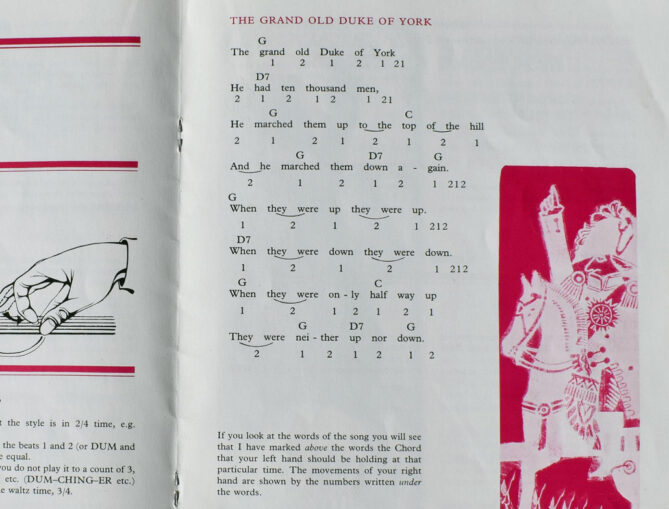
In the first example below, taken from a 1967 BBC publication Hold Down A Chord – Folk Guitar For Beginners, you’ll see the words of the song, with the name of the chord you should be holding down at that time above, and the points at which you should strum (or pluck), marked with numbers below the lyrics.
In the second example, taken from the songbook for Neil Young’s ‘Harvest’ album, you will see the words are there, and above is the music notation for the lyrics, and above that, the chord to be played from that point, complete with its name and a vertical chord ‘window’, or diagram, showing you exactly where to place your fingers on the fretboard to form the chord.

There are other guitar diagrams known as ‘Tabs’ or ‘tablature’, which confusingly feature six horizontal lines, and serve a slightly different purpose, indicating which fret and string to play for melodies, or riffs, or indicate how a chord is picked (rather than strummed).
Your Poor Fingertips
You will soon find that the tips of the fingers on your fretboard hand get a little sore, because of all that pressing down on steel wire, but rest assured that with regular playing, the ends of your fingers will harden up, and any discomfort will eventually disappear.
I was told a long time ago that dipping your fingers in methylated spirit hastened the fingertip hardening process, but I never tried it, so can’t vouch for the efficacy, or otherwise, of this trick.
Final Advice
Like all things, practise makes perfect, so practise, and then practise some more! Regularly – but don’t overdo it, and go stale.
Copy Your Heroes
Listen closely to how your favourite guitar heroes play, and as time goes by, try and emulate their playing. Even play along with their music. There’s nothing wrong with sounding similar to a great guitar player!
In my case, as a bass guitarist, I can name three main influences, and I played along to a lot of their records as I learnt the instrument – Paul McCartney, for his quirky, harmony-driven basslines; Roger Waters, for his atmospheric style, and sometimes powerful rhythmic grooves; and Jack Bruce, with his dynamic, punchy, aggressive playing style.
Music Theory
Don’t worry about learning to read music, or about studying music theory at this early stage – you’ll absorb a lot of it unconsciously anyway.
It may sound odd, but mathematics plays a part in music – you could say it’s the bedrock, but that’s not a very romantic idea, is it?
There is a precise numeric relationship between all notes, and counting out beats and bars in your head, especially in instrumental sections, is very important – and doubly so if playing in an ensemble of some kind, where co-ordination is key.
Expanding The Possibilities
There are various techniques you can learn for your plucking/picking/strumming hand, while you will also discover you can play the same named chord using different chord shapes on different parts of the fretboard.
Also, you don’t have to stick to standard tuning for your guitar, because you can tune the strings to a chord, as bottleneck (slide) guitarists do, for example, although such tunings are really only suitable for electric guitars:
Standard Tuning: E A D G B E
Open A: E A E A C# E
Open D: D A D F# A D
Open E: E B E G# B E
Open G: D G D G B D
You could even experiment with your own tuning. Back in the day, I devised my own tuning for a bouzouki, with identical tuning on two pairs of strings. Chords had to be modified, of course, and people were amazed how the instrument seemed to hum, resonate and ring like a hurdy gurdy, and were baffled when they picked the instrument up and tried to play it.
As your playing improves, and you learn more, hopefully the time will come when you get the chance to play with other musicians – in a band, or some other kind of musical ensemble. It can be quite thrilling, and the buzz after completing the performance of a song or tune can be amazing!
So how’s Mull of Kintyre coming along? A good choice for a starter song – slow and simple, and everybody knows the words to the chorus, at least. The chords you’ll need are: A, D, E, & G. It’s almost completely just A & D, with a couple of E’s and G’s thrown in at key points.
So I’ll wish you well in your musical endeavours, and hope this pair of articles have been helpful, and even inspiring. You’re on your way!
© 2026 NeverUpToTheJob.