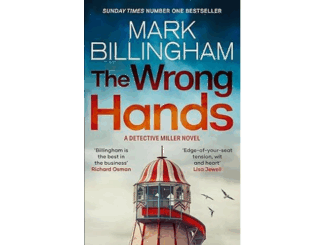
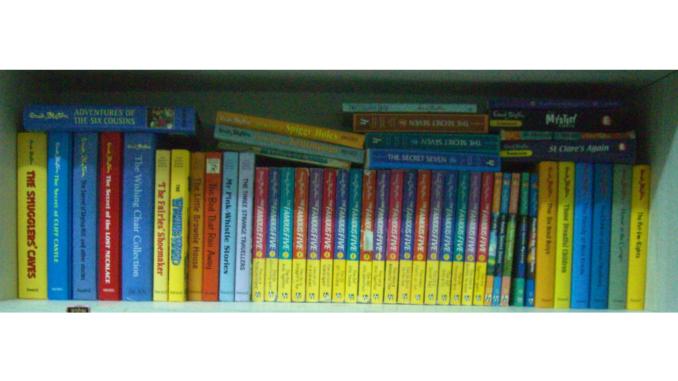
After the first few months of getting to grips with the reading at a low level the classroom books on offer while reasonably entertaining were not really enough for me and so I turned to other sources.
School itself was mildly diverting – at some point I was introduced to maths and after a few days of writing addition and subtraction equations was forced into learning division and multiplication by the omniscient, and indeed omnipresent, Mrs C. Writing sums such as 3+2=5 and 4-1=3 and then preening at your cleverness was quite different to a perceptive teacher setting you 44/4. I had to go round several tables appropriating enough plastic blocks to enable me to work this out.
School milk was still available. At some point prior to lessons starting a crate of two dozen small bottles would be plonked on to a table at the side of the room. It took me about three days to work out that you have to get in early with this stuff. 10 past nine rather than five past eleven because by then it had been festering in direct sunlight for a couple of hours and you had to chew the first two mouthfuls.
After the summer of 1971 I was shunted on to the upper bit of the school and came under the guidance of Mr H. A jovial youngish fellow he made attending school something to be looked forward to rather than dreaded. His enthusiasm for Morris dancing was a bit suspicious but he was infinitely preferable to the retired sergeant majors walloping 7 year olds across the country in the 70s.
At this point I realised some of us were getting it and some weren’t. There were some who advanced who were, to all intents and purposes, illiterate. Quite a few were never likely to climb that particular barrier.
And we enjoyed life. We wrestled, played football and laughed at and with the girls who often outdid us lads in everything except footy. The best times were when it had snowed. Sliding across a highly polished hall floor in your socks was nothing compared to stamping down a bit of ice and snow in the school playground to make a runway that would make the Olympic luge course look safe for someone with brittle bones. After some of the falls I had I’m quite surprised I didn’t fracture my skull or worse.
So what were my sources outside the classroom?
Chief of these was Mum and Dad. Ever indulgent on this matter (despite I suspect money being shorter than I realised at the time) they were aided and abetted by other family members and friends in supplying many books for Christmas, birthdays and holidays. Comics were in plentiful supply as well. They all seemed to know what I liked.
The second source of course was the local library. Unlike today where my local is like feeding time at the zoo back in the 70s the library was a haven of calm and quiet. Invariably staffed by middle aged ladies who at first glance might make a red blooded man think that homosexual activity would be preferable these guardians of knowledge and pleasure were almost always kind generous souls prepared to help and, at least to my memory, treated a young kid’s questions with utmost seriousness.
At the basic level it was Ladybird books, comics and annuals. The former never held much appeal for me although the more advanced ones about things like space, nature and inventions did catch hold. Comics – well it was the Beano mainly due to the folks allowing us a subscription and borrowing things like Dandy, Whizzer and Chips and some of the militaristic stuff from other kids. With the benefit of life experience I do wonder how many sprogs Minnie the Minx had popped out by 17 , whether Billy the Whizz was a drug dealer and whether Dennis the Menace hid in the bushes in the local park thus justifying his appellation. The Bash Street Kids would today be puffing weed in the playground and addressing the staff as “Yo muthafucka”
The annuals were the Beano and Rupert the Bear. This creature wearing a red jumper and yellow checked trousers hung out with a seedy looking badger, a pug that looked like it had been chasing too many parked cars and an elephant whose nickname “The Trunk” I’ve since assumed was a reference to what was below his waist rather than on his face. I suspect he could have picked up buns with it.
Really though it was Enid Blyton, Enid Blyton, Enid Blyton.
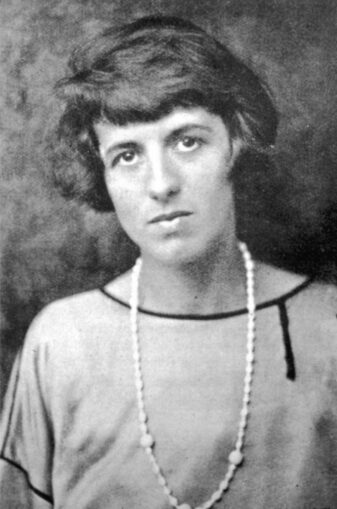
This outwardly prim plain woman churned out children’s books at a volume that would make a battery farm swoon in admiration. For some reason she was persona non grata with the BBC and various libraries – reasons suggested include writing formulaic middle class prose but also the regular presence of golliwogs in the Noddy books and the frequent use of names like Dick and Fanny to titillate 6 year olds who had no idea what the sexual connotation was. Her personal life would have made Mary Whitehouse and Malcolm Muggeridge reach for the whisky and aspirin bottle if they’d known about it. Nude tennis and lesbian affairs with the nannies seemed normal and Heaven knows what she got up to when no one was looking.
The range was quite astonishing – everything from quasi fairy tales to adventure stories involving middle class kids roaming around obscure parts of the world without any parental supervision whatsoever. I would expect social services to be straight on to this in 2026 except they seem to spend most of their time holding open doors to minicabs to facilitate 13 year old girls being driven to derelict council houses. There many middle aged men (largely from bits of Kashmir where the wheel is an unknown concept) await them with cheap nasty trousers round their ankles.
I didn’t read the girls stuff like Mallory Towers and St Clare’s – it was targeted at the young ladies rather than a young lad who was more interested in emulating George Best’s lifestyle than Mrs Beaton.
The Secret Seven series was an early favourite – these books like many of her adventure stories featured both boys and girls and hence appealed to both. Clandestine meetings in the garden shed seemed to ignore the fact that Mum was peering through the kitchen window. She’s rustling up one of those healthy 70s meals made from items like spam, mince , smash and boiled cabbage that verged on the liquid. Still they got there in the end and the local pikeys and perverts were thwarted by a good old dose of British spunk and being savaged by a cocker spaniel.
My personal favourite though was the Famous Five. God knows what they’d be up to today. Down in a cave on the local beach they’d have cleared the area of rough sleepers with Satan and Adolf their pet rottweilers before sparking one up all the while keeping an eye out for dinghy invaders through the scope of their bazooka. The picnic basket contains potted shrimp, sticky buns, gingerbread and lashes of White Lightning.
Meanwhile Uncle Quentin is at home in his study watching special interest material on the internet ( after giving proof of age to the local Labour komissar) and Aunt Fanny is on her mobile looking for “well endowed men in your local area”.
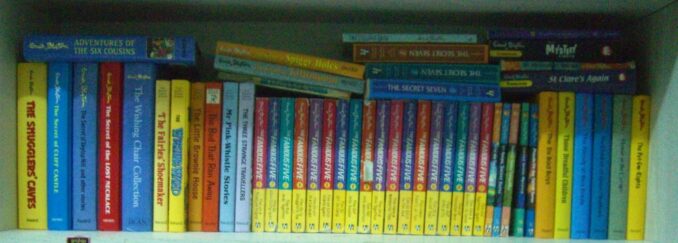
Blytonite at English Wikipedia, CC BY 3.0, via Wikimedia Commons
It wasn’t just the adventure series though ( and there were quite a few of them) | also enjoyed the fairy tale books when 5 or 6. Mr Meddle (also known as Tony Blair) and Mr Pink Whistle ( also known as Ed Davey) but the best of these was the Magic Faraway Tree series. Moonface, Silky and Dame Washalot were benign characters but the Angry Pixie is Sadiq Khan to a tee. My favourite character though was Dame Slap – an enthusiastic supporter and administrator of corporal punishment. The queue of elderly Tory MPs itching to relive their relationship with matron at some dodgy boarding school would have been down the tree, through the woods and out on to the main road. They would have been joined by other well known afficionados of such gentlemen’s sport like Major Ronnie Ferguson, Frank Bough and Max Mosley. I have a lot of confidence that if Dame Slap had been charging the same sort of fees as Cynthia Payne she would have been the most affluent inhabitant of the Faraway Tree by far.
On the kerbside was Nigel Farage resplendent in Heinrich Himmler’s old black Hugo Boss uniform complete with riding boots, jodhpurs and monocle. Ushering them in out of their antique Rollers, Bentleys and Daimlers and waving his riding crop at the more timid to warm them up for the main event.
We should also consider what Blyton was up to in her private life to conjure up such a character.
In reality I really enjoyed her books because, for the five year old me, the stories were good, the characters interesting and the complexity of the plot and the language at about the right level for someone at the reading stage I was at back then.
Once the school twigged I was ranging a long way outside their set reading curriculum I was invited in for a session with the headmistress along with my current book – a Secret Seven one if I recall correctly. This venerable woman had actually taught my Mum some 20 years previously and was practising what today is a lost art – proactive teaching designed to help young kids get ahead rather than instilling in them a sense of guilt about their cultural heritage. The purpose of the exercise was to make sure I wasn’t just memorising the shapes of letters and phonetics of words but actually understood what I was ingesting. I passed with flying colours and my parents were told “Let him read what he likes – he gets everything”. As a by-product I found out from my mother a number of years later that I have a partially photographic memory which helped no end when studying for exams later in life.
As mentioned previously my chief source of reading material through other than home quickly became the local library. Although Blyton was verboten at such establishments there were plenty of treats on offer.
There were some popular kids books I tried but they didn’t stick – Richmal Crompton’s Just William was one set and Captain WE Johns’ Biggles series was another. The latter’s main characters were Biggles himself, Algy, Bertie and Smyth all of whom seemed to sport bushy moustaches and leather jackets. I’m not even going to go into details about the officers’ mess but suffice to say the Blue Oyster Bar seemed a natural habitat.
There were more than a few though that captured my attention.
Hugh Walters series of books for kids about exploration of the solar system was certainly one – he pre-empted the moon missions and then swiftly assumed interplanetary travel would progress very quickly and way faster than it has in fact done. I think the series extended to twenty books in the end but one of the problems reading an ongoing series when a young kid is you outgrow them so the 14th – Passage to Pluto was my last.
An unlikely crew of a Brit, an American and a Soviet suggest that Walters hoped for a thaw in the Cold War and was nostalgic for when the UK was a world power.
Another such series was Willard Price’s Adventure books where two teenage Americans (aged 18 and 13 if I recall correctly) are turned loose by their zookeeper father across the world to capture various animals. Once again social services and the education authorities were notable for their absence and what responsible parent would turn loose a couple of teenagers to try and catch things like elephants, lions, gorillas, crocodiles and giant squid. He’d nearly finished them by the time I read but still I missed the last couple.
Price’s books though had more than entertainment value. They touched on genuine environmental issues like poaching, deforestation and damage to coral reefs. We’re not talking Ed Minibrain levels of delusion here but just core things we all should pay attention to.
The last genre was boarding school stories. I didn’t read Bunter stuff until later so the first cab off the rank was the Jennings series by Anthony Buckeridge ( that surname sounds like something you’d get a prison sentence for and a hefty fine back in the day). Somehow this stuff appealed to me – stories of minor disasters in a middling school. This was completely outside my home environment. The chances of my parents sending me to some decrepit draughty boarding house at vast expense to get buggered by a wheezing middle aged weirdo with a combover were about zero.
But the books, always the books.
I was a very lucky lad. Encouraged by my parents, relatives, teachers, and a number of librarians a whole world opened up.
© ArthurDaley 2026