
There is a saying that one chainsaw is too many, but 10 is not enough….
I have fidddled about with mechanical things all my life – not only because of the enjoyment but because of a lack of money (or my wish to part with it!) I have always repaired my own garden machinery, and over the years have had a shed full of mowers, strimmers etc, but until 2019 had never owned or used a chainsaw.
I do the odd bit of gardening in semi retirement, and in 2019 decided that it really would be useful to have a chainsaw about the place, to do any minor tree pruning etc. Of course being the cheapskate that I am there was no way I was going to buy new, or even working (!), so I started to look on the usual websites for some thing close to hand.
Fairly soon I spied an advert for a couple of non running Homelite XL saws. Homelite you say – surely that was a crap Chinese brand sold by B&Q in the noughties, and not worth bothering with? I began doing my due diligence – not wanting to waste £15 of my hard earned, and in doing so discovered that in fact Homelite had once been a pioneering American brand who manufactured a vast array of garden equipment, pumps, generators and all sorts of things. My interest was piqued so I placed my bid and duly collected the mortal remains on 2 little Homelites.
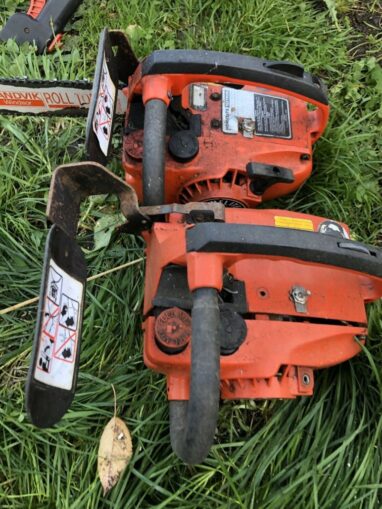
Once home I set to, and within minutes had found that the more complete of the 2 had a spark, and popped off with a drop of fuel down the plug hole. Very shortly afterwards I had swapped bits around and had a complete and running saw, all 26cc of it. Running like a champ and noisy as buggery – you can’t beat a virtually un-silenced 2 stroke at 10000 rpm….
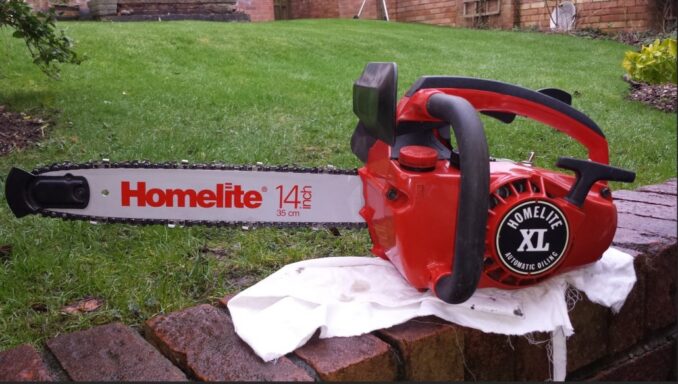
Boredom soon set in, so I idly wondered if I could get the second one going – a new starter rope, carb kit etc and off we went – a runner in no time. I then realised that the first one was really unmarked and in very nice condition, so after a NOS guide bar turned up on eBay, I quickly turned it into a shelf queen, with the other saw to be used, as and when needed.
Not to get too technical, but these saws were definitely at the lower end of the market, designed for home/hobby use. There was a small range based on the same architecture, initially with magnesium alloy shells containing the motor, a 26cc reed valve 2 stroke (originally called the XL2) before changing to plastic in some applications. There was a Super 2 model with a slightly different handle and some more power, and also a Super 2 VI which had a basic form of vibration isolation (hence VI). This type was made from the early 70’s up until almost the end of the company in America in the late 90’s. Many of the early ones have no form of chain brake, so if it all goes pear shaped look out….
Shelf Queen and the worker.
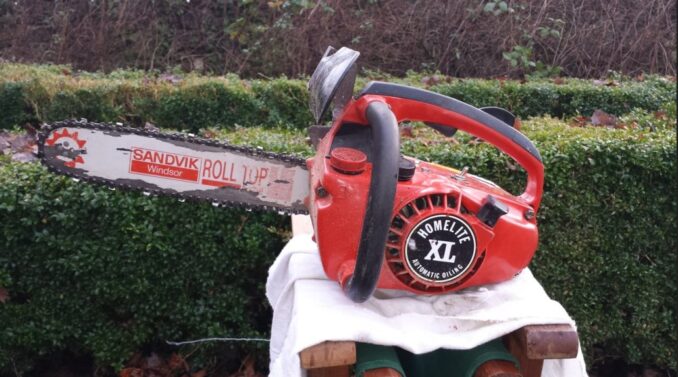
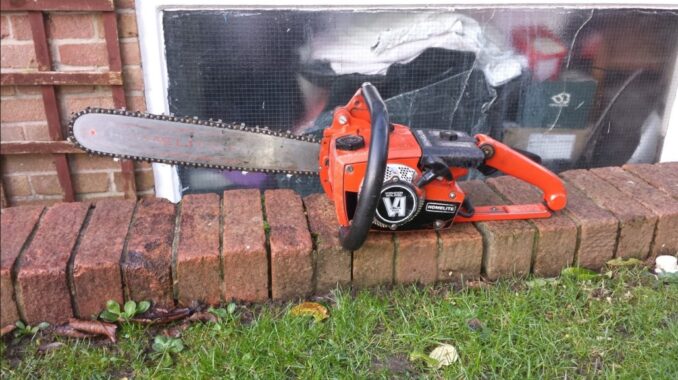
Of course this was the start of it. Within a couple of months in January 2020 I had acquired another Homelite saw via Gumtree, collected locally for the princely sum of £35. This is probably the most original example I have, a VI Super Mini from 1972, complete with original guide bar, and a lovely patina (well to my eyes anyway). This one was a sort of runner – it would not idle and spat fuel back through the carb, so after some initial cleaning I started investigation and found that there was a chip of wood trapped in the reed valve assembly stopping it from closing properly. Once this was solved, along with a couple of minor tweaks the saw was good to go. Being a Vibration Isolated saw it has a rubber mounted handle assembly – Homelite seemed to go through a variety of different ideas regarding isolating the user from vibration, some of which were peculiar to say the least (see later in this article!)
VI Super Mini. No safety chain brake on this one, so handle with care.
And on we went. We were now in lockdown (my views on that bullshit are not printable), so I was at something of a loss as to what to do, although I was still doing some work gardening at a large house a few miles away and enjoying the ride there on my motorcycle with no traffic about!
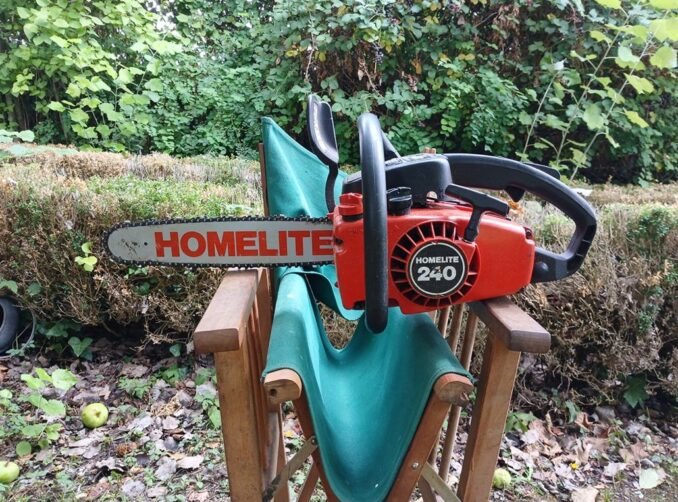
Next on the list was another Gumtree purchase, this time delivered to my door after the owner agreed to post it. This was a Homelite 240, another fairly late saw in the history of the company, made in 1989. This was really a big brother to the small XL range, plastic cased machines with the engine laid flat inside the case, although a bigger capacity – 2.4 cubic inches for this one. The saw when unpacked had clearly led a hard life, and was in a bit of a state with the wrong type of guide bar fitted, damage to the chain brake mechanism, and bits of the anti vibration system missing.
One thing that I had discovered very early on is that there were very few parts available for any of the Homelite range in the UK, so I had to look across the pond or hope I was lucky on eBay over here. Patience is not a virtue I have in abundance so on this occasion I bought a new chain brake spring from America, which arrived very promptly. I had of course already pulled it to pieces and cleaned it all up. It was pretty ropey, and eventually I had to fit a thread insert for the spark plug because the old one was so butchered. Once assembled it started and ran really well, and is now my go to saw for most jobs. After a couple of years eBay turned up another NOS Homelite guide bar, so it now wears this with a new chain. Good little saw….
Homelite 240
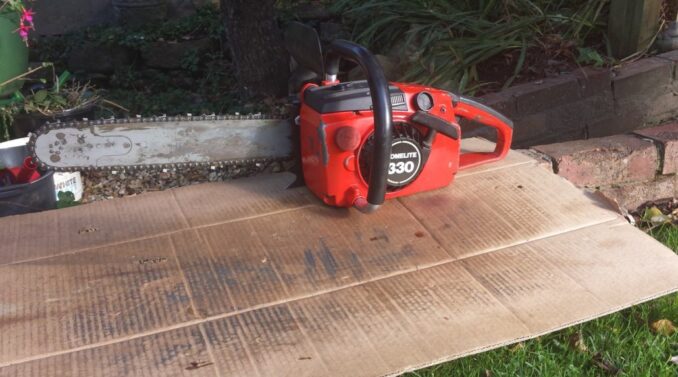
By now the roller coaster was beginning to run out of control. Bloody eBay again tempting me…. October 2020 saw a Homelite 330 arrive, for the princely sum of £40. Complete, and with a spark, but not running. Looking at this saw made me realise a possible cause for the later demise of the firm. Here was a stand alone design, completely different from any other saw in their range, with a single engine size of 3.3 cu in. Imagine the cost of design for this one saw. All the moulds etc, with the same product being made over about 8 – 10 years, with no improvements or user upgrades other than a ‘Winterised’ version that heated the fuel line, and a chain brake version for foreign markets – the Yanks didn’t seem too keen on that safety aid for many years.
Anyway, the usual story – the inside was covered with sawdust and oil, and the rubber inlet boot had fallen to bits. The 330 tried another method to insulate the user from vibration – this time the outer covers and handle were isolated from the engine by rubber isolators that allowed the engine to shake away inside the saw without the vibration reaching the parts you touch. The disadvantage of this was that as the carburettor was mounted to the outer shell, it required a flexible rubber boot to connect it to the motor, and these deteriorate with age and fall to bits. Another order to the USA had this sorted, and the saw was up and running. The other issue with this machine is the chain oiler – it has a plastic pump that uses pulses from the crankcase to operate a diaphragm that pumps oil to the guide bar (eventually). Notorious for not working, and this one is no exception – you have to blip the throttle for a couple of minutes to get any oil to the bar, and the noise it makes is fearsome, so I can only use it out in the wilds! I also had issues with it not wanting to start, and flooding petrol everywhere, but after rebuilding the carb and messing about with it I came to the conclusion that they all do that – just keep pulling and it will eventually start! If you run it with the air filter cover off you can see fuel squirting right down the throat of the carb like fuel injection – economical it is not! Again the design of the air filter assembly is totally different to any other Homelite – another expensive unique part produced for just one machine. Madness.
Homelite 330
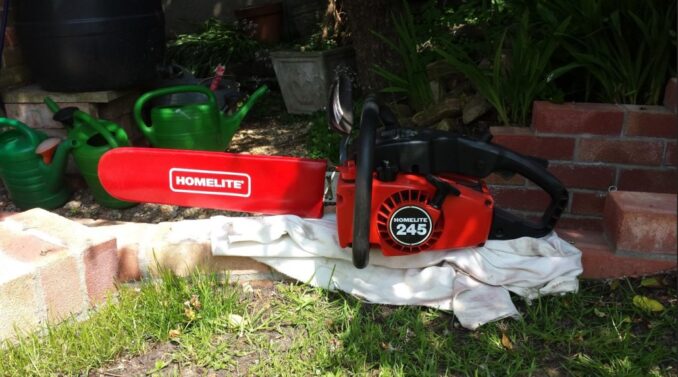
Careering out of control, on we go… I spy a Homelite 245 SL on Gumtree close by. A trip to the owners house on the way home from work, and I snag it up for £35. This was a one owner saw, bought new from Kellands at Bridgwater for the not inconsiderable sum of £250 in 1990! It was fitted with an 18” long guide bar which is a bit long for this type of machine – it is virtually identical to the 240 other than having a manual oiler as well as an automatic one (vacuum type again). I don’t think this saw had ever been cleaned inside in its life – it was absolutely chock full of crap, and so was completely pulled apart and cleaned. The oiler can be a bit reluctant to work on this saw despite me taking the pump to bits numerous times, but it is really not used much. Now wearing a 14” bar which is more sensible.
Homelite 245
And now it just gets silly.
One of the Youtube car channels I watch has the ‘waste of time Olympics’ – how much time can you waste doing something completely pointless with a vehicle? Well in my case with chainsaws, quite a lot (plus lots of money as well….)
Like most of these things it started on eBay; for reasons I can’t explain I clicked on a lot of mower fuel tanks and assorted rubbish advertised for £5, and located near my workplace. One of the photos in the lot was of a tin containing numerous bolts and a carburettor, all of which was definitely Homelite stuff for an unknown saw. Useful for spares maybe? I ignored the auction which ended, and was re-listed twice before eventually I put a bid of £5, and of course won it. I confirmed with the seller that it was a tin of Homelite parts, and when I went to collect just before Christmas 2020 the owner very kindly gave me a dog food sack containing the mortal remains of a saw – all the nuts and bolts belonging to it were in the tin. Being a sad bastard I actually recognised what was in the bag – a very rare Homelite XL400 Floating Power chainsaw. A weird and wonderful device made for 2 years only that incorporated the first wacky vibration isolation design. And here it is…
Absolutely knackered.
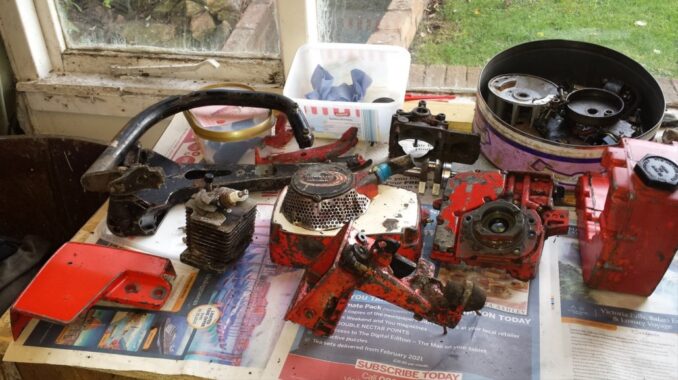
And in closer detail :-
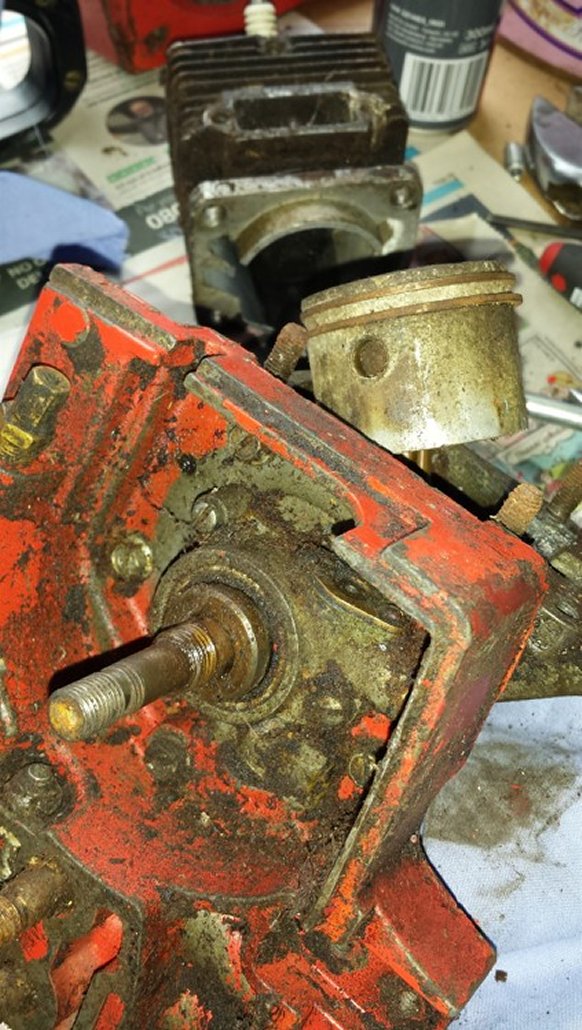
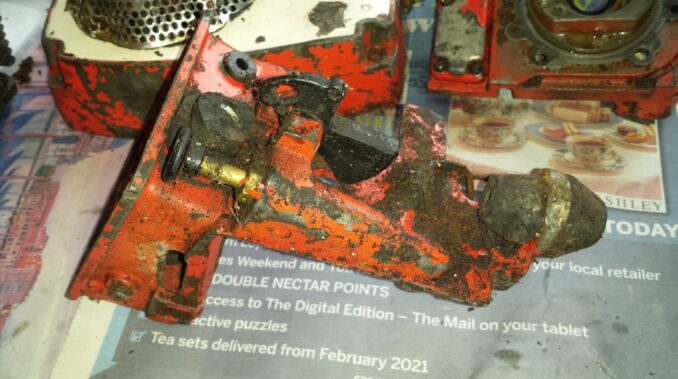
And so let the Olympics begin……
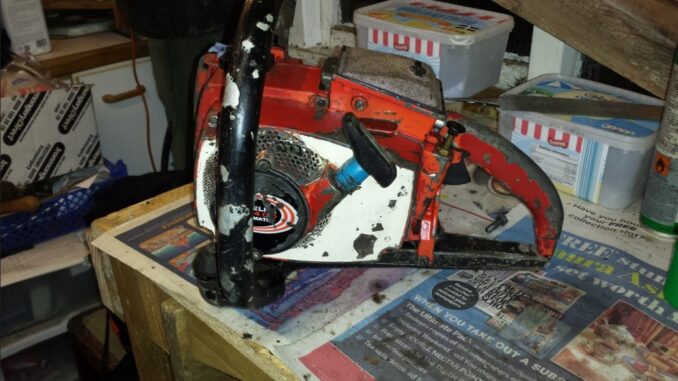
A check of the parts revealed that I was only missing an air filter cover and the exhaust, but everything had been utterly butchered to get it apart – some gorilla had been hammering on the end of the crank and ruined the threads, the piston was covered in seizure marks, rings were stuck etc etc. I think that it had seized after running weak, caused by the crankcase halves becoming loose and the central gasket blowing out. It would then have sucked in a load of neat air, which blew the motor. The bolt holes between the case halves were oval, and one of the locating dowels was missing (never there?) which had made matters worse. I roughly assembled it with no internals just to give the previous owner a laugh :-
What to do? Well I had to rebuild it of course and get it running! I felt obliged to do so – such a rare saw and worth quite o lot of money in the USA (but nothing here!) For unknown reasons all the rubber isolation mounts were present and in good condition, almost unheard of, particularly in the USA where they dry rot badly, so I started on my list of things to do, and parts to get. The casing is all magnesium alloy, and basically the design involves putting an exoskeleton around a normal saw – the XL400 was also available just as a straight saw. There was only one area of alloy damage to the black skid plate base which was fixed with JB weld. The crank thread was repaired by using a split die (actually some Land Rover nuts with a slot cut in them, all threads are imperial). I managed to get the air filter cover and part of a new correct exhaust in the UK, but everything else – piston rings, oil lines fixings etc all came from my source in Oregon, and the correct decals were also from the USA. I sort of lost my way with it for a time, but after a lull of a couple of years I set to and painted all the parts and with much care assembled the complete saw.
Homelite XL400 Floating Power. Note the ridiculously fragile handle casting with its rubber isolator
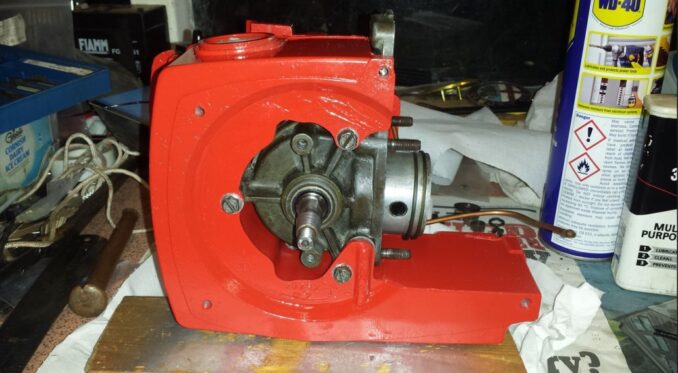
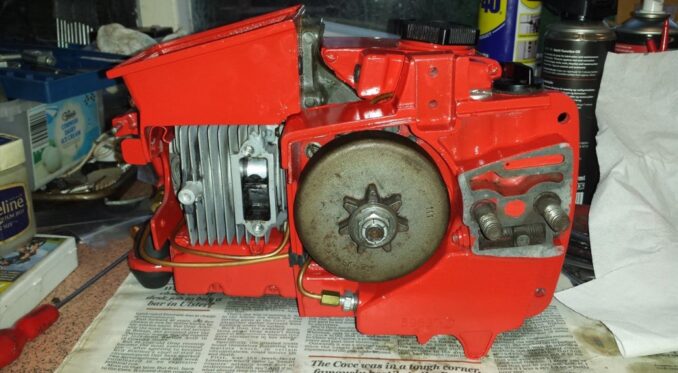
Until I got to this..
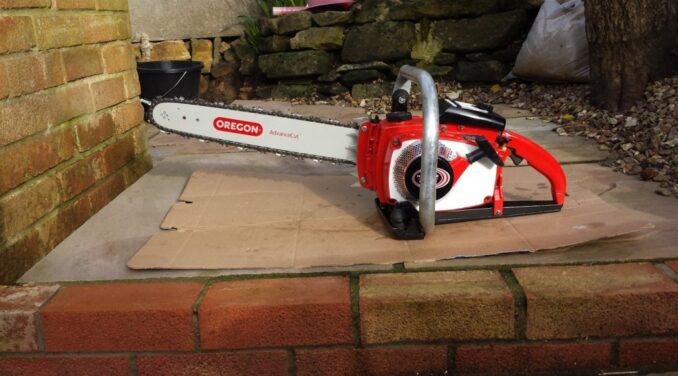
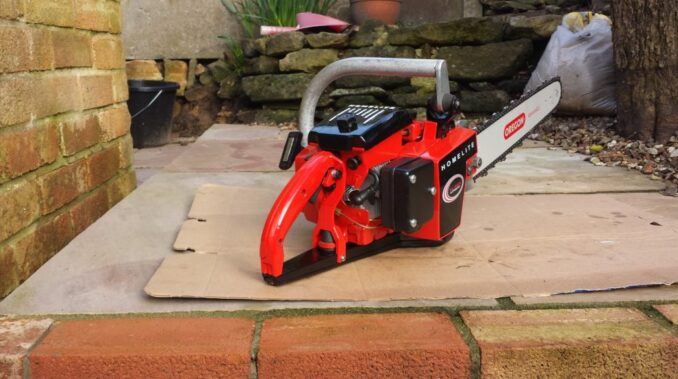
And it bloody well runs! Only the once mind you, for about 30 seconds, but that was the goal achieved. I can’t disclose how much this saw cost me in case my wife reads this, but it has had the effect of (almost) curing me of the Homelite disease, and the only other arrival since has been a pair of parts saws bought for £20. Of course, I got one of them running (as you do), but I think that is probably enough for me now.
© dpress 2025