
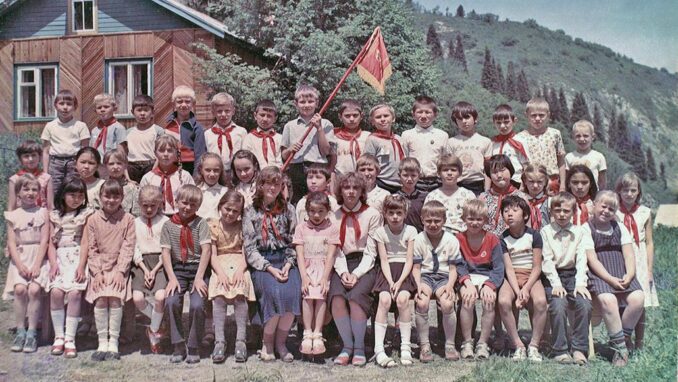
Peter Hübert from Dortmund, Germany, CC BY 2.0, via Wikimedia Commons
So-called “Democratic Socialists” are winning elections in America (New York City and Colorado). I’m sure that no one who either is running on a socialist platform or who voted for a socialist candidate has ever visited a real socialist country. One of the reasons is that there are not that many left. I can think only of Cuba and North Korea. Older voters may have been to some of the nations in Eastern Europe before the iron curtain fell around thirty-five years ago. I know of several former Air Force officers with whom I served who visited East Berlin and one long time friend who went to Romania on a Fulbright scholarship in the late sixties. None of these gentlemen had anything good to say about what they saw or, in the case of the Fulbright scholar, what they endured there. But I saw the mother of all socialist countries, the Soviet Union, in the early 1970’s as a young Air Force officer. The following is just what I actually saw there. I’ll try not to inject what others have said that may be interpreted as propaganda. So, the following will be a first-person account of what life is like in a real socialist country.
First—Some Background
It was the early 1970’s and US President Richard Nixon and Soviet Premier Leonid Brezhnev had reached an agreement to de-escalate the Cold War in a set of policies called Detente. Visits to one another’s country was loosened and encouraged. I was a young Air Force officer based in England at one of the key bases of US nuclear deterrence. Frankly nothing changed from a force posture standpoint, but word came down that we all were encouraged to go to the Soviet Union on leave. First the higher ups went and reported back that it was OK and that our eyes would be opened. So my wife and I booked a tour through an English tour company. We were joined by another Air Force officer and his wife. The tour would take us to the two so-called “jewels” of the Soviet Union: Moscow and Leningrad, as St Petersburg had been renamed after the Revolution of 1917. The total trip would take about two weeks, which included flying first to Leningrad for a few days, then taking the Red Arrow express train to Moscow, and finally flying back to London.
We four were briefed by the Judge Advocate General’s office on base before departing. The briefing was simple. Just assume that our rooms were bugged, so don’t talk about our jobs. Don’t trade currency on the black market. (The Ruble was greatly over valued on the official exchange). Don’t accept any packages or letters from Russian citizens. Follow any other rules the guides imparted. Simple enough.
First impressions
The guided tour, although booked through an English company, was conducted entirely by an Intourist guide, in our case a delightful young lady who spoke fluent English. The rules were simple. We could walk anywhere in either city at any time of day or night, although we were asked to refrain from taking pictures in train stations and a couple of other big government buildings. That was surprising at first but not in hindsight, for there was little to see other than the beautiful subway stations, for which the Russians were very proud and rightly so.
Next, let’s get this out of the way quickly. What we saw in Leningrad and Moscow was probably the most depressing experience of our lives. Nothing before or since ever matched the dreariness of the country, from arriving at the airport in Leningrad until our return to London from Moscow. There were hardly any cars anywhere, nor people on the streets. Remember these are the two great populace cities of the entire country. There were no lights of any kind other than street lights. There were very few shops and the few we visited were depressing and hardly worth a visit. We all wanted to buy something as a souvenir, but even in Gum, billed as the world’s largest department store and located along Red Square in Moscow, we could find nothing worthy. The goods on sale there would not be offered at a flea market in the West, which stands to reason because at one time Western flea market items were in high demand but had gone out of fashion or were supplanted by superior goods, which is part of the market process that we in the West take for granted.
Foreign Passport Required for Entry
Our young Intourist guide directed us to a stand-alone building where one needed a foreign passport to enter. It was a Beryoska shop. Ordinary Russians could not shop there even if they had foreign currency. So much for the “classless society”! Inside one found a small collection of nice souvenirs, such as scarves and the ubiquitous tokens with Lenin’s profile at the inexpensive end to fur hats and musical instruments at the high end. My wife bought a nice lacquered jewelry box and a set of traditional Russian nesting dolls.
Tourist Attractions
There were two types of attractions, all conducted by our Intourist guide. One category was pre-Soviet revolution sights, such as the Hermitage in Leningrad and the Kremlin in Moscow. Buildings such as these and their housed treasures can be found in every capital city in Europe. The other category featured the few government-built structures, such as the Bolshoi in Moscow. Missing was the joy of walking around a great city and seeing gardens, bookstores, restaurants, coffee bars, and thousands of gaily decorated small shops selling every kind of good imaginable. Think of London, Paris, Rome, or any town of any decent size anywhere in the world. There was none of this anywhere. What we did see were ugly, shoddily constructed buildings with huge cracks and solemn people. All in all Moscow and Leningrad were extremely depressing places.
There were two rather bizarre attractions, both in Moscow’s famous Red Square. At the time Lenin’s tomb was housed there, and it was almost obligatory to visit it. One entered through a wall and found armed soldiers lining the way to his tomb. Signs in every language admonished visitors to remain silent, as we filed past Lenin himself! Yes, supposedly what we saw was the corpse of Lenin with embalming fluid running through his veins. It could have been a manikin for all we knew, but that was a strange tourist attraction! (After the fall of the Berlin Wall and the demise of the Soviet Union, Lenin’s corpse was removed.) At one end of Red Square sits St. Basil’s Church. It is a beautiful and iconic structure…from the outside. But inside there was…nothing! No pews. No religious paintings, sculptures, or other decorations found in all churches everywhere. Why? Well, the Soviet Union persecuted all religion as the “opium of the people”. There could be but one guide to life in the Soviet Union—Marxist-Leninism.
A Very Depressing Encounter
We were housed in two large hotels and we ate all of our meals there, all of which were lavish and delicious. We had returned to our room after breakfast one morning when my wife left to retrieve a guide book she had left on the breakfast table. When she returned she said that saw our wait staff consuming our breakfast leftovers, which depressed us immensely.
A Return to Bright Lights and Happy People
All of us on the tour, numbering twenty or so, as I recall, were pleasantly shocked back to reality upon flying back to London. The airport was a sea of bright, colorful lights and happy, smiling people. London itself seemed almost overwhelming. For a long time we marveled at everyday life choices and beauty in mundane things like going to a bakery or the butcher shop. For example, our hotel room in Leningrad overlooked the Nevsky Prospect, one of the city’s main arteries. In the early hours of the morning one could look out our window and see a long line forming for the bakery somewhere out of sight. Our one purchase “on the economy” was to buy some sausage prior to our almost all day Red Arrow rail trip to Moscow. It took us a long time to, one, stand in line to view the goods and find out how much it would cost, two, stand in another line to get a payment voucher for the purchase, and, three, to stand in yet a third line to present our payment voucher and take delivery of our sausage. I am not making this up! I have no idea why people were put through this rigmarole, but think about it the next time you walk into a well-stocked grocery store, pick up a loaf of bread, a gallon of milk, and a dozen eggs, pay for it and walk out in just a few minutes. Do you think that New York Mayor Mandami’s socialist government grocery stores will work like those in capitalist countries or like those in the defunct Soviet Union? Yeah, that’s a rhetorical question.
© Patrick Barron 2026 Website