
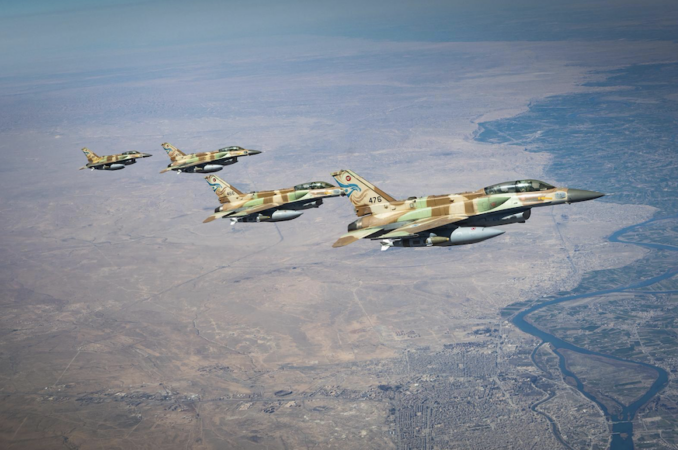
Israeli Air Force F-16I Sufa fighter jets, Operation Roaring Lion 2026,
IDF Spokesperson’s Unit – Licence BY-SA-3.0
The history of relations between Jews (and later Israel) and Persians (later Iran) stretches back over two and a half millennia and is more than a simple narrative of continuous hostility. For much of that time, coexistence, imperial patronage, and even strategic alliance characterised a relationship that only turned into sustained hostility in the late twentieth century.
In recent media coverage, some Iranians cite a 6,000-year-old civilisation threatened with cultural annihilation by Donald Trump’s 250-year-old United States of America. At the time of writing, a two-week ceasefire has been announced. Whether this is an edge of the precipice face saving device by Trump or a genuine step towards a permanent peace in the region remains to be seen.
What can be said for certain is that the ensuing calm, no matter how brief, allows for reflection upon the history of the hostilities between Iran and its proxies, and the USA and Israel. Although a wartime mainstream media Vox Pop in the streets of a war-edgy Tehran may allow the locals six millennia of identity, much of that timeline consists of prehistoric artefacts best attributed to hunter-gatherers and nomads.
Classical times
The earliest recorded references to Iranians (ethnic Persians and Medes native to the Iranian plateau) are Assyrian, and date to the 9th century BC from the reign of Neo-Assyrian emperor Shalmaneser III. The Assyrians originated from around ancient Ninevah (modern-day Mosul) in northern Iraq. By the time of Shalmaneser III, their empire stretched from contemporary Turkey’s Toros Mountains to the north of the Persian Gulf.
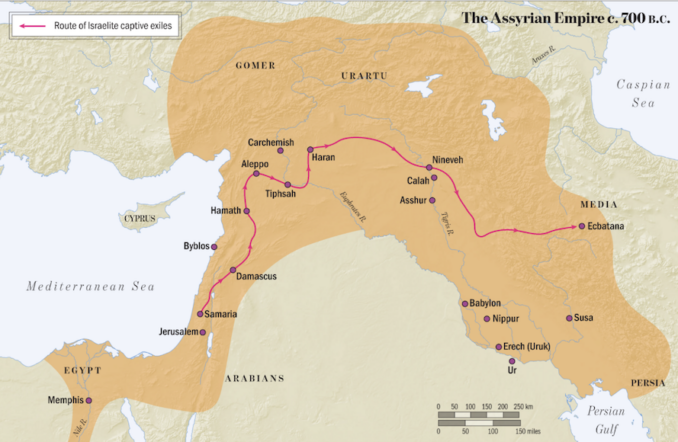
A map of the Assyrian Empire c. 700 B.C.,
Biblica, Inc – Licence CC BY-SA 4.0
In 722 BC, the Neo-Assyrians destroyed the northern Kingdom of Israel and deported many Israelites eastwards. By 609 BC, that empire was no more, having been defeated by the Babylonians. Later, in 586 BC, it was the Babylonians who conquered Judah and exiled large numbers of Jews to Babylon – which is in modern-day Iraq.
A decisive turning point came between 539 and 538 BC, when Cyrus the Great of Persia defeated Babylon. According to biblical and historical sources, Cyrus issued a decree allowing a return to Jerusalem and rebuild the Temple, which they completed around 515 BC. This act established a Jewish memory of Persia as a benevolent imperial power. It was this temple that was destroyed by the Romans in 70 AD, resulting in an acceleration of a long-term Jewish diaspora across the Roman Empire.
Elsewhere, Jewish communities remained in Persian lands forming part of another diaspora that would persist for over 2,500 years. During this Persian period (c.550 BC–330 BC), key biblical texts such as Ezra and Nehemiah show the Jews enjoying a degree of autonomy. Not all was harmonious. The Book of Esther, set during the reign of Xerxes I (dated to the fifth century BC), recounts a plot to destroy the Jews of Persia.
Under subsequent empires — Hellenistic, Parthian and Sasanian — Jewish life in Persian territories continued. The region became a major centre of Jewish scholarship by late antiquity, when the Babylonian Talmud was compiled. The Babylonian Talmud is a central text of Rabbinic Judaism, containing discussions on law, ethics, philosophy, and biblical interpretation. Relations with Persian authorities varied: at times, tolerant, at others, marked by restrictions or persecution, especially under the Sasanian rulers.
The arrival of Islam
Although Trump’s Truth Social posts claim the present conflict is ‘one of the most important moments in the long and complex history of the world’, a pivotal historical moment did occur with the Islamic conquest of Persia in the seventh century AD. Jews, like Christians, became “People of the Book” under Islamic law and were permitted to practise their religion in exchange for ‘dhimmi’ taxes and legal limitations. While this status involved discrimination, it allowed Jewish communities in Persia to survive and, at times, flourish compared to their co-religionists in parts of medieval Europe.
From then through to the early modern era, Jewish life in Persia continued under successive dynasties such as the Safavids (1501–1736). The Safavid establishment of Shi’a Islam (as opposed to the Arab Sunni Islam) as the state religion sometimes led to harsher treatment of religious minorities, including episodes of forced conversion or segregation. However, the tensions that existed were localised and intermittent rather than part of today’s continuous geopolitical conflict.
The modern era
That modern phase of relations began in the nineteenth and early twentieth centuries, as the nationalisms of the Jews (Zionism, with its insistence upon a return to the historic land of Israel), Irans and the Arabs, developed.
Persian attitudes towards the idea of a Jewish state in Palestine was often ambivalent or negative. In 1947, Iran voted against the United Nations partition plan for Palestine, and in 1948–49, opposed Israel’s admission to the UN, aligning with Arab states. Although, during the Arab–Israeli War of 1948-1949, Iranian hostility was exercised through dipomacy rather than in direct military action.
Despite this early opposition, relations between Iran and Israel soon entered a cooperative phase. A while after the establishment of the State of Israel, Iran — under Shah Mohammad Reza Pahlavi — developed close, albeit informal, ties with both Israel and the United States. From the 1950s through to the 1970s, Israel and Iran shared strategic interests: both were non-Arab states wary of Arab nationalism and the Cold War Soviet Union. Israel pursued a “periphery doctrine,” courting neigbouring regional powers – including Tehran. Likewise, the United States of America, desirous of Iranian oil, arms sales to the Shah, and to keep the Soviet Union out of the Gulf.
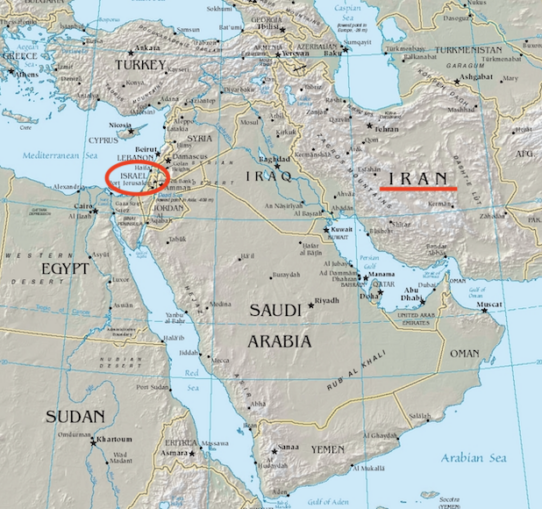
Political map of the Middle East,
CIA – Public domain
During this period, the three cooperated in economics, technology and the military. Israel provided Iran with expertise in agriculture, medicine, and infrastructure. Iran supplied oil and served as a strategic partner. This era — 1950 to 1979 — is often described as a “golden age” of relations, suggesting modern hostility is not rooted in ancient enmity but in recent political transformations. How so? Because of the disconnect between the strategic level and the experience of ordinary Iranians which led to the Iranian Revolution of 1979.
Post-revolutionary Iran
The overthrow of the Shah and the establishment of the Islamic Republic under Ayatollah Khomeini transformed Iran’s foreign policy. Both for religious and geo-political reasons, given their support for the Shah, the new regime adopted an anti-Israel and anti-American ideological stance, framing Israel as illegitimate and as a ‘dushman’ – an enemy of Islam. Diplomatic relations were severed, and Israel’s embassy in Tehran was handed over to the Palestine Liberation Organisation.
Khomeini’s intention to march on Israel sounded like far-fetched Trumpian rhetoric at the time, but from the earliest days of his revolution, Iran supported actors opposed to Israel, such as Lebanon’s Hezbollah and later Hamas and Islamic Jihad. This marked a shift from indirect political opposition to active involvement in the broader Arab–Israeli conflict.
Israel began to view Iran as its most significant regional threat. Concerns centred on Iran’s ideological hostility, its support for armed groups near Israel’s borders, and from the 1990s onwards, its nuclear programme. Covert Israeli action became a defining feature of the relationship. These incuded cyber operations, assassinations of scientists, and widespread intelligence activity.
The twenty-first century sees this rivalry escalate into open confrontation. Events such as the 2006 Lebanon War, the Syrian Civil War (from 2011), and repeated Israeli strikes on Iranian-linked targets in Syria intensified tensions. As Syria collapsed into chaos, the Islamic Revolutionary Guard Corps found themselves in the south of the country, with a land border with Israel and the ability to put drones over the Jewish state.
The situation worsened dramatically after 7 October 2023 with the Hamas attack on southern Israel, which Israel attributed in part to Iranian support. The subsequent two and a half years have seen direct exchanges, including missile and drone strikes, and, until a two-week ceasefire, open warfare between the sides.
In brief
To summarise, the long history between Jews and Persians cannot be reduced to a simple narrative of hostility. From the sixth century BC through much of the following twenty-five centuries, relations were often characterised by coexistence and even cooperation, with Persia playing a foundational role in Jewish history.
Modern enmity is a product of twentieth-century geopolitics, especially the establishment of the modern-day state of Israel, American and Israeli support for the Shah’s regime, and the ideological transformation brought about by the 1979 Iranian Revolution. Rocket fuel being added by the Persians historic conversion to Shia Islam.
© Always Worth Saying 2026


