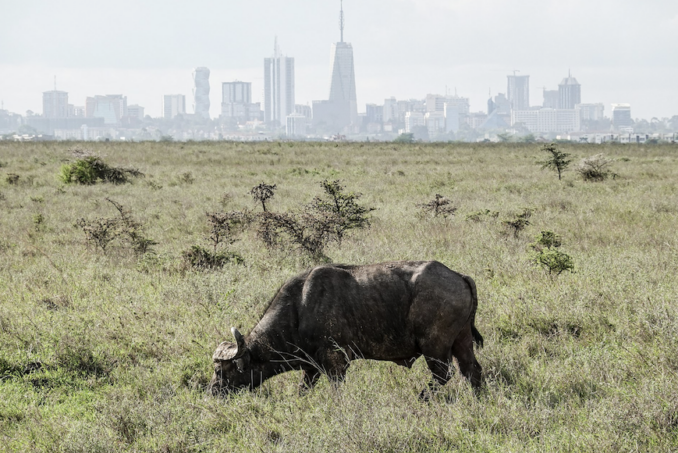
Buffalo and Nairobi skyline,
Timothy A. Gonsalves – Licence CC BY-SA 4.0
Under the Presidential Spotlight: Recent Scandals
Since taking office, WSR’s administration has been accused of overseeing massive graft, with over 25,000 corruption cases dropped – many involving his allies – while ignoring judicial directives on procurement and reforms.
Key controversies include:
Adani Group Contracts (2024): Two high-profile deals with India’s Adani Group were scrapped in November 2024 following U.S. indictments for fraud and bribery against the firm. The first, a US$1.85 billion 30-year lease of Jomo Kenyatta International Airport (JKIA), bypassed competitive bidding and public input, sparking fears of job losses and tax evasion. The second, a Ksh 127 billion ($741 million) power transmission project, was similarly single-sourced. WSR blamed the cancellations on external evidence, but reality cited cronyism and potential kickbacks.
Edible Oil Import Fiasco (2023-2024): Through the Kenya National Trading Corporation (KNTC), tax-exempt imports of 125,000 tons of cooking oil via firms like Multi Commerce FZC and Charma Holdings resulted in Ksh 6.6 billion (US$51 million) in losses from unsold stock. Part of a subsidy initiative, it was criticised for enriching WSR’s associates.
Fake Fertiliser Scheme (2024): Farmers received counterfeit subsidised fertiliser via the National Cereals and Produce Board (NCPB), costing Ksh 3.5 billion ($27 million). Agriculture Cabinet Secretary Franklin Linturi survived an impeachment attempt after a parliamentary probe allegedly suppressed witnesses.
Finance Bill (2024) IMF austerity measures and budget reforms backed by WSR for higher taxes on essential goods, including bread, sugar, healthcare, cooking oil and fuel sparked nationwide protests that were met with brutal crackdown. WSR was forced to withdraw the bill after deadly protests which even saw parliament set ablaze. WSR finally addressed the nation, saying it was clear that Kenyans “want nothing” to do with the bill. “I concede,” he said, adding that he would not sign the bill into law.
Mosquito Nets Procurement (2024): Ksh 3.7 billion ($28.5 million) vanished in overpriced bed net deals at the Kenya Medical Supplies Authority (KEMSA), exemplifying favouritism in health sector tenders.
Social Health Authority Claims (2024): Fraudulent payouts totalling Ksh 24 billion ($185 million) under the new health insurance program exposed lax oversight.
Additional Losses: Procurement irregularities at the National Youth Service (Ksh 791.4 million, US$6.1 million) and Kenya Pipeline (Ksh 550 million, $4.2 million), alongside unauthorised extra-budgetary spending of billions – including Ksh 82 billion (US$634 million) in 2022-2023 – have drawn ire. Lavish expenditures, such as Ksh 1 billion (US$7.7 million) yearly on State House renovations and a US$2 million U.S. flight charter, contrast sharply with austerity measures.
Payroll Anomalies: A Ksh 62 billion ($479 million) discrepancy in public payrolls revealed nearly 20,000 ghost workers, including overstaffing at State House.
Selective Justice: Cases against allies like former Deputy President Rigathi Gachagua (Ksh 7.2 billion money laundering), Wycliffe Oparanya (county fraud), and Henry Rotich (Ksh 63 billion Arror and Kimwarer dams scandal) were dismissed, while protesters faced harsh charges.
In early 2025, former Attorney General Justin Muturi levelled fresh corruption accusations against WSR, though details remain sparse. A 2023 incident saw 1,000 tons of condemned sugar disappear from state warehouses.
Critiquing the ‘Africa’s Singapore’ Rhetoric: A Vision Undermined by Unwillingness to Sacrifice
WSR repeatedly invoked the dream of transforming Kenya into the “Singapore of Africa,” a vision of rapid economic development, infrastructure boom, and first–world status that echoes ambitions voiced by Kenyan leaders for over 40 years. In recent speeches, he has touted a Ksh 5 trillion plan to achieve this, emphasising Kenya’s potential to replicate Singapore’s success through bold investments and reforms. However, critics, including opposition leader Kalonzo Musyoka, have dismissed this as unrealistic, arguing that it ignores the foundational sacrifices that propelled Singapore’s rise – chief among them, an unrelenting war on corruption.
Singapore’s transformation under founding Prime Minister Lee Kuan Yew was built on zero tolerance for graft, meritocracy, and strict enforcement that spared no one, including friends and political allies. Lee declared war on corruption by removing incompetent or corrupt officials regardless of personal ties, implementing high salaries for civil servants to deter bribery, and empowering independent bodies like the Corrupt Practices Investigation Bureau (CPIB) to investigate without fear or favour. This required profound sacrifices: jailing corrupt ministers, streamlining bureaucracy, and fostering a culture where integrity trumped loyalty. Development, as history shows, demands such tough choices to build trust and efficiency.
In contrast, WSR’s anti-corruption efforts have been lambasted as ironic, selective, and lacking political will. Reports highlight state capture, weaponisation of institutions like the Kenya Revenue Authority to silence critics, and the dropping of cases against allies, which directly contradicts the Singaporean model of impartial justice. Without the resolve to jail corrupt friends and political partners, as Lee did, Kenya’s path to becoming “Africa’s Singapore” remains illusory. True progress requires sacrifice – not just rhetoric – to eradicate graft and restore public faith, lest the vision devolve into another unfulfilled promise amid escalating violence, economic blunders, and eroded trust.
Shirika Plan (2024) The plan seeks to integrate refugees into host communities, transforming Kakuma and Dadaab IDP camps into sustainable municipalities.
WSR, knowing he has no power base or support, will allow under Shirika plan, for refugees to vote in the next Kenya election. No different to Koran Kier seeking to support illegals in return for votes and financial welfare, WSR is following the same approach.
In tandem with this, WSR is also seeking to stranglehold the Independent Electoral and Boundaries Commission (IEBC) and radically reshape how Kenya announces its presidential election results, stripping the IEBC chairman of the exclusive authority to declare the winner. Under the proposed system, returning officers would be required to count and announce presidential results before any other race, potentially delivering final outcomes by 11 a.m. on election day.
The legislative proposal, tabled in the Senate and rooted in recommendations from the National Dialogue Committee (NADCO) report, seeks to decentralise this critical mandate to all 290 constituency returning officers.
Compounding this in February 2025, WSR signed a proclamation removing the mandatory vetting requirement that residents of border counties had to undergo before acquiring national identity (ID) cards, a process long criticised for discrimination and systemic exclusion. The scrapped rule had existed for over six decades and was primarily applied to communities living in Northern Kenya and other areas bordering Somalia and Ethiopia.
The IEBC resumed continuous voter registration in September 2025, aiming to add 5.7 million new voters ahead of the 2027 general election, which would likely decide the election winner. Former Interior Cabinet Secretary Fred Matiangi announced at the end of January 2026, WSR’s IEBC had registered 5 million votes, 3 million in Dadaab, 2 million in Kakuma, in a week, while voter registration in Nairobi and central Kenya has been suppressed.
It gets even worse. As of now, WSR is also associated with contracting Zimbabwean Wicknell Chivayo to print votes for the 2027 election. Chivayo has form having undertaken similar activities in Zimbabwe, Namibia and South Africa. This is on top of Mark Malloch Brown’s Smartmatic also being used in previous elections here, and SE Asia etc. controlling everything from registration, to vote count, through to results proclamation.
A further added factor, following the exposure of the fraud scam in Minnesota (and other states) predominantly involving camel herders, as covered in previous pieces by Armin Rosen, Nick Shirley etc. is the deportation of camel herders from the US. Kenyans are expressly clear they don’t want a single camel herder sent to Kenya. The primary concern is camel herders deported to Somalia will again trek south and register in Dadaab, knowing they will be made welcome.
Established as Deputy President in 2022, Rigathi Gachagua, having ensured a near block vote on behalf of WSR, was conveniently removed and impeached (all currently in abeyance).
In January 2026 Gachagua made his bold statement (obviously with evidence to back it) that foreign (Somali) money laundering was used in Kenya’s 2022 elections. He urged the Don to act, urging him to fast-track investigations into fraud, both vote and money laundering linked to Minnesota, for both the 2022 Kenya election and impending 2027 election, knowing that political protection would be provided by WSR.
While US federal prosecutors’ work is ongoing, the disturbing camel herder money trail, hidden behind shell companies and smuggled in bulk cash, leads directly to Kenya’s “booming” real estate sector, with Kenyan authorities either unwilling or unable to stop it.
Between 2020 and 2025, investment using stolen funds acquired stakes in Kenya Real Estate, upmarket apartments / houses, estates in Kilimani, Kileleshwa, Lavington and Karen, land parcels in Mandera (near Somali, Ethiopian borders), all paid in cash at inflated prices.
Gachagua’s stance signals a widening rift within Kenya’s political elite with a strategic repositioning ahead of future electoral contests. By linking local politics to global financial investigations, questioning institutional credibility, and attacking flagship government programmes, Gachagua has carved out a populist narrative centred on accountability. It obviously touched WSR’s nerve.
In January 2026, Gachagua had attended a church service at the Gatundu South, Nyeri, when police officers stormed the church, lobbed tear gas, and fired shots, causing chaos and bringing the celebration to a halt. The officers, mobilised by lawmakers from the region, also torched Gachagua’s car and destroyed and deflated several cars parked within the region.
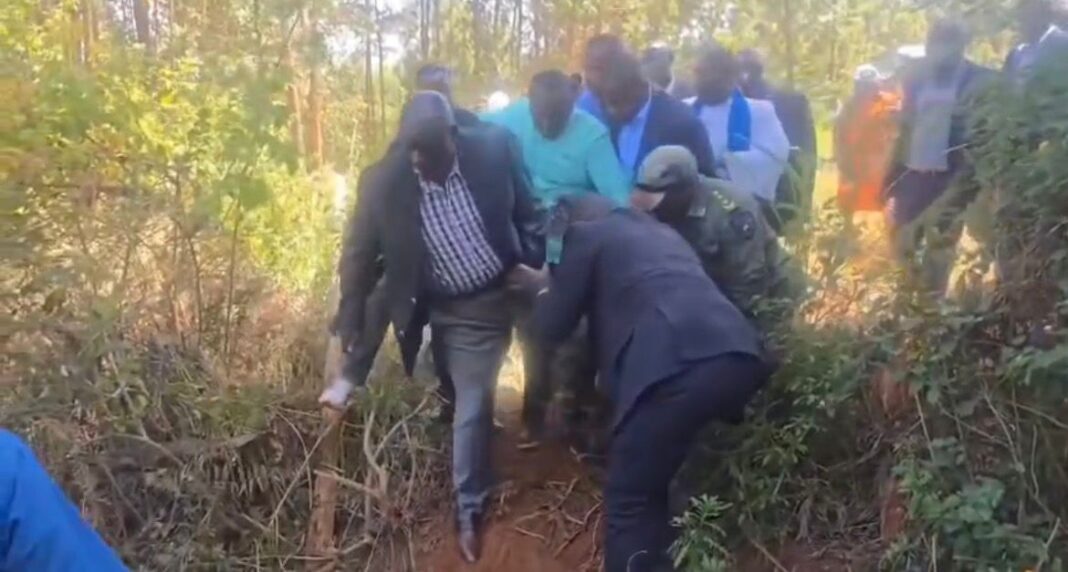
A couple of weeks later, while attending another church service, yet another attack at Witima ACK church, Othaya, which forced him to escape with his handlers. Gachagua has stated he will call for (Maandamano) on 16 February 2026 to remove the heads of the security docket from office if the police officers who attacked him in Nyeri are not arrested.
Information up to date as of time of sending.
© AW Kamau 2026