
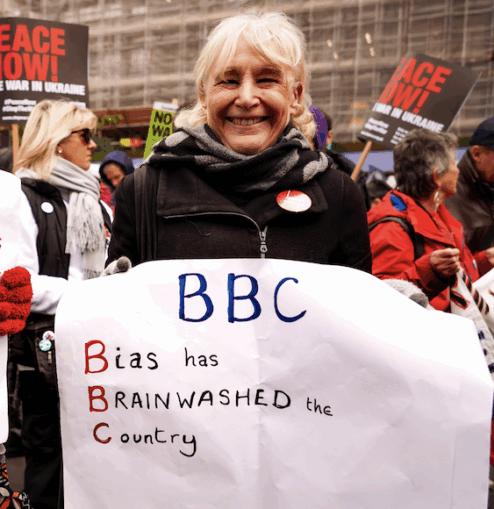
Peace talks now,
Alisdare Hickson – Licence CC BY-SA 2.0
A making-of Question Time feature entitled ‘Behind the Scenes’ is available on the iPlayer. Having already penned the ‘Making of QT Review’, we must give this a viewing. Previously, I was harsh on the politicians. At the end of early summer’s St Andrews edition of the programme, that night’s duty officer at QT Review HQ signed off as follows: ‘With our hard-working representatives in the Houses of Liars and Thieves now talking a well-deserved four-month-long summer holiday, QT Review will return in September.’ In fact, our MPs didn’t rise until 24th July and returned to the Westminster cesspit on Monday, 1st September.
QT episodes used to coincide with parliamentary sessions. Not any more. At the moment, and hence this ‘filler’, Parliament is in recess until January 5th, but BBC QT does not broadcast again until the 22nd. Therefore, it’s La Bruce and the Question Time team who get the extended holidays. Who so? Because the programme is expensive to make.
At the start of the eight-minute behind-the-scenes iPlayer special, we are shown drone footage taken from above Bedworth in Warwickshire. Three truckloads of kit sit outside a venue. Inside, while I’d be doing my biographical prep on the panellists, a small army of artisans is preparing the space for the evening’s show. These include venue manager Paul Devine, who confides to the camera the complexities of getting everything there, parked up and unloaded. Among the artisans are camera, light and sound wallahs – all of which cost money even before La Bruce starts the clock on her £30,000-an-hour remuneration.
Earlier in the week, there was an editorial meeting with, judging from the photos, Fiona pulling off the old female trick of turning up glam after telling all the other girls it’s a dress-down day. This being the BBC, it takes six pen-pushers – one a female with alopecia – to pull three or four topical current affairs questions from the front pages.
Jaguar Land Rover is the big issue for Bedworth, according to La Bruce, the car manufacturer being partway through a £2 billion cyber-attack, and Bedworth a six-mile Discovery drive from their Coventry plant. Although the attack’s link to Putin turned out to be false, perhaps the BBC’s obsession with Russia might have been on the agenda all the same? As, within that editorial meeting, there lurked an important behind-the-scenes connection kept secret from viewers and licence-fee payers. Read on!
Guests are announced on Wednesday teatime. Later in the evening, pen portraits are published on X. Wanting to be quick off the mark, QT Review HQ keeps an eye on the Question Time website in the hope of some new faces among the same old, same old talking heads on the predictable panel line-ups.
Under a banner headline of ‘Credits’, presenter Fiona Bruce and the director and executive producer are billed. Beneath them, the panellists. Although our interest lies with the guests, the other names stick in the mind, in particular an unusual one, that of executive producer Nickolai Gentchev.
In the editorial meeting section of the behind-the-scenes promo, we are introduced to Nickolai and, for the first time, I can put a face to the name. To camera, he says, ‘As we travel round the country, we get to see through the eyes of the people from the place we are that week. It’s unpredictable; it’s a real privilege to look from their viewpoint.’ All very ‘down with the people’, but, as Puffins are about to learn, ‘power to the people’ might be a more apt speech bubble attached to the interesting Mr Gentchev’s Red lips.
Greying at the temples and filmed in a casual open-necked blue shirt, Mr Gentchev’s clipped tones disguise the fact that he hails from Bulgaria and moved to Britain when aged eight. Not quite the horse, cart, hand-plough and gypsy violin Bulgar, Gentchev attended London’s exclusive St Paul’s School (£54,000 per annum) before studying Economic History with Russian Language and Literature at the University of Glasgow. Yes, links with Russia.
A media-bubble lifer, the fluent Russian speaker worked for Bloomberg News between 2000 and 2006, starting out in multimedia and television before moving into roles as a radio producer and presenter for Bloomberg Radio.
In April 2006, he joined the BBC, presenting on BBC Radio 5 Live. He later worked as a producer and output editor on Puffin’s favourite, The Today Programme, until 2010. From January of that year to April 2011, he served as editor of Good Morning Scotland, BBC Radio Scotland’s flagship breakfast show. In April 2011, he became editor of another BBC flagship, Question Time, through the programme’s production company Menthorn Scotland. He became an executive producer at Menthorn in September 2016.
During his time on Today, Mr Gentchev produced a special series from Russia with Bridget Kendall looking at the country’s changes under Putin. Not only that, at Menthorn he visited the country with another Menthorn talent, and another Puffins’ favourite, David Dimbleby, when executive producer for ‘Putin’s Russia with David Dimbleby’. At the time, Dimbleby was still chairman of Question Time.
Despite this being post the Salisbury poisoning, Dimbleby gives a platform to young Russians who are massive Putin fans. Also, a lady with an Order of Parental Glory and her ten children – housed in triple-decker bunk beds in commie-era accommodation. Neil Harvey, a British newsreader at Russia Today, is also given a platform, with Dimbleby pulling funny faces rather than asking killer supplementary questions to his anodyne questions.
If this were done by someone with even the most tenuous, long-arm’s-length connection to Reform UK, Broadcasting House would be in a frenzy over supposed ‘links to Russia’. Yet both the production team and their Russian subject matter receive a free pass from the BBC.
Are we surprised? Regarding Gentchev, we shouldn’t be, as he has form when it comes to leaning towards the iffy side of the Iron Curtain. Gentchev’s original appointment to Question Time was controversial, as he has a history of writing for extreme ultra-hard-left publications, such as the International Socialism Journal, Socialist Review, and Socialist Worker – the mouthpiece of the toxic ultra-hard far-left Socialist Workers Party.
Included in his published writing is a critique in Socialist Review knocking down Richard Pipes’ book ‘Russia under the Bolshevik Regime (1919–1924)’. In this, surprise surprise, Gentchev takes the side of the Bolsheviks and blames the White Russian anti-communists for everything, including hopes of a better Russia being ‘pushed aside by the realities of fighting a bitter war’, [with] ‘all the resources of the new workers’ state being thrown into a fight for survival against the Whites’.
Gentchev criticises the old order, i.e. capitalism and the free market, and chooses to side with a violent revolution, one which, Nickolai states, was not a result of a Bolshevik conspiracy but because of ‘workers’ attitudes’. Rather than Lenin and Trotsky slaughtering their fellow Russians and stealing their wealth, they are fighting against ‘degeneration and bureaucratisation’.
In another Socialist Review piece, ‘A People Torn Apart’, Gentchev blames nationalism rather than communism for the plight of the Chechen people under, erm, communism. As for the Socialist Worker magazine, in his ‘Revolutionary Interventions’ review of the ‘Balkan Socialist Tradition’ by Dragan Plavsic and Andreja Zivkovic, the Question Time show runner waxes lyrical about Marx and Engels’ opposition to Tsarism.
The arrested development of the Balkans between 1871–1914 is not because of the lead weight of domination by Muslim Ottoman Turkey, but rather due to ‘1890s Western imperialism’. Descending into the habitual factionalism of the far left, Gentchev obsesses with Serbian Socialists, Bulgarian Narrow Socialists, the Bulgarian Bolshevik–Menshevik split of 1903 and the Second International parties. Quite.
This dog’s dinner is ‘an under-explored area in the development of Marxism’, according to the executive producer of Question Time. This nonsense perhaps helps to explain the constant point-scoring, game of catch-out and obsession with ‘narrative’ that takes precedence editorially on the BBC’s QT flagship – not least in the selection and priming of the biased BBC audience.
When reviewing Chekhov for the Socialist Worker, Gentchev begins as we will end: ‘It is easy to dismiss Ivanov, alongside Chekhov’s other plays, as being full of melancholy middle-class moaners who need a kick up the backside.’
Likewise, the reviewer’s own upper-middle-BBC-class Islington Marxist moaners who need a rocket up the behind. The difference being, Chekhov’s perspective was on stage for all to see, whereas the left-wing extremists at the BBC operate, as their own prescient iPlayer effort states, ‘behind the scenes.’
© Always Worth Saying 2026

.jpg)