
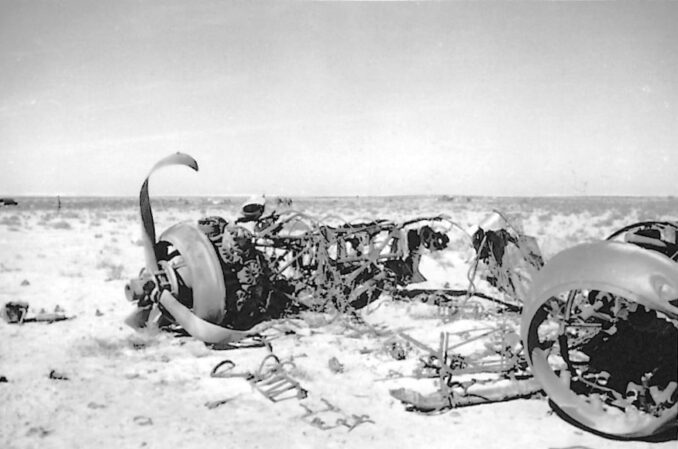
Amongst my collection of original photographs taken during the Desert War by members of the Deutsche Afrika Korps, I have several of wrecked aircraft but most are usually burnt out and, except to an aviation expert, unrecognisable.
© John Tull 2025, Going Postal
One photograph I do have however that would be instantly recognisable to those of an age whereby in their youth they would have spent their pocket money or had bought for them as Christmas or birthday presents, the wonderful plastic construction kits made by Airfix.
Originally founded in 1939, Airfix began making injection-moulded plastic products from 1947. In 1949, they were asked to make a promotional model of the Ferguson TE20 tractor, initially as an already assembled model used as a promotional giveaway by Ferguson sales representatives but later sold as a model construction kit through Woolworths.
The first aircraft model Airfix produced was in 1953 which was a Supermarine Spitfire Mk1 in 1:72 scale where one inch on the model equals six feet (72 inches) on the actual aircraft. From then on, they rapidly expanded their range and sales, with the building of plastic scale models becoming one of the most popular hobbies in the UK.
Amongst their range was a model kit of the Lockheed Hudson light bomber which they first sold in 1963 and has since been through many variants up to the present day with a new version going on sale this year as part of the Airfix Vintage Classics range.
As this is one of my favourite models that I have built several times, the first time around 1965 and the latest only a couple of years ago, which is why I immediately recognised the aircraft in this particular photograph:
© John Tull 2025, Going Postal
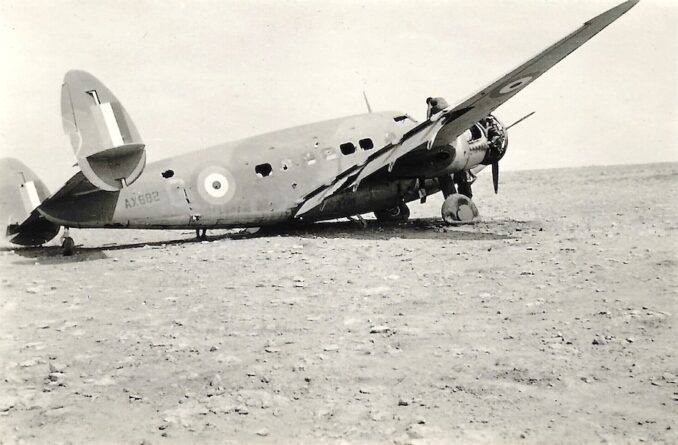
The photograph is of a wrecked Lockheed Hudson lying in the desert with the serial number “AX682” and with a German soldier crouched down examining the starboard engine.
The Lockheed Hudson started life pre-war as the Lockheed Model 14 Super Electra, a civil passenger and cargo aircraft that first flew in July 1937, as a development of the Model 10 Electra (as flown by Amelia Earhart), and entered service in October 1937 with Northwest Airlines. It was also built under licence by Tachikawa in Japan. A British Airways Super Electra, G-AFGN, was the aircraft that brought Neville Chamberlain back to Heston Airfield from Germany with “…peace in our time…” in 1938 and can clearly be seen in the newsreel of that event.
In 1938, as part of Britain’s preparations for war, the British Purchasing Commission were looking for an aircraft to take on the initial role of being a maritime patrol aircraft alongside the Avro Anson. Having seen what was on offer from Lockheed as military conversions of the Electra, they placed an immediate order for 200 aircraft for the RAF. The first Hudson aircraft undertook flight trials in December 1938 and deliveries started in February 1939. It proved successful in many different roles and was used in all theatres of war with a total of 2,941 being built, and was operated by the RAAF, RNAF and the USAAF as well as the RAF.
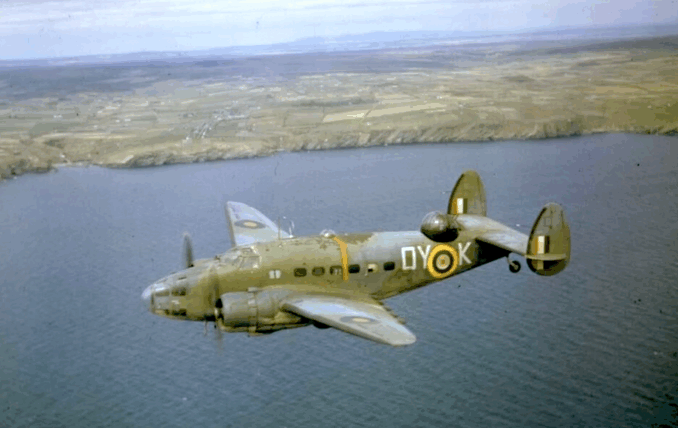
A Royal Air Force Lockheed Hudson Mark V,
No. 48 Squadron RAF – Public domain
So what of “AX682”? How did it end up wrecked in the desert, and when? On the back of the photograph is written in German “Engl. Transporter” or English Transport, so no clues from that…
I next turned to various internet sources to see if a history of AX682 existed anywhere. What I did find was the “Bureau of Aircraft Accidents Archives”, a Swiss website set up in 1990 to document and preserve “all information related to aviation accidentology.”
In their records they have that on the 8th of April 1941, Lockheed Hudson AX682 suffered an engine failure in flight en route to Tobruk and had to perform an emergency landing at El Salloum in Libya which is approximately 128 kilometres from Tobruk. On landing, the brakes failed and the undercarriage collapsed on the port side. All of the occupants were able to get out uninjured and the aircraft was then abandoned as damaged beyond repair.
In March 1941, the Deutsche Afrika Korps had defeated the British at El Agheila, Libya, causing the 3rd Armoured Brigade to start to retreat to Benghazi. On the 4th of April, the DAK captured Benghazi, on the 6th they captured Fort El Mechili and Derna and on the 10th they captured Bardia. On the 15th of April, the DAK captured El Salloum (now Sallum) before driving the British forces completely out of Libya and into Egypt by the 17th of June 1941, the high-water mark of the Deutsche Afrika Korps North African Campaign.
My photograph of AX682 must therefore have been taken by the DAK photographer soon after the 15th of April 1941, which solves this Desert Mystery.
© John Tull 2025


