
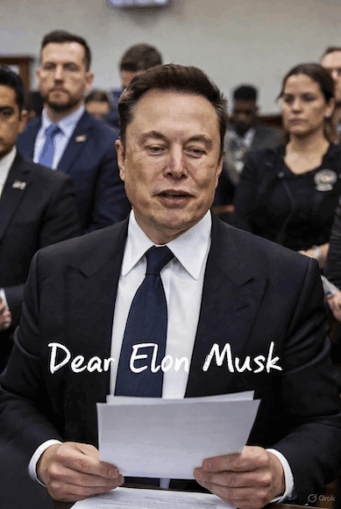
Image generated using GROK AI
Dear Mr Musk,
I hope this message finds you well. I am reaching out to you to ask …
Firstly, some background. Being the cleverest person in the world, Elon already understands all of this, but Puffins, including myself, may benefit from a primer.
A certain Mr Michael Prescott submitted a memo to the BBC in the summer while serving as one of their external advisors. It was not formally commissioned but written independently by Prescott in his position on the Corporation’s Editorial Guidelines & Standards Board. In the ensuing turmoil, the ex-Sunday Times journalist explained his 29-page document emerged from “despair at the inaction of the BBC Executive”. He prepared the memo to highlight what he viewed as systemic problems at the BBC.
These included biased editing of a speech by Donald Trump, skewed coverage of the Gaza conflict, and one-sided treatment of transgender and historical issues, suggesting the broadcaster systematically violated its impartiality rules. Leaked to The Daily Telegraph on the 3rd of this month, the newspaper put key details into the public domain. The Telegraph’s first article published the allegation that the BBC edited Trump in its flagship Panorama documentary programme. Different portions of his January 6, 2021, speech were spliced to make it appear he urged on that day’s Capitol riot.
Subsequent articles highlighted further claims in the memo, including:
- Biased coverage by the BBC’s Arabic service of the Israel-Hamas conflict
- One-sided treatment of transgender issues, with stories raising difficult questions being omitted
- Historical programming favouring non-experts for sound-bite comments on colonialism
- Ill-researched material about race, such as a false story about minorities paying more for car insurance.
These Telegraph pieces, particularly the Trump one, triggered a strong reaction resulting in fierce political and media pressure causing the resignation of Director-General Tim Davie and News Head Deborah Turness. Some BBC lifers and fellow travellers were critical of Prescott and questioned the motivations behind the leak. Others thought it whistle-blowing. Others still, an attempt at a right-wing coup d’état at the hands of Sir Robbie Gibb, a non-executive BBC Board member.
The most telling response came from Donald Trump, who accused the broadcaster of “defrauding the public” by mis-editing his January 6 address so he appeared to incite violence. The president went on to threaten legal action in a letter from his lawyers that demanded at least US $1 billion in damages, unless the Corporation retracted the edits and issued an apology. He publicly thanked the Daily Telegraph for revealing the internal memo and, via X, said the top executives of the BBC “were caught ‘doctoring’ my very good (PERFECT!) speech”. Trump characterised the BBC’s actions as a betrayal by a key ally interfering in a U.S. presidential election.
At the time of writing, Trump’s deadline remains hours away.
Besides the high-profile presidential chagrin, what of the countless legions of other people libelled, slandered, deceived, dropped and cancelled over the years by the Corporation? As an example, also at the DT, journalist Harriet Sergeant wrote an article titled I was cancelled by the BBC for telling the truth about homeless migrants.
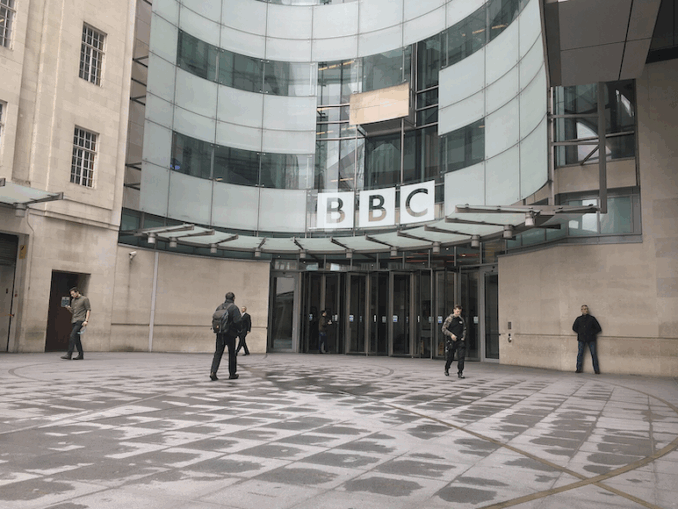
BBC Broadcasting House, Portland Place,
Bryn Homles – Licence CC BY-SA 2.0
According to Harriet, she heard she’d never work at the broadcaster again if she spoke about that issue. They were right. She never did. The issue was vulnerable British people not receiving hostel places as they had been allocated to immigrants. Her radio programme, A Waste of Space, found migrants made up around half of rough sleepers in London and one in three elsewhere. The rise in homelessness and the overwhelming of facilities was a direct result of the increase in immigration. It was also an example of how migration hits the poorest in society hardest. Harriet wanted these as crucial points to make in her broadcast.
Harriet explains, ‘The BBC producer who checked my script thought otherwise. I only wanted a sentence or two as background. But she warned that any criticism of immigration would harm my future relationship with the BBC. I was astonished. Not even when I researched my first book on apartheid in South Africa or my second, in China shortly after the Cultural Revolution, had anyone tried to censor me before. Yet here was the BBC, the BBC of all institutions, insisting I ignore a key fact.’
When pitching for a further programme, Radio Four rejected her and her editor’s presentation, complaining that Harriet was too right-wing. She concludes, ‘The BBC producer had warned me, “You will never work at the BBC again if you question immigration”. She was right. I never did.’
Which is where Elon comes in. Might he underwrite the legal cost of making claims for damages against the BBC?
Such a thing is not unheard of. The late Max Mosley, former president of Formula One’s FIA, played a key role as a litigant in the UK phone-hacking scandal. In 2008, News of the World published a story (and secretly filmed footage) claiming Mosley participated in a “Nazi-themed” sex party. Mosley successfully sued the paper for breach of privacy and won £60,000 in damages. During the wider News International phone-hacking scandal, Mosley not only became an outspoken critic of tabloid intrusion but put his money where his mouth was by funding legal actions.
Mosley pledged to underwrite the legal costs for people bringing civil claims against News International (the publisher of News of the World) for phone hacking and related privacy intrusions. Former Deputy Prime Minister John Prescott was later to state, ‘The only reason that I could take judicial review proceedings is because Max Mosley sponsored me.’ Mosley reportedly pledged around £3 million to Prescott and up to ten other claimants. If a claimant lost their case, he would cover their expenses. A significant undertaking in UK civil law as the losing side may be liable for costs.
Mosley also recruited a private investigator Glenn Mulcaire (late of News of the World) as a security consultant and encouraged him to share information about the hacking operations with journalist Nick Davies of The Guardian. Might we seek a benefactor to sort out the BBC through civil action in the courts? And might the obvious benefactor be Elon Musk?
It was Musk who, upon taking control of Twitter, not only changed the name to X but began labelling the BBC’s tweets as, ‘government-funded media’. Although following an objection from the BBC, this changed to ‘publicly funded media’, Musk remains steadfast over freedom of speech and Asian Muslim rape gangs this side of the Atlantic.
Could he be a Puffin? Only one way to find out!
Dear Mr Musk,
I hope this message finds you well. I am reaching out to ask whether you would consider underwriting the legal fees for individuals pursuing lawsuits against the BBC for the dissemination, and the consequences of the dissemination, of false information. Your support could help ensure future accountability and transparency in British media.
Thank you for your consideration.
Sincerely,
© Always Worth Saying 2025


