
There’s much talk these days about Artificial Intelligence—our supposed saviour or eventual enslaver. Most of us now realise that much of what’s labelled “AI” is really shorthand for Large Language Models (LLMs): systems capable of analysing and generating language at speeds that make our human minds look almost glacial.
But can they ever produce anything truly original when they’re trained on vast oceans of existing work? That’s a philosophical rabbit hole I’ll gladly sidestep. Instead, I want to share my own experience of AI—from a creative perspective. (Or not. You can decide.)
The Spark
A few months ago, I stumbled across a comment that I didn’t read online. The writer mentioned that Suno—an AI music platform—had done more in minutes with a small musical idea than they’d managed in years. I’m paraphrasing, but whoever wrote that (in the comment I definitely didn’t read) is indirectly responsible for my new obsession with AI-assisted music creation.
After a thirty-year hiatus, I recently picked up my guitar and bass again. To my surprise, my fingers found their way back to the same riffs and fragments of lyrics I’d toyed with in my youth. Those old sketches began to grow. With a few newer lines added, I had the makings of a small collection.
The Collaboration Begins
I uploaded one of my chord progressions and lyrics to Suno, specifying production styles rooted firmly in the 1980s and 90s. The result astonished me. It sounded close to how I’d always imagined it—like I’d finally managed to get a roomful of talented session musicians to bring an old dream to life.
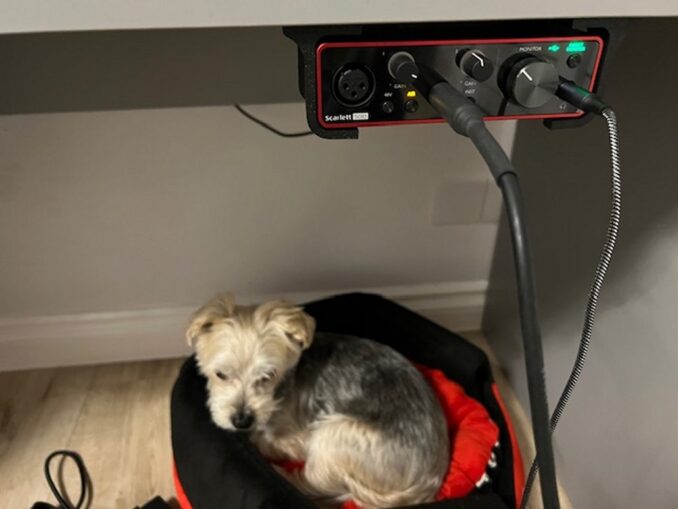
Curious to see how far this could go, I downloaded the stems—the separate audio tracks for each instrument—and imported them into Audacity, a free audio editing programme.
From there, I began experimenting. Using a Focusrite Scarlett Solo audio interface (along with my canine assistant) to connect my instruments to the computer.
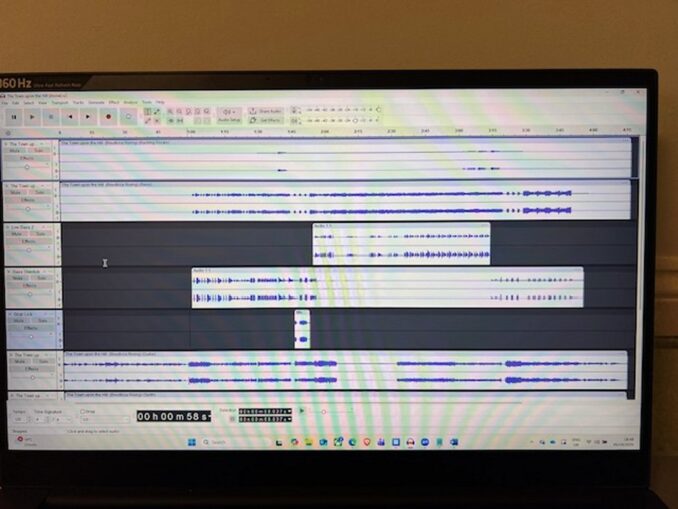
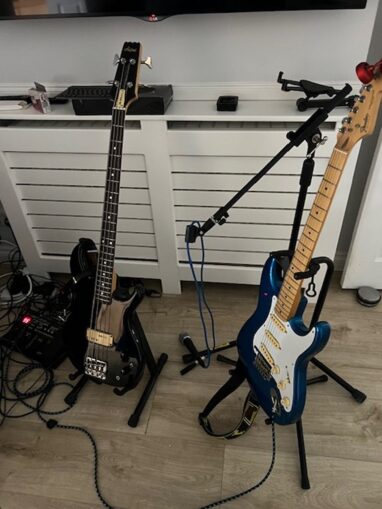
I replaced the bass with my own playing on an Aria Pro2, adding the kind of human simplicity (and imperfection) that comes from real strings and fingers that are still getting back up to speed after 30 years.
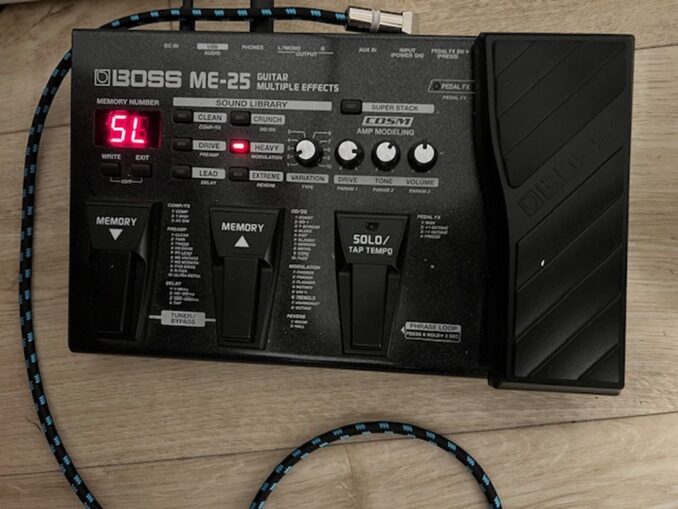
Then I layered my guitar parts using a Japanese Fender Strat, running through a Boss ME-25 effects pedal, sometimes replacing the AI’s contributions, sometimes weaving around them. My aim wasn’t to completely overwrite it, but to collaborate with it—a human-AI duet of sorts. The result was something I was genuinely pleased with.
That song became Hear My Name. It began decades ago as a few lines about returning home to find everything changed. It ended as something larger—an anthem of identity rediscovered and voice reclaimed.
Finding the Thread
From there, the project gathered momentum. I found inspiration in The Wanderer, the ancient Saxon poem. I asked ChatGPT to translate and reframe it—from Old English through to modern—and I then reimagined it as a contemporary song written in the third person. The result felt hauntingly relevant. A voice from our ancestors still resonating, even now. That piece became The One Who Walked Away.
Two songs quickly became four, each carrying its own reflection on loss, change, and resistance. Frustration found form—at unasked-for change, at the kind of politicians who escape consequence, at the quiet erosion of things once known. As the collection grew, I realised these weren’t just individual songs—they wanted to be something more cohesive. They were telling a single story: a journey from silence to storm, from submission to defiance.
Out of this came Boudicca Rising. The name and concept drew on the legendary queen of the Iceni—a woman betrayed by empire, rising in fury and defiance. Her story echoed what I was already exploring: betrayal, awakening, and the rediscovery of strength. This would be an album not of resignation but of remembrance.
The Album
The story begins in mourning. I imagined the album as a double act—two sides of a single awakening that moves from loss toward reclamation. Interestingly, the tracks get progressively heavier from a rock perspective as the album unfolds. Whether that was intentional, subconscious, or just my inner teenage metalhead finally breaking free after thirty years, I honestly couldn’t tell you. But it fits—the music mirrors the journey from quiet loss to full-throated defiance.
Side A: The Internal Journey
- The Old Ways — History gets rewritten, traditions fade, and a once-rooted people find themselves adrift. The album opens with the loss of what once grounded us—forgotten wisdom, abandoned values, the slow erasure of cultural memory.
- The One Who Walked Away — The Saxon wanderer reimagined, carrying the weight of exile and haunted by what’s been lost. Sometimes leaving is the only way to preserve what remains of yourself.
- The Town Upon the Hill — A warning about suicidal empathy, where kindness becomes compulsion. The need to please and appear virtuous strips away the self until nothing remains but conformity. Not all that glitters is gold; not all promises are kept.
- Wide Awake — The breaking point. Waking up after manipulation, realising that no matter how much you give or comply, it will never be enough. Whether this is about an abusive relationship or the bond between individual and state is left for the listener to decide. There’s no going back from here.
Side B: The Outward Storm
Yet awakening isn’t defeat.
- Hear My Name — The voice that was buried rises again. Identity reclaimed, the internal awakening finds its expression and refuses to be silenced.
- House of Smoke — The mask of deception stripped away, tearing away the illusions that sustain corruption. What’s left when the lies burn off?
- Blood Moon — The omen before the reckoning. Truth hardens into resolve under a crimson sky.
- Storm Rising — Resolution becomes action—not reckless vengeance, but the assertion of will, justice, and survival. The storm itself, not as rage, but as clarity and purpose.
The album doesn’t end in peace—it ends with purpose. The storm isn’t destruction; it’s renewal. The future remains unwritten, but this time, it’s ours to write.
Reflections on AI and Creativity
I find the future of AI both exhilarating and unnerving. It’s terrifying because it breaks down old barriers—the ones that kept creative production in the hands of the few. And it’s exciting because it puts power back where it belongs: with the individual.
Could this album be better produced? Absolutely. Am I a great musician? Not even close. But that’s rather the point. Think about what this project would have required even a decade ago. Studio time at £50-100 per hour, minimum. Session musicians—bass, drums, lead guitar, maybe keys—another few hundred pounds per day. A competent producer. Mixing and mastering. We’re easily looking at £5,000-10,000 for something like this, and that’s being conservative. For most people with a creative vision but no record deal, that barrier was insurmountable. Now? A subscription service and some audio editing software.
What mattered to me wasn’t perfection—it was finally being able to express something that had been locked inside for thirty years. This project became a form of cathartic release, a way to work through ideas and emotions that needed an outlet. The themes are there for those who want to dig deeper, but I wasn’t trying to create a lecture. Each track needed to stand on its own, to work as a song first and foremost.
It’s no wonder the current gatekeepers are nervous.
On a personal level, AI has made me a better musician—or at least pushed me to try harder. Competing with its precision encouraged me to improve my playing, even if my aging fingers still ache after a take. It also pushed me to learn new tools: from audio editing to AI-assisted artwork (the album covers were created using AI and Paint.NET). Most importantly, it gave me the means to turn decades-old fragments into something tangible, something I could finally share.
For those who read my other article, “A Bridge Too Far?”, listen carefully at 3:41 in Storm Rising. That’s where you’ll hear the modded guitar cutting through.
You can find Boudicca Rising on Spotify under the artist name “Boudicca Rising”.
© WayneeWeedee 2025