SAKON NAKHON – สกลนคร
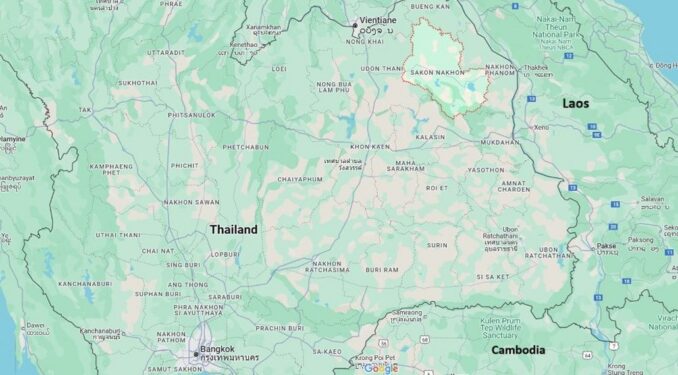
A one-hour flight from Bangkok saw us arrive at Udon Thani airport in the North East of Thailand.
Mrs ABS’ stepmum, Nin, (NHRN) was waiting for us along with her son, Ning, (NHRN either) who had driven the 120 or so miles from their home to meet us.
As with every flight we took, we had to wait for the wheelchair to be bought to the aircraft exit door so we were the last ones to clear the plane. Of course, this meant they had been waiting somewhat anxiously for us to appear, having seen just nearly every other passenger leave.
It is customary in Thailand when meeting anyone (or just to politely say ‘thank you’) to do so with the ‘Wai’ – this is done by placing the hands together – similar to that in prayer but usually with the fingertips pointing slightly more outwards, not straight up towards the chin) – positioning the hands central to the chest and then bowing the head.
The higher up the chest the hands are placed together and the deeper the bow, the greater the respect is shown.
Up until now, most of the Wai we had seen had been a short (hands clasped and short nod) polite ‘thank you’ version (it is also customary to return the Wai, something we rather enjoyed doing – ‘when in Rome’ etc.)
Having cleared customs, we entered the exit hall and met up with (a relieved!) Nin and the first-time meeting for Mrs ABS with her step-brother, Ning.
He stepped away from his mother and walked up to us, came almost to attention in front of Mrs ABS and proceeded with the deepest Wai we encountered on our holiday. His thumbs were touching his chin and he bowed almost from his waist. It was quite an ‘oh wow’ moment and Mrs ABS was really flattered. It took her a second or two, but she remembered to respond..
Then it was my turn, but as I’m not really family, his Wai to me wasn’t as deep. J
Formalities over, we went out to Ning’s car – it was a pick-up, a quite common means of transport in this much more rural region. Being a pick-up, the suspension was, well, a bit ‘firm’ and given that the roads were … ‘interesting’ (by comparison the Bangkok roads were billiard tables), the three hours it took us to get to Mrs ABS’ dad’s home left us a bit shaken and stirred.
Da-da-dang, da…. (Stop it! – Ed.)
The journey was broken when we made a short stop along the way at a roadside café for something to eat.

My first foray into eating Thai noodle soup – the picture really doesn’t do it justice – it smelt gorgeous, the pork was tender and it was really tasty with just the right level of spices.
It was fun eating noodles with chopsticks, too.
(a spoon was provided for the soup in case you’re wondering)
Pork, noodles with pork balls – the Thais do like their pork..
Fed and watered, we climbed back into Ning’s pick-up and bounced our way onwards to the village where we were going to be staying for the next 10 nights.
Near to the village we passed a small Thai Buddhist school that had been closed down by the authorities. Thai monks are supposed to be celibate, and it turned out that the ones who ran the school.. well, let’s just say they weren’t.
And they got found out.

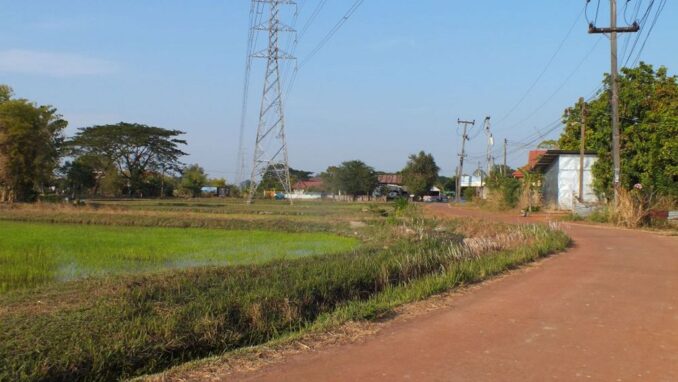
Just past the school, we turned onto a dusty dirt road that led between paddy fields and on to the village where Mrs ABS’s dad was waiting
Given that this article is about Thailand, and that those who travel there don’t usually go to visit long lost relatives, I’ll skip over the family bits…
Suffice to say, there was lots of hugging and some damp eyes.
We then spent most of the next 10 days with Mrs ABS’s dad, catching up on the missing years, having him reminisce to me over his past life (RAF, BAE in Saudi) and just enjoying the warm January sunshine.
There were some day trips though:
7th January
SAKON NAKHON CITY เทศบาลนครสกลนคร
Nin’s daughter Noy (NHRN) was the family designated driver (Nin didn’t drive and my FiL had given up a few years earlier due to immobility and ill-health) and she offered to take us into Sakon Nakhon in the family Jazz for an afternoon.
I should mention here that all the Thai family used nicknames – Nin and her children: Ning, Noy & Noye (a bit of a theme there, you’ll notice) – their real names were unpronounceable!
Over 90% of the Thai people are Buddhist, there are temples everywhere and so one doesn’t have to travel far to find one. The city of Sakon Nakhon is no exception and as the regional capital, it has a rather grand central temple.
It just so happened that there was a music and dance festival being held at the temple later that evening and some ladies, wearing the costume of the Phu Thai people of the Sakon Nakhon region, were wandering around during preparations.
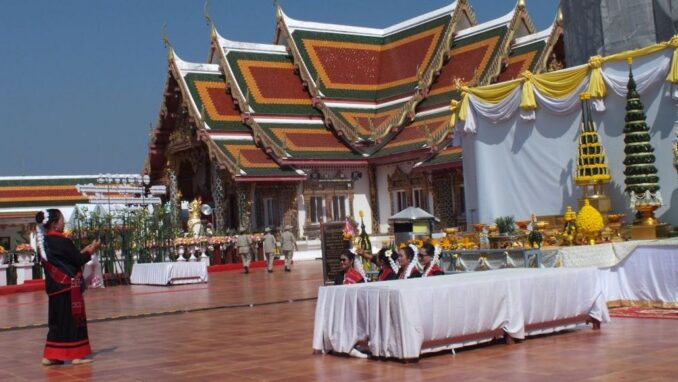
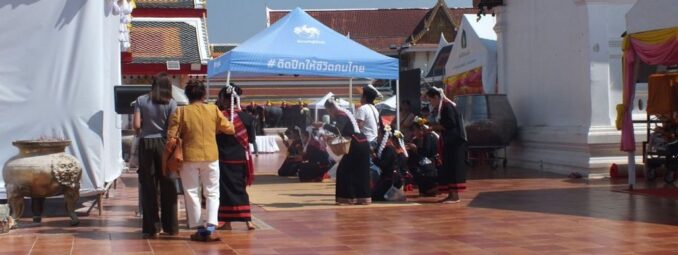
“Would you like to come back later and see the festival with all the dancing?” asked Noy
“Ooo”, said Mrs ABS “Yes please!”
So, we went home and returned a few hours later.
The number of costumed ladies had in the meantime grown … slightly.

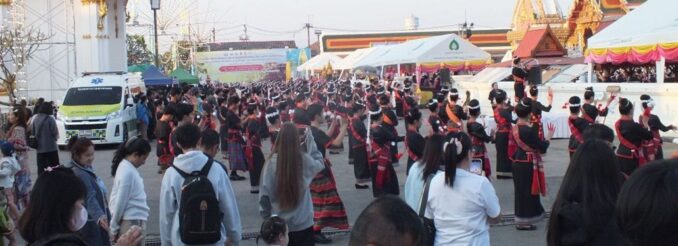
This was one side of the outer concourse of the temple:
This was another:
When we arrived, an incantation was already underway and it didn’t stop for another 25 minutes or so.
The dancing was all rather sedate, with just delicate hand/finger movements and light shuffling of the feet; there were raised plinths dotted around the walls where individuals were stood leading the moves – it was all very graceful and a pleasure to watch, it was also done in silence – there was no stamping of feet, or hand clapping although the music did go on a bit…
It wasn’t jarring but it was a bit naff and ‘plain’, but.. this is Thailand.
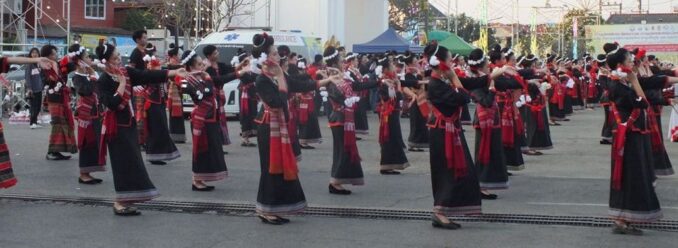
Many of the dancers were wearing finger decorations – I not sure of the significance, but for the 2nd incantation they performed to, they were removed.
This individual stood out a bit:
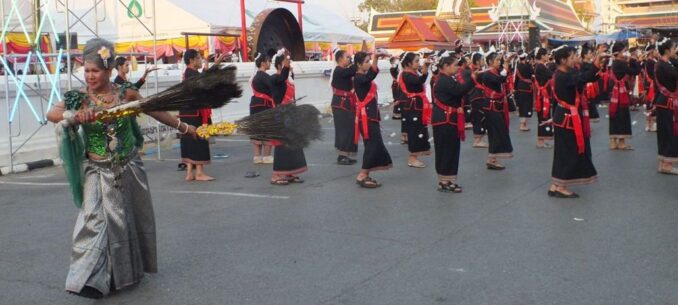
Mrs ABS: “Noy, what is the significance of that lady in green?”
Noy: [slight cough] “That’s not a lady”
“Oh.”
It was at this point that we realised that, in fact there were quite a few ‘not ladies’ in among all those dancing.
Hmm.
We then decided to move into the inner compound, so Noy & Mrs ABS wandered on ahead while I slid along behind them with my back to the temple wall keeping a very close eye on proceedings…
This was just one corner of the inside of the compound:

I noticed that these ladies [well, I presumed they were all ladies!] were generally more, shall we say, mature than the ones outside.
I asked Noy if there was any significance to this, but she didn’t know, thinking it was perhaps just seniority.
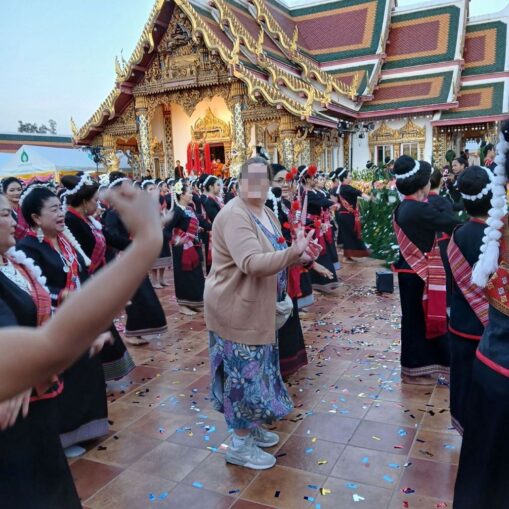
Even in this part of the world, the evenings could get quite chilly (well it was January…) so Mrs ABS had taken a cardi with her. Even though it was still around 25oC at the time of this photo, she had put it on as earlier while stood around outside the compound, she had had her upper arms stroked a few times by passers-by.
She had assumed it was because her upper arms were bare and perhaps the contact was a hint to cover them up, being around a temple and all that, so on went her cardi and as a result she was roasting!
Noy thought that the contact was more likely locals wanting good luck.
There weren’t many Western looking people around; as Sakon Nakhon is not exactly a tourist hot-spot, we were a bit of a novelty. We even had one chap ask us if he could have his picture taken with us both…
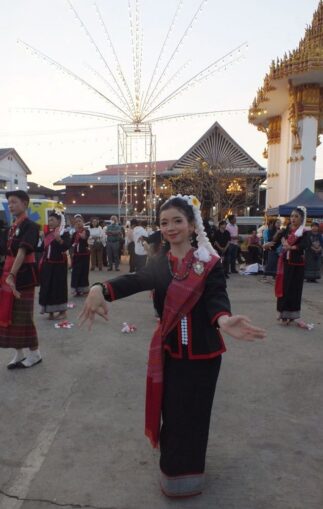
It was all very relaxed and informal and no-one seemed to object to spectators wandering around even while the dancing was ongoing; taking pictures with them and so on. I found that a bit uncomfortable (plus I have clown feet so I was a bit reluctant!) But once the official dance routines had finished and there was now a sort of ‘farewell’ for everyone and the crowd had thinned, I couldn’t resist taking at least one picture up close as we were leaving.
I took the picture, gave the lass a customary ‘thank you’ Wai. She smiled ever-so sweetly and then I scurried off after the Mrs in case she noticed my interest in … umm… the Phu Thai costume.
Yes, that was it.
We finished the day in side street café (known to Noy, so it was safe to eat there!) with the inevitable bowl of spicy pork noodles and then made our way back home.
9th January
Wat Tham Pha Daen วัดถ้ำผาแด่น
Most of the temples we’d seen or visited up until now had been rather elaborate buildings but all either centrally placed or with easy [roadside] access to Buddha.
Noy and her cousin offered to take us to ‘the temple to visit in Sakon Nakhon’ – pronounced ‘tam-far-dain’ – it was about an hour away, up in hills to the south.
Pull up into a car park and – for 20 Baht (quite a lot here was 20B) – a shuttle bus would take you just over a mile up the hill to the temple grounds.
With no usual central pagoda-like structure on the site, I felt it was the least ‘religious’ place we visited; spiritual certainly, but almost a working art museum.
It was however by far the most spectacular we saw during our visit.
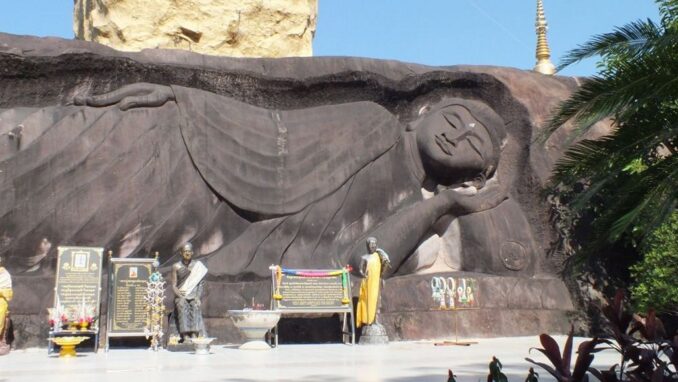
It wasn’t so much built on a hill as built out of it with some huge rock carvings of statues.
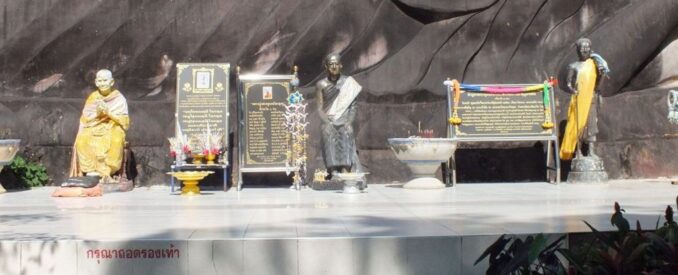
I was told these (you weren’t allowed to get too close) are life-size stone carved statues; impressive enough until you realise what the back drop is:
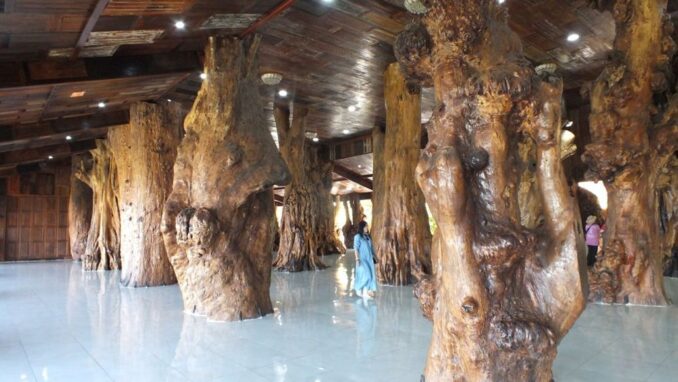
There were a couple of open-sided pavilions, with tiled floors and wooden ceilings. The pillars were ancient tree trunks.
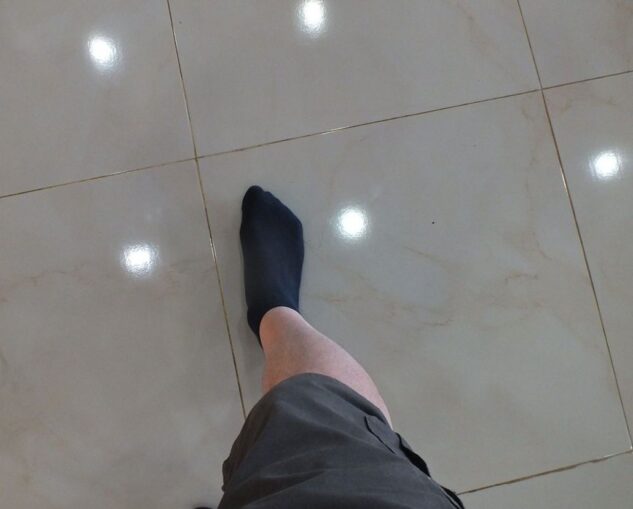
No shoes allowed!
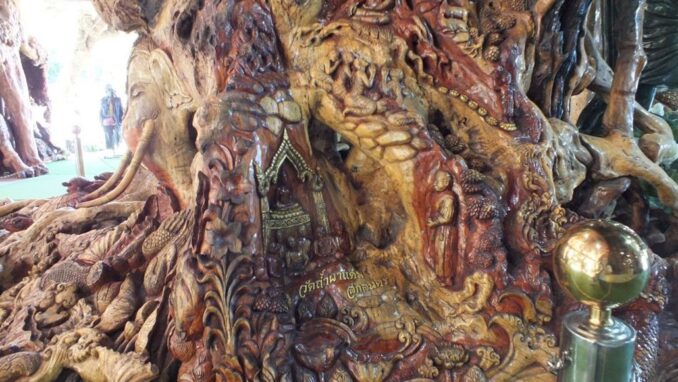
There was some stunning detailed and intricate carving on a couple of the pillars
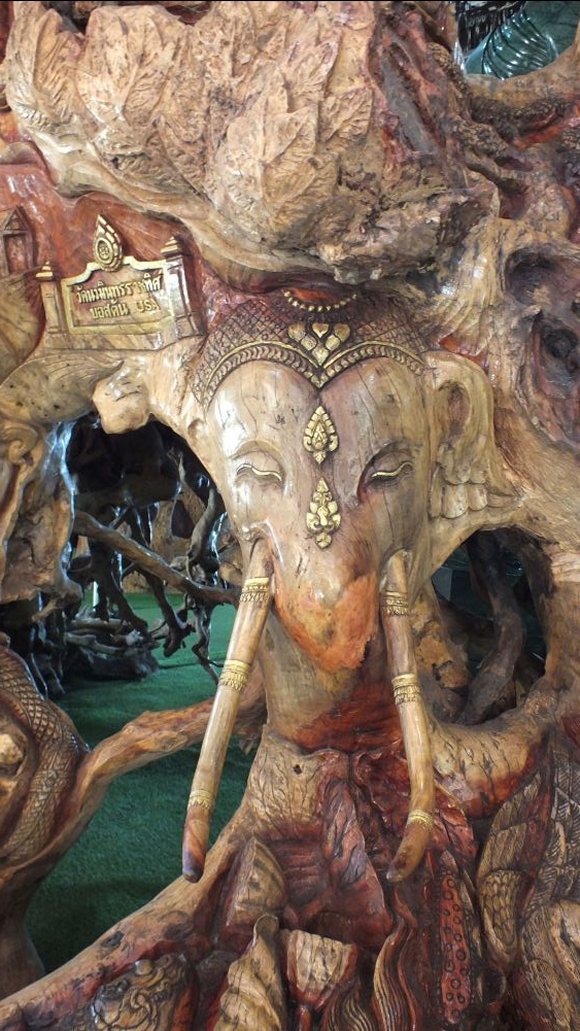

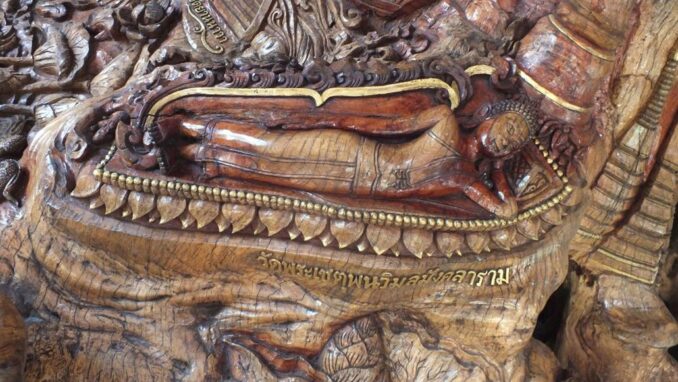
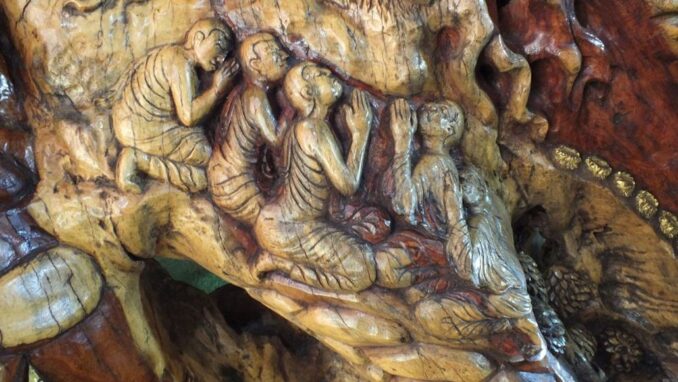
Both pavilions contained a speaker system through which was constantly played some soft flute-style music which added to the laid-back feelings of the surroundings.
As the site was on a hill, there were also a couple of small waterfalls, so those parts of the grounds had this lovely crackling soft hiss of rushing water as a backdrop – although the heavy foliage kept the waterfalls largely unseen, which was a bit of a shame.
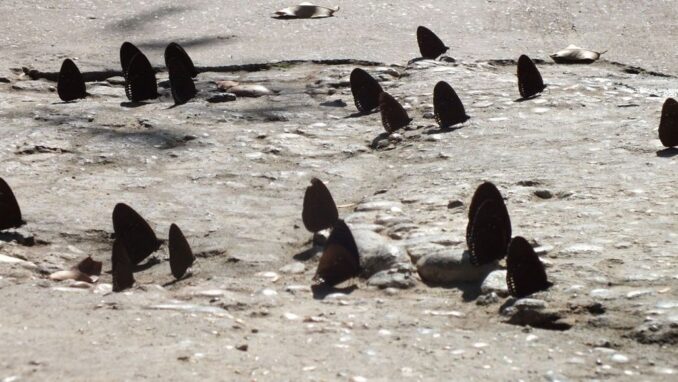
One particular path had a large number of these black-winged butterflies (a little larger than our Peacock butterflies), warming themselves in the sunshine. Walking through them got them swarming around you; purely on the off-chance, I stood still and held out my hand, and one of them landed on it – only a touch-and-go so no time to grab a picture, but it was bit a of a cool moment and at least I wasn’t standing there looking a complete prat.
With the site being on a hill there was a fair bit of step-work to the various terraces and this proved a little too much for Mrs ABS, so we didn’t reach the upper elevations, although it didn’t matter as there was plenty to look at and from the elevation we were on the view was still impressive.
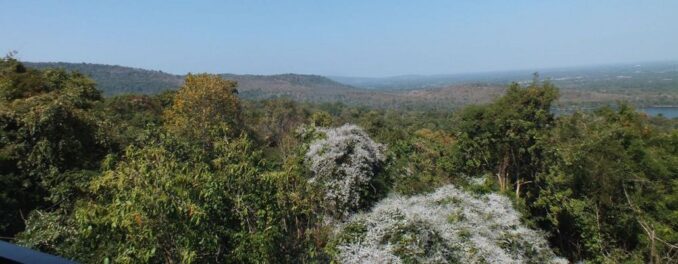
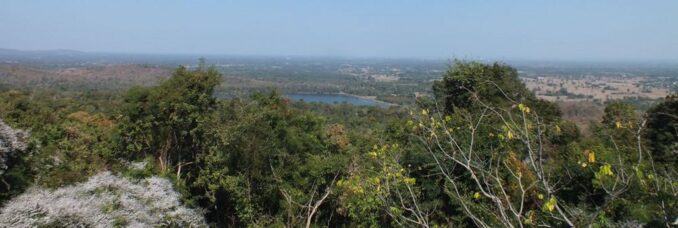
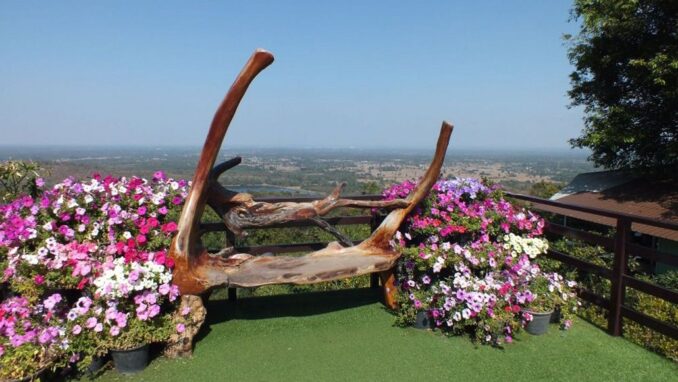
On this elevation there was a café, so one didn’t go thirsty and there were plenty of seats. There was lots of seating on the terrace if you wanted to enjoy the gorgeous sunshine (and the wonderful aroma from the flowers).
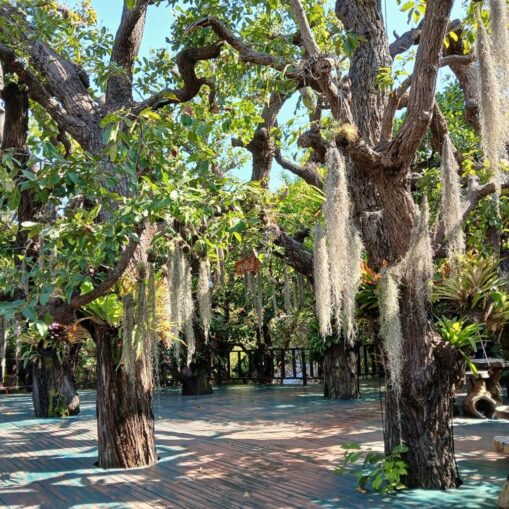
Or, if the sun wasn’t your thing, there were some shady areas as well
The centre piece of the temple is a jaw-dropping very colourful 60ft tall statue of Buddha depicted being protected by a seven headed forest serpent called a ‘Naga’
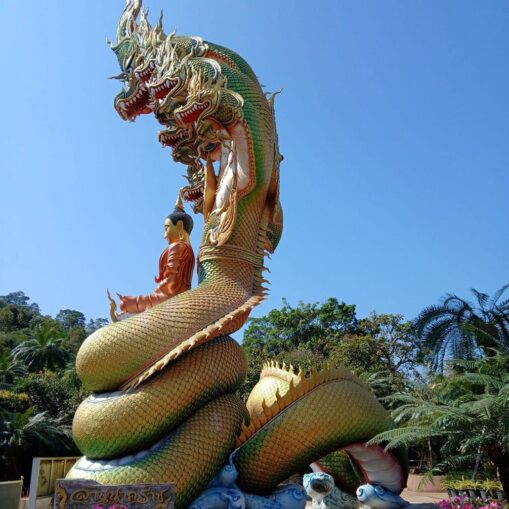
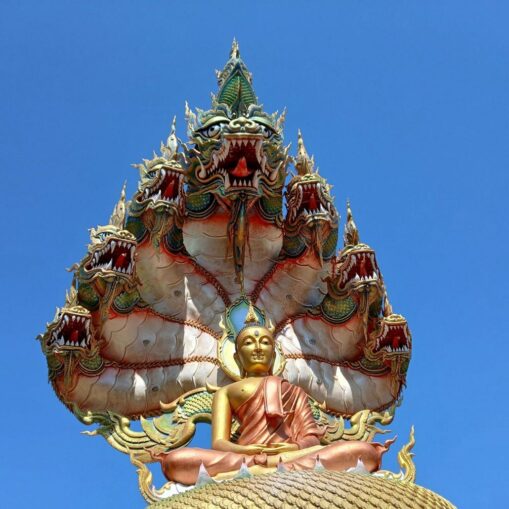
Thai legend has it that the monks who established the forest tradition in Thai Buddhism were protected by Nagas from the forests. During his enlightenment, Buddha was threatened by a violent storm and a seven-headed naga rose out of the forest to protect him from the elements.
The Naga Statue, being as it represents a significant moment in the life of Buddha, is common in Thailand, although this was the first we had seen.
The statue was overall ~135ft in length with the tail of the Naga coiling around its base before tapering off towards some trees. It was very impressive.
The visit over, we were driven our way back down the hillside and made our way home. During the journey Noy and her cousin tried to teach us some Thai language.
Which was fun.
The usual form of ‘Thank you’ is ‘khop khun’; for a more polite/grateful way to say this, you can add a gender-specific ending. For women this will end in either ‘ka/kra’ or, if you’re male it ends in ‘krap’.
Yep.
The wife and I started laughing at this; they didn’t understand why.
So, we told them what ‘krap’ meant in English.
They found that rather amusing…
© Afghanistan Banana Stand 2025