
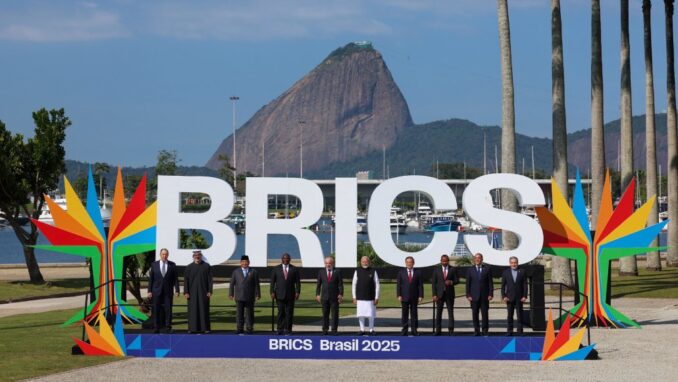
There is much gnashing of teeth and pulling of hair by just about every leader in the West, especially by an almost apoplectic President Trump, over a so-called “sinister threat” by the BRICS nations to form a new world trade settlement mechanism that bypasses the almighty dollar. President Trump may invoke sanctions and asset confiscations similar to those invoked against Russia, the “R” in “BRICS”, in addition to his current favorite weapon, the tariff . Apparently President Trump equates the possibility of the BRICS nations forming a competing settlement system that bypasses the dollar to be close to a declaration of war. But it is not sinister. It is not a threat. And it definitely is not war. In fact, it may lead to a more stable, prosperous, and peaceful world.
Abandoning the Gold Standard
Toward the end of World War II the Allies met in Bretton Woods, New Hampshire to establish a new world monetary system. At the time the US was the world’s leading creditor nation with a predominance of the world’s central bank gold reserves. The Allies settled on a semi-gold settlement system in which central banks could redeem dollars for gold at thirty-five dollars an ounce. Thusly, instead of periodically shipping physical gold from country to country to settle international trade accounts, countries could transfer dollars, mostly via bank transfers. Since dollars were “good as gold”, this was safer and more efficient. But the weakness, identified by Henry Hazlitt, reporting on the conference for the New York Times, was the complete reliance on the US not to expand its monetary base beyond the point that every dollar could be redeemed in gold at the thirty-five dollar per ounce promise. Almost before the ink was dry the US was printing dollars. Roughly two decades later Lyndon Johnson’s “Guns and Butter” war and welfare spending led to an excessive build-up of dollars in foreign central banks that triggered a run on the US Treasury’s gold reserves. In 1971 Richard Nixon closed the gold window “temporarily”. That stopped the US gold drain, of course, but removed the last real brake on the expansion of fiat money printing and increasing loss of the dollar’s purchasing power.
(According to the Federal Reserve Bank of St. Louis, the US monetary base has expanded from $84 billion in 1971 to $5.648 trillion in 2025. Over the same time period the US national debt has expanded from $424 billion to over $36 trillion. The purchasing power of the dollar is not easily measured, but the price of gold—real money—has gone from $35 per ounce in 1971 to $3,371, an increase of almost one hundred times.)
It is certain that dollar expansion will continue, possibly at an ever increasing rate with the concomitant loss in its purchasing power. Combine this will the power that the US possesses to “discipline” any nation that bristles at US hegemony by cutting it out of the SWIFT messaging system for settling trade accounts with dollars or by freezing or outright seizing dollar assets held in Western banks and you have the basis for an international financial revolt.
It is clear now that the BRICS will establish a competing international trade settlement system to complete with or completely bypass the dollar. This is nothing more than rational self-interest on the part of the BRICS nations. For a long time now, the US has floated the claim that China wished to supplant the dollar with its own currency, the Yuan. This was part and parcel of the claim, perceived or real, that China wants to challenge US hegemony in order, perhaps, to defeat the US militarily. Even if it is true that this is China’s aim, it appears now that BRICS will not be the tool.
Gold Settlement, Not Yuan
As reported by esteemed monetary analyst Alasdair Macleod, China plans to establish gold vaults/banks outside its borders into which BRICS nations can deposit gold. Their only purpose can be to settle international trade accounts in gold and not Yuan or some basket of national currencies. Such a system would leave national currencies under the control of their home institutions, which has great appeal to proud, sovereign states which do not wish to jump out of the dollar frying pan and into a Yuan fire. In simple terms, each country would be responsible for sending enough gold to one or more gold vaults/banks to pay for anticipated net settlements, much like the way that banks settle transfers internally through their central banks using national currencies. Countries that run persistent negative settlements, meaning they owe more gold than they are paid, would be required to send more gold to one of the gold vaults/banks. This has a built-in discipline that does not require coercion by anyone. Furthermore, it is honest. No creditor nation need be concerned that its reserves held in any one or many foreign currencies might suffer loss of purchasing power, as is the case with the dollar.
A Return to the Gold Standard
I predict that this system will work and that more and more nations will join BRICS. Dare I say that under more enlightened and less xenophobic leadership even the US itself might join eventually? Joining would be beneficial for the American people, because the underlying monetary discipline is provided by the need to hold gold. That discipline would filter down to strengthening the dollar, meaning an end to monetary inflation and steady loss of dollar purchasing power. The world would be back on a gold standard with a better chance of peace and prosperity through trade. To turn Bastiat’s dictum around somewhat, goods would cross borders and not armies and bombs.
© Patrick Barron 2025 Website


.jpg)