
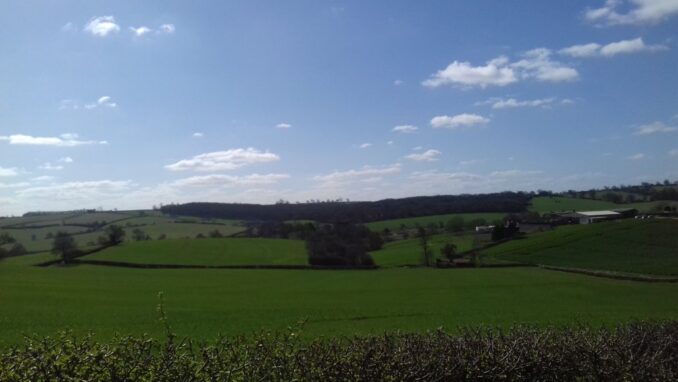
Once again, on a thread of comments that nobody reads, Beri Cicikov Ital mentioned “the English Clearances” of the 18th century. Polar Opposite asked what they were. I said I assumed that they were the Inclosure Acts (also known as the Enclosure Acts) and Polar asked me to explain them. When I replied that it would take a very boring header, he suggested that I write it. Oddly enough, I have had to deal with them on a few occasions during the course of my professional career so prepare to be bored.
To understand them, initially one has to understand the laws, customs and practices of rural England from 1066 until more or less the end of the age of the Stuarts. 1066 was Year Zero. William the Conqueror held all of England by right of conquest and parcelled out vast estates to his followers on the basis of personal loyalty and a requirement to furnish money and armed men when required. In turn each aristocrat inherited one or more manors which would consist of his own castle, cultivated the best land which he would let out to his tenants in chief (usually keeping one close to the castle for produce for his own consumption which was generally known as Home Farm- you’ll find one so named near almost every stately home) and the waste land of the manor (which was usually of poor condition) in which his serfs would be allowed to graze livestock, giving a goodly proportion to their Lord but keeping the remainder for themselves. They would also have various other manorial rights over it such as gathering wood for the fire, stone for the house, fish from the millpond and rushes for the thatch of the roof. Their Lord would grant them land for a house and a small personal plot to grow root vegetables and keep a couple of pigs for themselves. The system of indentured serfdom collapsed with the population after the Black Death but the agricultural system and legal tenures long survived it. English prosperity was built on wool. To this day the Lord Chancellor sits on the Woolsack in tribute. The towns of eastern England served the sheep farms which grazed the marshy, common wastes in the summer and the fallow drier fields in the winter. It was the source of the wealth of towns such as Lavenham which is in an area few would now associate with sheep farming.
Agricultural practices improved gradually but accelerated in the 17th century when Dutch engineers were engaged to drain the Fens and gradually more and more marshland in the east of England was converted from poor grazing land to first class arable land. Production and profits soared. Elsewhere, major landowners looked at their own holdings and wondered how they could be squeezed to make more money. The answer was to enclose the ancient commons and use the new methods vastly to improve the land and the profits arising from ownership. Sadly, a long way down the list of priorities were the plight of the bottom of the rung who already struggled to make a living from exercising their ancient rights of common over the manorial wastes. They were unlikely to agree. They had neither vote nor voice. The landowners sat in the House of Lords. The merchant classes sent Representatives to the House of Commons still based on Simon de Monfort’s formula of two knights from every Shire and two burgesses from the Boroughs within them which had been set four centuries earlier. They had the power and would use it.
Between 1604 and 1914, over 5,200 local and general acts of Parliament were passed to convert common land into private holdings but the Act most recognised was the Inclosure Act 1773 (also known as the Enclosure Act 1773) . It appeared at first glance to set out a fair system. A petition by landowners, tithe holders and a majority of those with rights was required followed by Parliamentary review. In practice this was undertaken in secrecy to such an extent that the Act had to be amended so that Notice of proceedings had to be nailed to the doors of the local Parish Church. The rights of the poorer commoners were bought out with derisory compensation and the land and rights that they were left with , insufficient to live on. It was the dawn of the Industrial Revolution so they migrated to the towns allowing the local magnates to acquire their holdings at knock down values. The Enclosure awards usually reserved the mineral and quarrying rights to the Lord so that any within a coalfield provided riches for generations to come. Thus was the English countryside cleared of its people through forced economic migration, leaving a set of poor agricultural workers to farm the lands in conditions immortalised by the novels of Thomas Hardy. Those that left became the colliers and steelworkers of the new towns forming around coal or ironstone deposits. Although they too endured terrible lives, they were more prosperous than those left behind.
The Acts worked in a different way in the upward areas such as Wales, the Pennines, Cumbria and the high ground in the South west such as Dartmoor or Exmoor. Here they targeted upland moorland and , rather than converting land to arable or rotational farming, aimed to make cattle and sheep farming more efficient by ending communal overgrazing and fragmentation. Again, it drove people from the land but not to the extent of the lowlands so that there was not the same level of clearance as the populations were more sparse in the first place.
In all, it is thought that 6.8 million acres, just over one fifth of the area of England and Wales, became enclosed under the Acts, leaving just the remaining commons to this day. Marxist academics such as EP Thompson described the Acts as the central driver of class formation, legal power and dispossession to give rise to modern Britain. I think that is an overstatement but there is a kernel of truth. The riches kept the old families of Norman origin in wealth for generations still to this day.
© Bergen 2026