
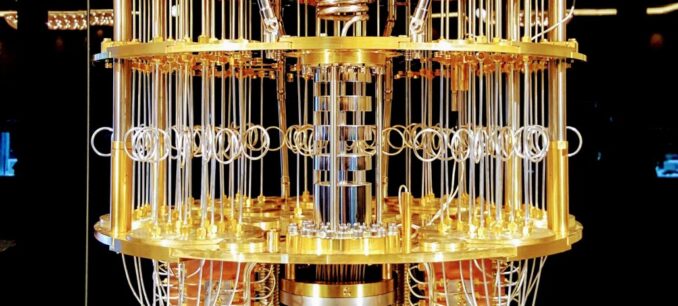
By Lars Ploughman CC BY-SA 2.0
At the moment whenever the media want a “tech” story to fill some space or try to panic people artificial intelligence is the “go-to” topic. Every now and then though they head in the direction of quantum computing so I thought it was about time to try to cover this fairly tricky topic (which I knew only a bit about before deciding to write this). I’m approaching this topic as someone who is not a physicist and who has had a career in what I assume will soon be called “classical” IT.
Let’s start by getting one thing clear – discussing any topic with the word “quantum” in it is going to either start off making sense and then fall apart (e.g. the Bond “Quantum of Solace” film), start off making no sense and then make a bit more sense (e.g. the Quantum Jump song “Lone Ranger”) or just be unfathomable gibberish all the way through (I’m looking at you “Ant-Man and the Wasp: Quantumania”).
Having said that let’s buckle up folks, we’re going quantum.
What’s a “quantum”?
The term “quantum” doesn’t refer to anything that is physically in a quantum computer. It means that the computer uses the physics of quantum mechanics in order to do its thing. The first rule of quantum physics is that anyone who says that they understand quantum physics doesn’t.
The idea that everything is made up of tiny building blocks goes back to 430 BC, when it was postulated by a couple of Greek philosophers. They proposed that all matter was made of indivisible particles called “atomos” (“atomos” meaning “indivisible” or “uncuttable” in ancient Greek).
The English chemist, physicist and meterologist John Dalton set out the first scientific theory to support and explain the existence of atoms, backed with evidence from multiple experiments, in 1803.
The Scottish botanist Robert Brown observed what is now called “Brownian motion” – watching particles colliding with each other in 1827. This can be observed in a very simple experiment which I remember doing at school (later than 1827 to be clear).
In 1897 English scientist J.J. Thompson discovered the electron, proving that atoms were not, in fact indivisible but were instead made up of even smaller particles. The first domino had toppled …
We finally get a non-British contributor in 1911 when New Zealander Ernest Rutherford identified that atoms have a nucleus which the electrons orbit around (prior to this it was commonly thought that the atom was like a plum pudding, with the electrons just mixed in with the rest of the atom). In 1919 Rutherford became the first person to split an atom, splitting lithium into two helium atoms. At least he had the decency to do this at Manchester University as he spent the last years of his life in the UK, being buried in Westminster Abbey close to Sir Isaac Newton.
The scientific consensus (remember folks – the science was settled) was that the atom was made up of three particles – the electron, the proton (which Rutherford also discovered in 1919) and the neutron (which, although theorised, wasn’t actually discovered until 1932 (by James Chadwick – yet another Brit)).
Just as the neutron was proven to exist the whole idea of the three particle atom fell apart as the positron (basically an electron but with the opposite charge) was discovered. As we got better at smashing atoms apart we kept finding smaller and smaller sub-atomic particles, the most famous recently being the proof of the existence of the Higgs Boson at the Large Hadron Collider.
As knowledge of the physical world expanded physicists and mathematicians had their work cut out to keep up with theories which could explain how all of these tiny things hung together. In crude terms, “classical” physics works really well in the vast majority of cases but doesn’t work so well at a very small (way down below atoms) scale.
Physics at the teeny tiny scale had to break some of the rules of classical physics. This is where it starts to get a bit weird. In the world of quantum mechanics (and possibly in increasing order of weirdness):
- You can’t change things continuously. In classical physics things like energy and momentum can be changed by any amount you can think of, no matter how small. In quantum mechanics things can only have specific discrete values (e.g. the electron energy levels in an atom)
- You can’t know for sure what will happen next. In classical physics you can take anything and accurately predict its future state if you know everything that is going to be done to it (as a simple example, water is going to boil at 100 degrees Celsius if enough heat is applied). In quantum mechanics you can only state the probability that something will happen to an individual particle
- In quantum mechanics the famous “Uncertainty Principle” applies – there is a limit to how precisely certain pairs of physical properties (like position and momentum) can be known simultaneously. The act of observing one property alters the other
- Particles aren’t physical things all of the time. They behave both like a physical thing but also as a wave (Einstein proposed that light, which we think of as a wave, was made up of particles called “photons” and simple experiments show that light exhibits both wave- and particle-like properties)
- Things exist in every possible state at the same time and only become one or the other once observed. This is known as “superposition”. The “Schrodinger’s cat” explanation is that a cat in a box is both alive and dead until it is observed – hence the joke where a policeman pulls Schrodinger over to search his car then says to him “Sir, do you know there is a dead cat in your boot” to which Schrodinger replies “Well there is now”.
- Particles can be “entangled”. You can separate two particles by any distance you want to and on changing something about one particle and measuring it you will get a result which will be the same result when you measure the other particle. Both particles establish the same state simultaneously but no information is passed from the first one to the second one. Basically the two particles start off with both having all possible correlated outcomes and measuring one of them instantly defines the state of the other
How can this quantum stuff be of any use in a computer?
Here’s where the fun begins. In a classical computer everything is built from “bits” (binary digits) where transistors act like tiny switches which are either off or on to make a bit have the value of 0 or 1.
Thanks to the property of superposition “qubits” (quantum bits) can have the value 0, 1 or both at the same time.
This is important, as a classical computer with n bits can only represent one specific number out of 2ⁿ possibilities at once whereas a quantum computer with n qubits can represent all 2ⁿ possibilities simultaneously. This allows quantum computers to explore huge solution spaces in ways that are impossible (or extremely slow) for classical computers.
The strange properties of quantum computers are both a curse and a blessing. Classical computers do one thing at a time and give the same answer every time. Quantum computers work on probabilities and can explore many different routes to an answer at the same time. This means that they throw up errors a lot so they are fragile and tricky to program. The same question often has to be asked multiple times and the statistics of the different outcomes need to be analysed.
The two types of computing can be summarised as follows:
| Aspect | Classical Computers | Quantum Computers |
| State | Definite (0 or 1) | Superposition (0 and 1 probabilities) |
| Scaling | Exponential growth in possibilities is hard | Naturally handles exponential spaces |
| Best at | Everyday tasks, precise control, sequential logic | Certain optimization, simulation, factoring, search |
| Error rates | Extremely low (can correct easily) | Very high (decoherence, noise) — hard to correct |
In case you were wondering (I was), even programming a quantum computer is tricky. Users tell a quantum computer what to do by writing programs on a classical computer that are then compiled and sent to the quantum processing unit (QPU) as a series of control signals, such as shaped microwave or laser pulses.
When a qubit is measured it loses its quantum properties and “snaps” into either a 1 or a 0 (this is called “quantum decoherence”. The system then reads the results and the controlling computer converts these into something meaningful. In this sense the quantum computer part of the system is like a graphics card in a PC – it does useful work under the control of the CPU.
This is one of the problems with quantum computing as something random in the environment (like a bit of solar radiation) can cause a qubit to collapse, hence quantum computers being error-prone. One of the main research focus areas is to reduce or even eliminate these errors.
Given the drawbacks, why is anyone bothering with quantum computers?
We are very much in the early days of building quantum computers. They are currently very limited in their size (the largest ones have fewer than 5,000 qubits whereas the largest classical supercomputers have hundreds of trillions of bits of memory capacity) and some need to be cooled to almost absolute zero in order to work.
The key thing here is the size of the prize. The media tends to focus on encryption given that the current cryptography that protects the internet, banking and secure communications depends on the fact that the number of permutations and combinations of numbers required to decrypt something (if you don’t know the key to decrypt it) is so large that it would take a computer more than a lifetime to decrypt one message. Although current quantum computers can’t crack encryption one of them recently completed a related task in five minutes that would have taken the largest supercomputer in the world 25,000 years to do.
Although the media love to whip up fear, cracking encryption isn’t the biggest source of revenue for the organisations investing in quantum computing (encryption techniques are already moving into the “post-quantum” world). Because nature itself is complex and chaotic, quantum computing could revolutionise drug development through better modelling at the molecular level. The ability to better search enormous possibility spaces could allow quantum computer to train AI which could, in turn, develop better quantum computers which could in turn …. (at this point I think I’ll just go and live off grid as a hermit somewhere scenic)
For now, classical computers outperform quantum computers in everything other than esoteric tasks and benchmarks designed for quantum computers. At the current rate of progress this won’t change until some time in the 2030s (unless quantum computing is the next nuclear fusion, in which case you can add 50 years onto that. Then another 50 …).
Unlike AI, quantum computers won’t replace people – they will just be another tool to be used. The quantum computing market is estimated to be worth a mere $70bn by 2030, but the value to the people who use them is estimated to be between $1tn and $3tn.
I think I’ve answered my own question now – does quantum computing matter to the likes of you and me? I don’t think it does, though if I was starting out as a scientist now I think this is an area I would love to work in.
© Northern Man 2026