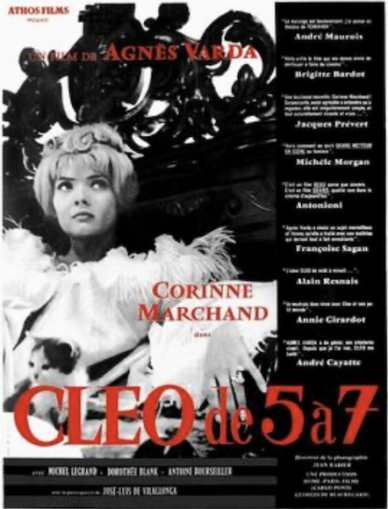
Poster to the 1962 Left Bank film Cléo from 5 to 7,
Compagnie Commerciale Française Cinématographique – Fair use, reference, review and educational
Late autumn 1962 was good to culture. The first James Bond film opened in London on 5 October. The French New Wave was at its height with the release of Cléo de 5 à 7 on November 1. In between times *cough*, I was born on Saturday, 27 October.
A friend tells me 5 to 7 are the hours between which a French gentleman might meet his mistress, with the work of the same name following an hour and a half in the life of Parisienne Cléo Victoire (not her real name). But what of the passage of my time, from birth to celebrating my sixty-fourth birthday this Tuesday? What are the passing years about, and might the comedy-drama help us understand?
The action begins with a tarot reading where we learn of Cléo’s past: She comes to Paris, a gifted singer. Her present: A recording artist sponsored by a gentleman suitor that she, the cards and the fortune teller decide needs replacing. The future? A grim foretelling of marriage-lessness, illness and death. Though the teller points optimistically to some flesh left remaining on the Grim Reaper’s (dismembered) hands and feet.
For Cléo awaits the results of a medical test, one that may confirm she has stomach cancer. And, in one of those curious coincidences that make all things revolve around late 1962, the tarologue, a certain Madame Irma, has a giant spot in the middle of her forehead — just like mine. A long-lost gypsy relative, perhaps?
Shot in black and white, in a documentary-realist style, and unfolding in real time against the real cityscape of Paris, the film gives us, as Cléo leaves the reading, a hallway of mirrors in which the chanteuse is multiplied into infinity. Before stepping onto the street — which even the least well-travelled of Puffins will recognise at once as Rue des Bourdonnais — she pauses to reflect aloud upon herself. “Hold on, pretty butterfly, ugliness is a kind of death. As long as I’m beautiful, I’m more alive than others.” Very French, very New Wave.
Emerging in the late 1950s and flourishing through the 1960s, the New Wave rebelled against the conventions of traditional filmmaking. Directors such as Godard, Truffaut and here Agnès Varda experimented with location shooting, natural light, handheld cameras and unconventional editing. Their films explored youth, identity and freedom. In Cléo de 5 à 7, beauty and mortality take centre stage, with the Paris of six decades ago providing a revealing backdrop. Clean streets, no graffiti, no road markings, few cars; uncluttered pavements populated by well-dressed, slender people; iconic Citroën taxis and open-backed city buses. Quel contrast to our own époque.
Cléo’s taxi is a Citroën DS, which takes her to her apartment after a café rendezvous with her maid. Another contrast: the easy interaction between the sexes, both here and in the numerous cameos that punctuate the film. Crossing the Seine at Pont Neuf, after a flash of the mansard roofs bordering Quai de l’Horloge, boys in a passing car whistle through her open window. “Do you live with your parents? Give us a smile,” they shout. Cléo waves them away, then laughs with the maid, who, rather than taking offence, tries to lower her own window.
According to the car radio, it’s 5.20 already and time for the news. Rioting in Algeria, farmers’ unrest in Poitiers: 2,000 agronomists armed with 300 tractors. Plus ça change! On to the metal gates at 4–6 Rue Huyghens. Still in place, they mark the entrance to rehearsal rooms that served as the set for Cléo’s oversized apartment.
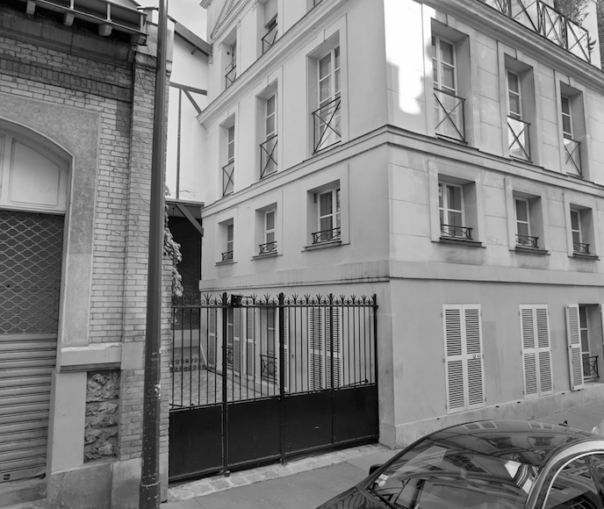
© Google Street View 2026, Google.com
Her older suitor calls and leaves. Her musician and lyricist make a comic appearance. Tired of being treated as a pretty trifle, Cléo sheds the wig, changes into one of THOSE little black French dresses and strikes out alone, destination: the famous Café du Dôme. Its habitués, the “Dômiers”, belonged to the illustrious avant-garde artistic and intellectual community. Too many to mention, but we’ll make an exception for Hemingway, Simone de Beauvoir and Picasso.
Here, Cléo plays one of her own records on the jukebox and circulates between the tables, overhearing the pretentious preoccupations of her tribe. Is this a well-plotted affectionate satire, or is Varda directing the New Wave a little too close to its own derrière? The London critics couldn’t decide. The French reception was favourable, both critically and at the box office, but on this side of the Channel opinion divided.
The Daily Herald thought the film “accommodates its pretensions as a boot accommodates a Colorado beetle”. It described Varda’s effort as “a meantime baffling, often maddening but always stimulating bit of new wavery”.The Queen was more positive: “An hour and a half in the life of a girl who thinks she is going to die. An elegant, perceptive film, directed by a talented woman, Agnès Varda. Very feminine, very Parisian, very subtle, very enjoyable.”
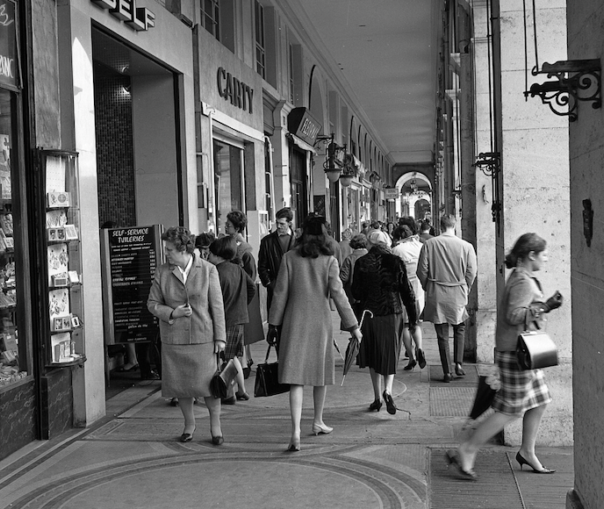
Shoppers on Rue de Rivoli,
Willem van de Poll – Public domain
The London Evening News concluded: “Where [the director] scores is in the richness of texture she gives her film, as the camera travels around Paris street scenes and characters.” It went on to note that the film was by a woman director, Agnès Varda, aged thirty-four, and marked the debut of a ravishing new star, twenty-one-year-old Corinne Marchand. “Cléo has been hailed as a masterpiece.” Some fake news, to which we shall return.
Back in the film, perhaps the Daily Herald missed a few of the references — and there are many, layered throughout. At the Dôme, Cléo takes a seat and orders a cognac beneath a poster of Manet’s Berthe Morisot with a Bouquet of Violets, the face of a beautiful woman artist whose surrounding clothing is portrayed with masterful use of graveyard black.
Then comes the film’s transformative montage, after Cléo’s taxi ride to Parc Montsouris as she returns to nature. On a mound near the entrance stands the meteorological observatory. “From One Thousand and One Nights,” she quips.
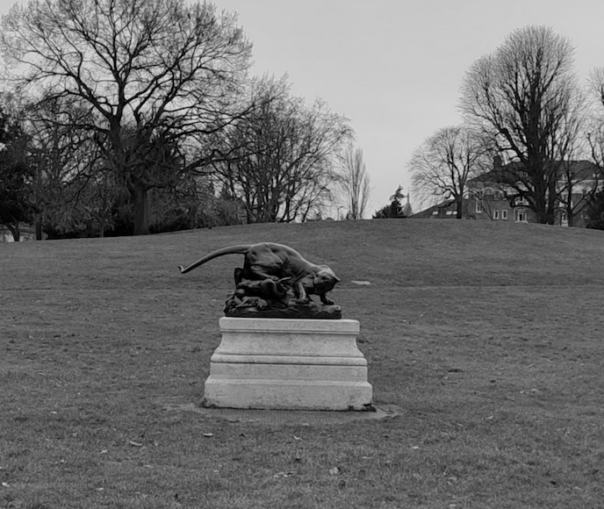
It might be too much to expect the Herald reviewer to recognise the building as the Palais du Bardo, a recreation of the Hispano-Moorish Bey of Tunis’s palace, constructed for the 1867 Universal Exhibition and re-erected in the park. The building burned down in 1991. But we can still locate the spot by the surviving sculpture nearby: Georges Gardet’s Drame au désert, which depicts the dramatic encounter between a lioness and a serpent.
© Google Street View 2026, Google.com
Which reminds us to the changes of my times. Since 1962, the population of France has increased by 50%. Today, approximately 40% of France has some form of immigrant ancestry tracing back over the last three generations. Furthermore, about 27% of all children born in France today have at least one parent from outside Europe. During filming, the North African presence in Paris was a few thousand – the only two coloured faces Varda captures are in the Café Dome. Today it is thought to be 1.5 million – with the catastrophic results seen in recent weeks.
As all of our lives have been changed by mass uncontrolled immigration, in better times Cléo’s life begins to pivot when she meets a soldier on leave in the park. Their clever wordplay reveals a man conscious of his own mortality, destined to depart from Gare de Lyon for the war in Algeria that evening. We also learn that it is the first day of summer, and that Cléo’s real name is Florence — evoking Flora, the goddess of spring — as she contemplates the possibility of terminal illness, the midwinter of her short life.
On a lighter note, fake news is nothing new. When the Daily Herald told us Corinne Marchand was twenty-one, she was thirty-one. If we may end with optimism, she is still with us, aged ninety-four. In the difficult times in which we live, some solace to accompany an approaching sixty-fourth birthday.
© Always Worth Saying 2026