
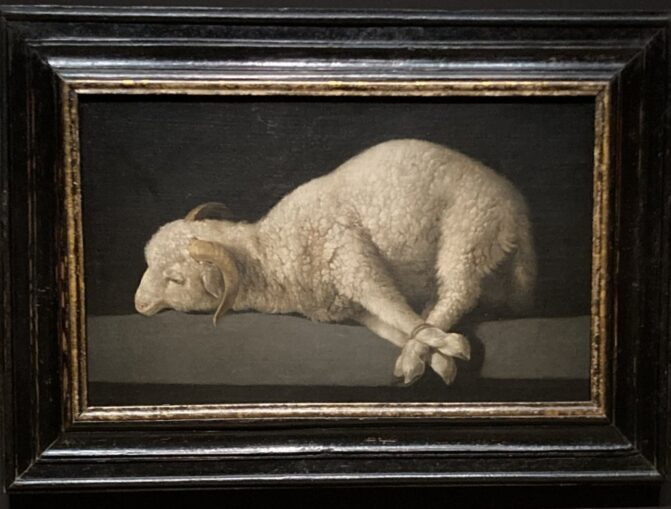
I visited 3 art exhibitions over the summer. The first was the Royal Academy’s Summer Exhibition. I shared my thoughts on that exhibition in early Summer. I also visited the Zurbaran exhibition at the National Gallery. This was full of sumptuous paintings by Francisco de Zurbaran who lived from 1598 to 1664, painting mostly for religious orders. His paintings are a wonder, deeply influenced by his faith and very influenced by Caravaggio. The crucifixion paintings were large and truly magnificent. However, emotionally I failed to connect with many of the paintings despite their beauty, many of these depicting saints that I had never heard of. I think part of the issue for those of us living in modernity when trying to appreciate these baroque paintings is that much of the symbolism is lost to us. Few people have a thorough art history or Christian religious education, and although the idiot boards by each painting can tell you some of the deeper meanings of the paintings, you cannot immediately connect with them as someone who lived in the 16th century would have. Also, realism seems commonplace to us now but the level of detail depicted in these paintings at the time would, I am sure, have seemed amazing. My favourite painting was Agnus Dei. The painting was of a young lamb. bound for slaughter and, of course, echoing the death of Christ.
So, my third exhibition of the Summer was a Tracey Emin retrospective. Emin emerged from the ‘Young British Artists’ scene, as they have come to be known, of the 80s. There are often rich patrons who promote new artists and the Young British Artist’s champion was Charles Saatchi; he initiated the infamous Turner exhibition that often featured YBAs as well as showing their work in his own gallery. Emin had a traditional art education, studying printmaking and painting at Masters level at the Royal College of Art. However, her upbringing was far from conventional, and neither was her life subsequent to her early years spent in Margate. Emin’s own life is the main subject of her work and the Emin retrospective at Tate Modern looks back at her life and career and was my art highlight of the summer.
The retrospective shows the sheer breadth of the mediums in which Emin worked, painting, installations, sculpture, photography, textiles, film, books and poetry. Some seemed to work better than others; I wasn’t a big fan of the sculptures, very blocky and the poems, even though written in Emin’s own hands, are more museum pieces than artworks. The paintings were fantastic as were the short films shown at the Exhibition.
Emin’s life has undoubtedly been traumatic. She recounts that she was raped at 13 and was extremely promiscuous in her early teenage years. The background to the first short film in the Exhibition was dreamlike showing a beautiful beach of Margate, while recounting her rape and her subsequent humiliation at the hands of boys she had slept with at a dance contest in Margate that she had hoped would launch a career in dancing. However, the ending cut to Emin dancing joyously to Sylvester’s hit ‘You Make Me Feel (Mighty Real)’, which was poignant considering Sylvester died of AIDs. Did Emin in her choice mean that she got out of the 80’s alive but others did not? Her early experiences I think go some way to explaining her early promiscuity, and her ‘everything out there’ exhibitionism.
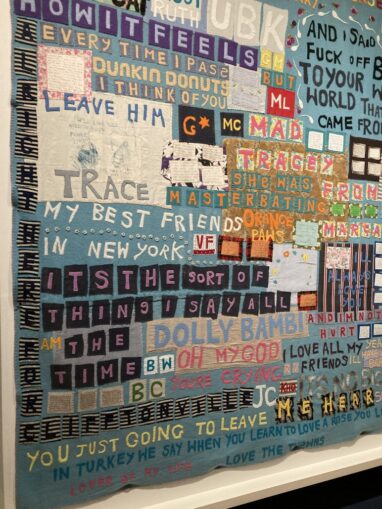
Other works I enjoyed were the tapestries, that highlighted names and places in tiny hand sewn stiches. Lovely things in themselves showing the random way we think and recall our memories.
The other key episode emphasised by Emin are the abortions she had. They were very much regretted by her and Emin focuses on the first abortion that was botched and made her very ill. She says in the film that no art she could create would match the creation of new life. She describes the mental breakdown she had following the abortion and describes it as an ’emotional suicide’. She purposely destroyed much of her work at this time, some of which are represented in small stamp sized versions in one installation. Emin produced a tapestry about the impact of the abortions featuring gold curtains from her mother’s house called the ‘Last of the Gold’, as ‘there is no more after me’.
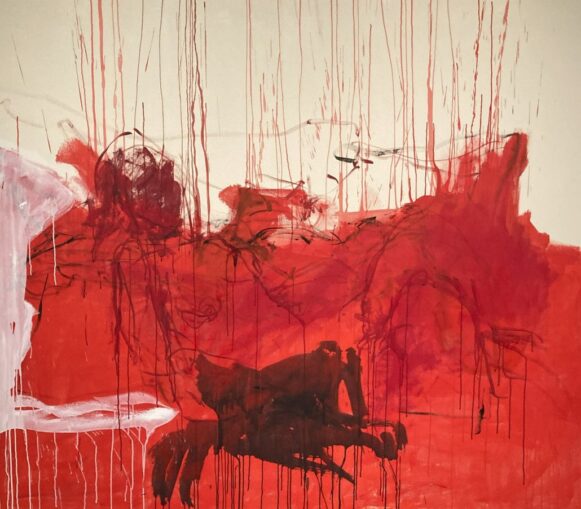
There are also paintings, very influenced by Schiele, that I really like. Like all of Emin’s work they are raw and emotional and generally feature herself. Not everyone’s cup of tea I know but I loved them, although not many would pass the ‘would I have it on the living room wall’ test, too unsettling.
There is, of course, the installation that made her famous, a copy of the Unmade Bed. In 1999 she was shortlisted for the Turner Prize for the work. Although her best known work and capturing her trademark self-obsession it is not my cup of tea.
There were also some of her neon works. If you want to see an Emin work in the wild, there is a neon work at St Pancras Station called ‘I want my time with You’. It is massive but the exhibition features some smaller works . Typically the jolly bright neon overlies dark unsettling words such as ‘I could have loved my innocence’. I have seen some call these trite but I like them.
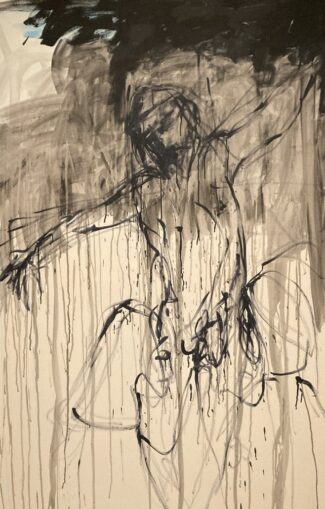
Emin was diagnosed with cancer and has had major operations, hence the title of the exhibition ‘A Second Life’. There were photographs of the stoma and scars resulting from the operation but although I admire the honesty they were not for me. I preferred the Crucifixion picture that she includes in the exhibition. Apparently she lost her faith following her abortion. I am not sure that she has found faith now but I know that Emin has said that she paints at least one rendering of the Crucifixion every year. They are some of the few paintings that do not feature Emin herself and perhaps represent that she is now looking beyond herself and the f’ed up role of women in modernity towards something more metaphysical.
If there are criticisms to be had of the exhibition, it is that the works are often very similar and predominantly feature Tracey Emin. However, I think that the self-obsession is a feature of women in modernity and bound to be reflected by the foremost female artist of the time. However, she has strong things to say about the role of women in her art. The promiscuity following rape trauma, knowing that sleeping around is not the same for boys as it is girls, the narcissism, the reality of abortion for many women, the loss of spirituality, all on display here.
I think about the exhibition often since my visit. The paintings and artwork are not traditionally beautiful in the way that the paintings by Zurbaran are, but they pack a powerful emotional punch. Emin’s life seems to reflect that of many intelligent women, working without guardrails, they broke new ground but Emin came to the self-knowledge that professional prestige does not lead to personal fulfilment. Emin does now seem to have moved to a place of acceptance and I think shows with honesty her own mortality. In the end you could regard Emin and her work a cautionary tale of why feminism is a disaster for women.
Of course, after both exhibitions Mr A and myself went on the search for decent pubs, and find them we did. Try The Harp in Covent garden, Tate Modern cafe for a nice Cloudwater brew, and The Blue Maid in Borough High Street.
© text & images @Alurka 2026