As the World Gentleman’s Wendyball Invitation Shield dominates yet another weekend, shall we use our weekly plutocrats’ tour of the North to spy upon the round ball game? I think we might as well. For the previous two episodes, our focus has been on a nineteenth-century golden triangle centred around Halifax.
The Worth-Sayings had a gold mine of a mill on the banks of the River Calder. A Mr Joseph Jaggers, an artisan of the West Yorkshire hamlet of Shelf, used his knowledge of worn rotating cylinders to break the roulette bank at Monte Carlo.
Enigmatically, the Halifax Guardian and Huddersfield and Bradford Advertiser of Saturday, July 6th 1833 – 193 years ago this very week – inform us of a selling-up at the house of Mr George Worth-Saying of Sowerby Bridge. A Mr Townsend is to auction a variety of goods and property ‘too numerous for insertion’. These include two pianofortes, mahogany wardrobes, an eight days clock and ‘a good mangle’.
Four years later, we discover Miss Emma Jane Worth-Saying, daughter of Sowerby Bridge’s George, marrying George Frederick Crossley Esq., at St Ann’s Church in Liverpool. Razor sharp Puffins will recall that it was the Crossley family, with their Manor Heath mansion at Skircoat, who were Halifax’s most prominent textile magnates of the Victorian era.
Straightened circumstances and the necessity of a good marriage? Two willing hearts and the liquidation of small town assets to profit bigly in the big city? I know not which, but I do know that our focus now moves from the Calder to the Mersey. Previously, Liverpool has often been mentioned in our plutocrats’ tour of the Industrial Revolution as the entrepôt for the Empire’s raw materials and northern England’s finished goods.
Yet another reason why my wife and I’s Cook’s tour of the North West must include a trip to the Mersey and, appropriate to this weekend’s sporting spectacular, to the soccer-mad city that stands at its mouth.
First, a note about getting there. A direct Trans Pennine Express service now connects Glasgow to Liverpool. This calls at our humble Debatable Lands halt. In keeping with the subject of our investigation, we feel obliged to travel first class.
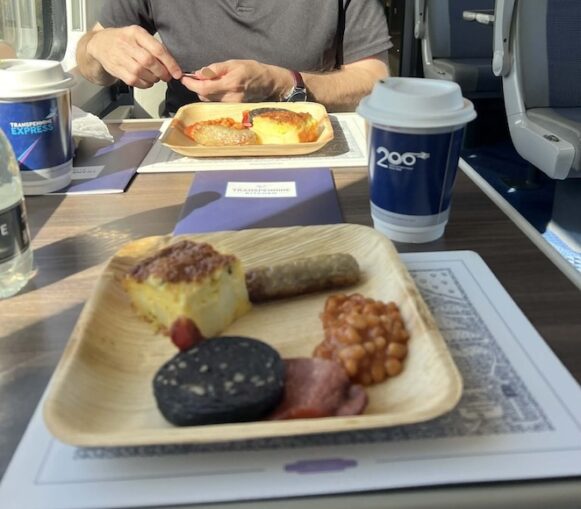
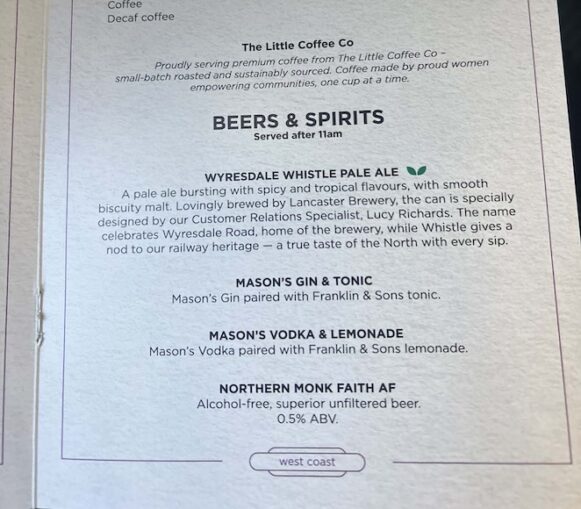
As well as passage, we enjoy a hot breakfast, followed by coffee and shortbread. At the posh end of a sky blue Class 397, the sun passes the yardarm at 11 o’clock, after which a long-suffering lady and her train-mad spouse may have a complimentary drinkie or three.
How much does all this cost? As I’m not only one of those annoying people who refuse to use phone QR codes but also keeps all of their printed tickets, I can tell you. For the two of us, booking in advance and travelling off-peak with our two Together Card, the damage came to £122.60.
Not bad for a 200+ mile, near five-hour round trip, considering how expensive everything is these days. Having said that, the train ‘out’ left at 09:25 and the Two Together card doesn’t count before 9:30, so I was ripped off all the same. Keep in mind, that when Andeh tells you rail prices are frozen, the terms and conditions have changed, meaning you pay more anyway. Grrrr.
Not to worry, to squeeze more out of the day on the way down we shall have a retrospective look out for Wendyball plutocrats. But first, breakfast:
© Always Worth Saying 2026, Going Postal
© Always Worth Saying 2026, Going Postal
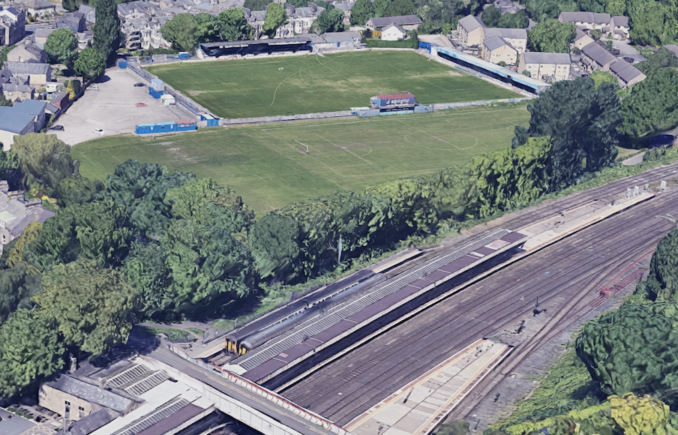
Portions are small – we all eat too much anyway – but tasty. Cutlery and crockery are wooden, which is a nuisance; I suggest you take your own knife, fork and plate. Dining was complete well before Lancaster, which allowed for a lookout of the football ground. Lancaster City’s Giant Axe stadium is next to the railway station and beside the railway line, but the club wasn’t founded by a plutocrat. Rather, following a 1911 public meeting in the city’s Market Hall.
© Google Maps 2026, Google licence
You can see Preston North End’s Deepdale from the train if you know where it is. Again, a plutocrat (as well as a trophy) free zone, Preston was founded by a school’s cricket club. An extended stop at there saw the driver come to have a word.
You know when somebody’s terribly disabled or only has six months to live, and everybody makes a fuss of them? Well, for some reason, that often happens to me. The driver wandered from his cab and through the first-class catering area to make polite conversation. How would I spend my weekend?
‘I’d like to spend it driving a train,’ I replied, ‘£100,000 a year for pulling a lever.’
‘There are two, one on each side,’ he assured me, ‘and sometimes a button to press.’
After reminding him my grandfather, on the non-mill-owning non-plutocratic side of the family, shovelled 10 tons of coal between Carlisle and Rugby for £3 a week while Hitler dropped bombs on him, we got down to business and decided the new GB Railways livery is naff.
The existing colour schemes should be augmented by a GB Railways sticker beside the present-day company logo. If push comes to shove, the livery should be the late-sixties ‘corporate’ of rail blue and silver (a rake of which was parked up when we passed Carnforth) with red piping.
By the way, last time I visited Deepdale to see my Local XI, our goalkeeper was a certain 19-year-old on loan from Sunderland. Name of Jordan Pickford, he’s now in America playing (well) for England. Back in the day, locked in our annual brutal relegation battle, he didn’t help the cause by letting in six. Better luck today against Big Harland, we hope.
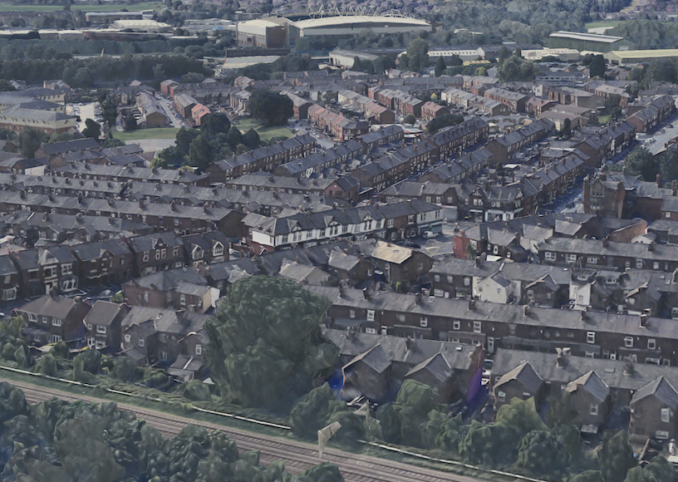
© Google Maps 2026, Google licence
The next football ground is Wigan. Obvious from the train, it is connected to a plutocrat, but not one from the Industrial Revolution. According to the Temp, Wigan Athletic was founded by the likes of a JP, a landlord, a former Bolton Wanderers defender and a colliery winding engineer.
Plutocracy was visited upon the Latics in 1995 when JJB Sports retail magnate Dave Whelan bought the club. A spell in the Premier League and an FA Cup win were to follow, but after Whelan stepped down, they struggled. One of the Wigan stalwarts during that heyday was Roberto Martinez, who recently managed Portugal at the World Cup.
After Wigan, we leave the main line and head along the branch to Liverpool. Where there’s muck there’s brass highlights spotted from our comfy seats included what’s left of Pilkington’s Glass at St Helen’s and a train full of mushed-up trees heading for Drax. More of which in another episode, but for the time being we shall concentrate on soccer-mad Liverpool.
The subject also being wealth and how to hang on to it, and keeping in mind Puffins’ well-known aversion to tax, how appropriate it was – and how tickled we were – to be greeted at Lime Street station by local wealthy celebrity Mr K.Dodd of Knotty Ash. During our day in Liverpool, will we bump into his two favourite Diddy Men? Diddy Pay and Diddy Heck? Find out next time on plutocrats’ tour!

© Always Worth Saying 2026, Going Postal
© Always Worth Saying 2026