The following morning, as we were digesting a formidable breakfast of kidneys and bacon sent up by the admirable Mrs Hudson, Holmes was again amusing himself with his violin. After his usual discordant improvisation he suddenly played a familiar tune, which I recognised as being an aria from Rossini’s opera The Thieving Magpie, whose plot centres on a magpie which steals jewels to decorate its nest. When the had finished I protested, ‘Holmes, you cannot be telling me that a magpie carried off these treasures. It could not lift some of them — that glass paperweight was more than a pound, and its smooth surface would have given the bird no hold.’
‘No, indeed,’ he replied. ‘But they are not the only members of their tribe.’
At that moment we heard the sound of the door bell. ‘Can this be the Duchess?’ I asked.
But it was not: it was our friend Lestrade, looking desperately baffled. ‘Holmes’, he appealed, ‘I do not often need to consult you while Scotland Yard pursues its enquiries’ (this was far from the truth and I saw Holmes repressing a smile), ‘but I have to confess that this case is truly mysterious.’
‘Indeed,’ said Holmes. ‘May I take it that we are speaking of the Duchess of Slackwater’s ruby necklace?’
Lestrade nodded in assent.
‘And may I further surmise,’ Holmes continued, ‘that the door of the room was securely locked, all the servants are trustworthy, the window of the room was open, and that the objects stolen are not what you would expect a thief to choose, some valuable items left and some of no value taken?’
Lestrade stared at him open-mouthed, and I turned away to hide my smile. ‘I cannot guess by what process of diabolical divination you discovered the truth of the matter,’ he admitted, ‘But that is inded the case, The thief took only two things, the ruby necklace and a small book of coloured illustrations with which the Duchess had been instructing her granddaughter. But he left a whole set of mourning jewellery of black jet set in silver which the Duchess had been wearing for the customary year after the sad death of the Duke. The year being up, she had taken out the ruby necklace to resume her usual adornments.’
‘Be assured,’ said Holmes, ‘that we are already pursuing this matter, although Her Grace has not yet honoured us with a visit, preferring to leave it in your capable hands’ (he delivered this sentiment gravely with a perfectly straight face). Naturally, as soon as we have unmasked the culprit, we shall be calling on your help to apprehend him, and I hope you will attend with all speed when we have done so. As you are well aware, it is necessary to seize the malefactor before he has disposed of his booty.’
‘Indeed,’ allowed Lestrade, still looking somewhat baffled. Holmes would not vouchsafe further information and the Inspector left, perhaps with more hope than when he had arrived.
‘I need to pay a visit to the Tower of London,’ said Holmes. I have already sent a telegram announcing our arrival, and trust that you will accompany me.’
After a smoky subterranean journey on the Metropolitan Line to the new station of Tower Hill we emerged, smutty and coughing, for the short walk to the Tower. Here we were admitted by a Yeoman Warder who guided us to the premises of the Ravenmaster. I began to grasp the theory that Holmes had been forming.
The Ravenmaster was a short plump man in his sixties, seeming all the shorter as half a dozen huge black birds strutted and flapped in the room around him. The door and window were open, and he explained that the ravens were free to come and go, but he had been obliged to restrain their ability to fly by trimming the secondary feathers of their wings, by which he mean those feathers on what in a man would be the forearm. They could make short flights but not go far.
‘They stay here because I give them food,’ he explained. ‘But they are not loyal creatures like dogs. It is necessary to reward them constantly. And yes, sometimes they do stray farther afield, as their feathers constantly grow back. Cuthbert’ (he pointed to one of his charges) ‘has been flying out, and recently he was seen perched on St Paul’s Cathedral. But, as you see, he has returned.’
‘Would it be possible,’ enquired Holmes, ‘to train a raven to perform tricks — perhaps to collect objects and bring them to you?’
‘Certainly,’replied the Ravenmaster. ‘They are exceedingly intelligent creatures and will learn anything if they find it to their advantage. Also, it is their proclivity to retrieve small bright and shiny objects to ornament their nests. It would be easy to bend their natural habit to your needs, as long as you constantly reward it.’
Holmes posed a further question. ‘Has anyone recently spoken or written to you about obtaining raven chicks?’
‘Yes, indeed. It is known among the birdkeeping fraternity that the ravens here breed occasionally. Requests are few, but I had one only a year ago. There were no young birds available, but I answered his letter. Indeed I still have it.’
‘May I see it?’
The Ravenmaster turned to a desk spattered with droppings and rummaged in the drawers. After a while he retrieved a letter and handed it to Holmes. It was a brief communication written in a rough scrawl on cheap yellowish paper, but the writer had supplied his address: 41 Crimscott Street, Bermondsey.
Thanking the Ravenmaster, we departed. It was only half an hour’s walk to Crimscott Street, and at number 41 we were not surprised to find the shop of a dealer in birds and other animals. It was a small and foetid establishment lined with cages and loud with the shrieks of parrots, but the owner was obliging enough.
‘Yes,’ he said. ‘I did write to the Tower a while ago, and the man had nothing to offer. A customer asked me for a young raven to train — not that I’d had anything like that before. I don’t see as how anyone would want one of them big troublesome things. They’d be a worry, no doubt of that. But I did find a young raven for him. Someone found a chick what had fallen out of the nest, and I gave him a couple of bob for it. Sold it for a quid and made a tidy profit.’
He remembered the buyer as foreign. ‘A little dark bloke with a big moustache. Maybe a Dago or a Greek. Spoke good English, though, and seemed to know his way around. Reckon he lived hereabouts.’
That was all we could establish, and we returned home in a hansom that Holmes had fortunately spotted hurrying empty through the rough streets to regain more profitable areas. ‘This,’ said Holmes, is a task for the Baker Street Irregulars.’
I do not know by what means Holmes was able to summon this disreputable but useful gang of boys, but that evening their leader, a tall lad by the name of Wiggins, was with us. (Mrs Hudson, usually tolerant of Holmes’s behaviour, had put her foot down about allowing the whole rabble into the house.)
Holmes repeated to him the shop owner’s description of the man, and also described a raven, a bird seldom seen in London. He promised the Irregulars their usual rate: a shilling a day for each boy, and a reward of a guinea for the finder. Wiggins, clearly a lad of considerable intelligence who in other circumstances might have gone far, took all this in and sped off to set his colleagues on the trail.
He returned in triumph the following morning, accompanied by a smaller boy. ‘Simpson’s cracked it,’ he announced proudly while the named person shifted shyly. ”E found a cat’s-meat man what supplies ‘im with food for the bird. An’ ‘e told us where the geezer lives, an’ says ‘e’s seen the bird. Sixty-one Page’s Walk, that’s where ‘e is, name o’ Mitsotakis or summat like.’
‘I knew you would find him,’ said Holmes as warmly as his ascetic manner would allow. ‘Here, Simpson, is your guinea,’ and he counted out twenty-one shillings into the boy’s grimy outstretched paw — a gold coin would have rendered him liable to suspicion. ‘And for you,’ turning to Wiggins, ‘ten shillings and sixpence for the speed with which you have conducted your enquiries. How many of you were at work?’
‘Twelve, sir,’ replies Wiggins. Holmes gave him a further twelve shillings, confident than the honour of the band would ensure that everyone received their due, and the two boys left well satisfied.
‘Now,’ said Holmes, ‘we must set to work, and quickly. But if we are to recover the goods and quiietly restore their property to the Countess and Marchioness, we must anticipate the arrival of Lestrade and his heavy-footed minions. Therefore I will send him a telegram warning him to be ready and within easy reach of Bermondsey, but it is we two who must carry out the initial action. If we can succeed in that, a further telegram should bring him to the spot soon enough.’
‘This is clearly the work of a single thief, and a skilled one,’ he added. ‘We need not fear falling into a gang. But Watson, bring your service pistol, and I shall carry my stick.’ So saying, he picked up his weighted weapon. My Webley was always oiled and ready with a box of cartridges in the drawer of my bedside table. As soon as I had fetched it we sallied out. Holmes also had a leather satchel, which he handed to me and I slung it on my shoulder.
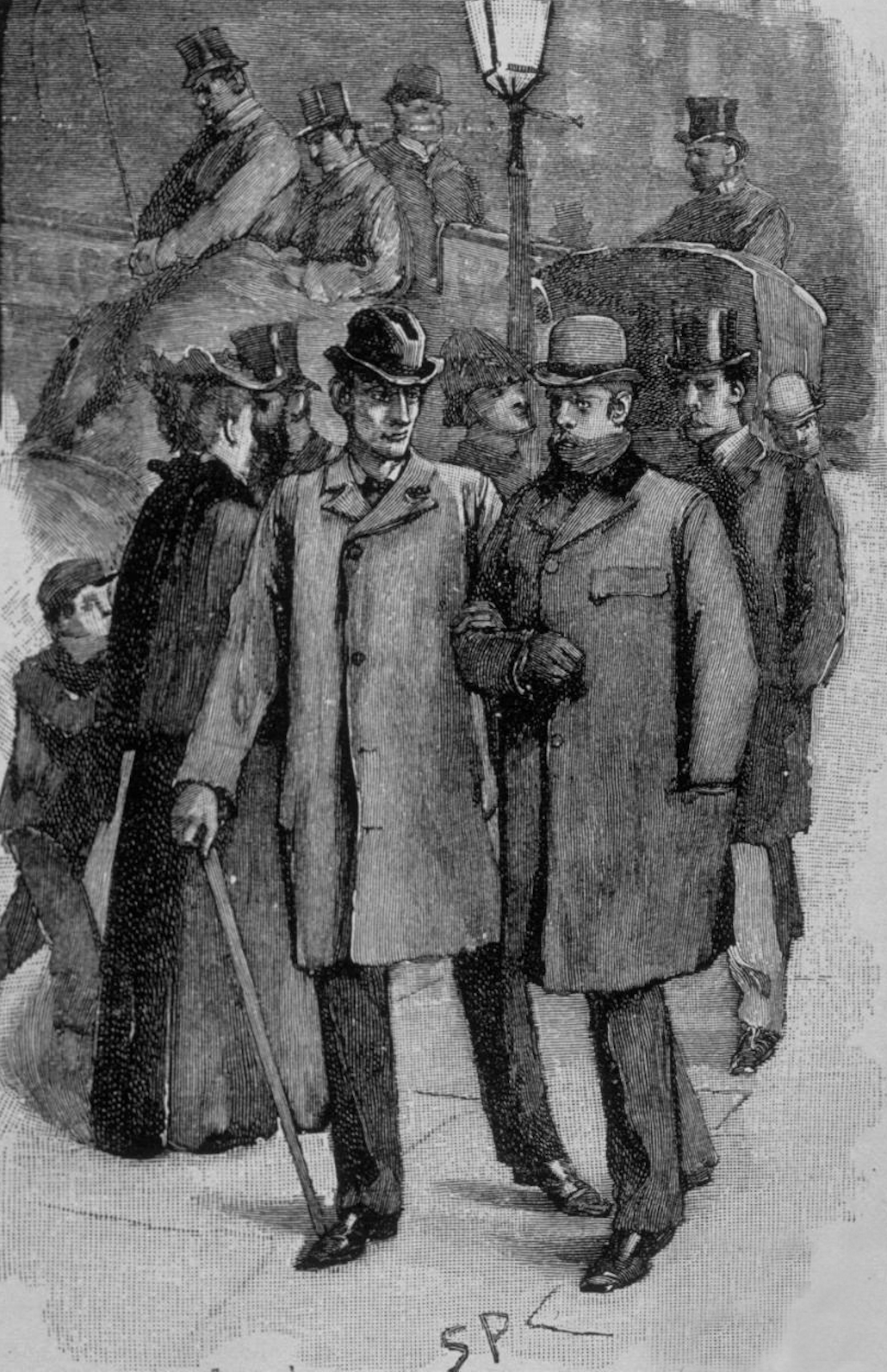
Once the telegram had been sent a hansom took us to Bermondsey, the reluctance of the driver to venture south of the river relieved by a promise of five shillings above the fare for the distance. Paying off the cab at one end of Page’s Walk we strolled down the street, feeling too smartly dressed for the neighbourhood, but I knew that if any of the local folk had ambitions to rob us Holmes’s stick would soon make them regret their impulse.
There was no sign of life at number 61, and Holmes’s rap on the front door brough no response. ‘Watson, stand in front of me and look around as if you were lost,’ Holmes instructed. He bent down to the lock, and dextrous use of his implements admitted us in half a minute. Once we were inside Holmes relocked the door and we set to searching the house which, though poorly furnished, was at least reasonnably clean. There was a slight ammoniac odour of bird droppings which had been imperfectly scraped from the bare floorboards.
It was laughably simple: Mitsotakis had put his loot in the well-known place under the mattress in his bedroom. ‘Honestly, Watson,’ Holmes laughed, ‘these folk lack imagination.’ He separated the Countess and Marchioness’s jewels from the hoard and put these, the pincushion and skein and paperweight still unseparated from the haul into the satchel. Then we retired to the kitchen at the back of the house to await his arrival.
A little more than an hour later we heard the sound of the front door being unlocked and the creak of the hinges. The moment it was shut Holmes sprang forward and I followed. There stood Mitsotakis, with a huge black bird perched on his shoulder, now flapping in panic. Holmes advanced, his stick raised and showing a clear will to use it. I drew out my revolver and covered him as a precaution, but the cornered man was docile enough.
‘Now, Watson, will you hasten to the post office at the corner and send the word to Lestrade, and I warrant that he will be here with his merry men within minutes.’ I handed my revolver to him and set off.
While Lestrade lacked talent in some respects, you could not fault him for promptitude. The house was soon swarming with blue uniforms, and Holmes quickly led them to the hoard under the mattress, which included the Duchess’s ruby necklace and the small brightly coloured children’s book as well as various gems of unknown provenance.
Holmes and I returned to the crestfallen and handcuffed miscreant. ‘Well, Mr Mitsotakis,’ said Holmes, ‘we have you fairly and you will pay the price for your actions. But I am concerned for your raven, which has merely carried out your orders and no blame can be attached to it. We have two choices here. I can take it to the Ravenmaster in the Tower and it will spend the rest of its life in captivity but well cared for and in the company of other ravens. In fact it would face the same fate as that which you will soon have to endure. Or I can set it free to fend for itself.’
‘Set ‘im free,’ said Mitsotakis, ”E’s a bright bird an’ ‘e’ll cope.’
He shrugged his shoulder and the bird stepped off on to the table. Mitsotakis, clumsy in his handcuffs, gently untied the jesses around its ankles. He stroked its shining head. ‘Go, my friend,’ he said in a choking voice. ‘Fly free.’
Holmes opened the window and the the huge bird hopped to the sill, gave a deep, bell-like call, spread its wings and soared away. Mitsotakis looked after it, tears coursing down his cheeks.
© Tachybaptus 2026