The Archbishop’s housekeeper, who had been watching us from the edge of the room as we made the horrid discovery, was trembling and trying to restrain her tears.
‘Mrs Armitage,’ said Holmes, ‘we are depending on you in this difficult situation. It is vital to ensure that not a word of this business leaves the palace. I myself will deal with the Home Secretary’ — there was audible contempt in his tone as he uttered the title — ‘but here it is vital that none of the servants should gossip. Can you restrain them?’
His address had exactly the desired effect on Mrs Armitage, who visibly stiffened with pride and resolve. ‘I can,’ she said. They have all been here for many years and have grown old with me. They will be as determined as I to protect the good name of this household and of the Church.’
‘We shall rely on you utterly,’ replied Holmes. ‘Would you be good enough to clean all traces off that floor yourself, as thoroughly as you can? But now, before we leave to pursue our investigations, I must write a note to keep the Home Secretary quiet — as you will appreciate, a harder task. And if you will, we would like to borrow that photograph of His Grace to take copies. I will make them myself and return the original as soon as I have done.’
Taking a sheet of the Archbishop’s own writing paper and one of his Waverley pens from the desk, Holmes wrote:
‘Sir H —, Events have taken an unexpected turn, and pending further investigations all I can tell you for now is that the Archbishop will certainly not be officiating at the Easter service. This is at present not a matter for the police, and I would urgently request you to keep it strictly in confidence. When I have found out more I shall, of course, keep you informed. In tghe meantime it would be politic to announce that His Grace is indisposed, and that we wish for a swift recovery’ — he permitted himself a sardonic smile as he wrote these words. It broadened as he penned a final doxology, ‘I beg to remain, Sir, your most humble and obedient servant, S, Holmes.’
Mrs Armitage had returned bearing the photograph as Holmes folded the letter and enclosed it in an envelope. ‘Please have this delivered by hand to the Home Office as soon as possible. And now we must be on our way but, Mrs Armitage, we are depending on you.’
‘I think,’ confided Holmes, as he horse strained to haul us up the steep approach of Lambeth Bridge, ‘that we have set a sufficiently powerful dragon to guard the dark secret. But now we must cast our own light on it.’
* * *
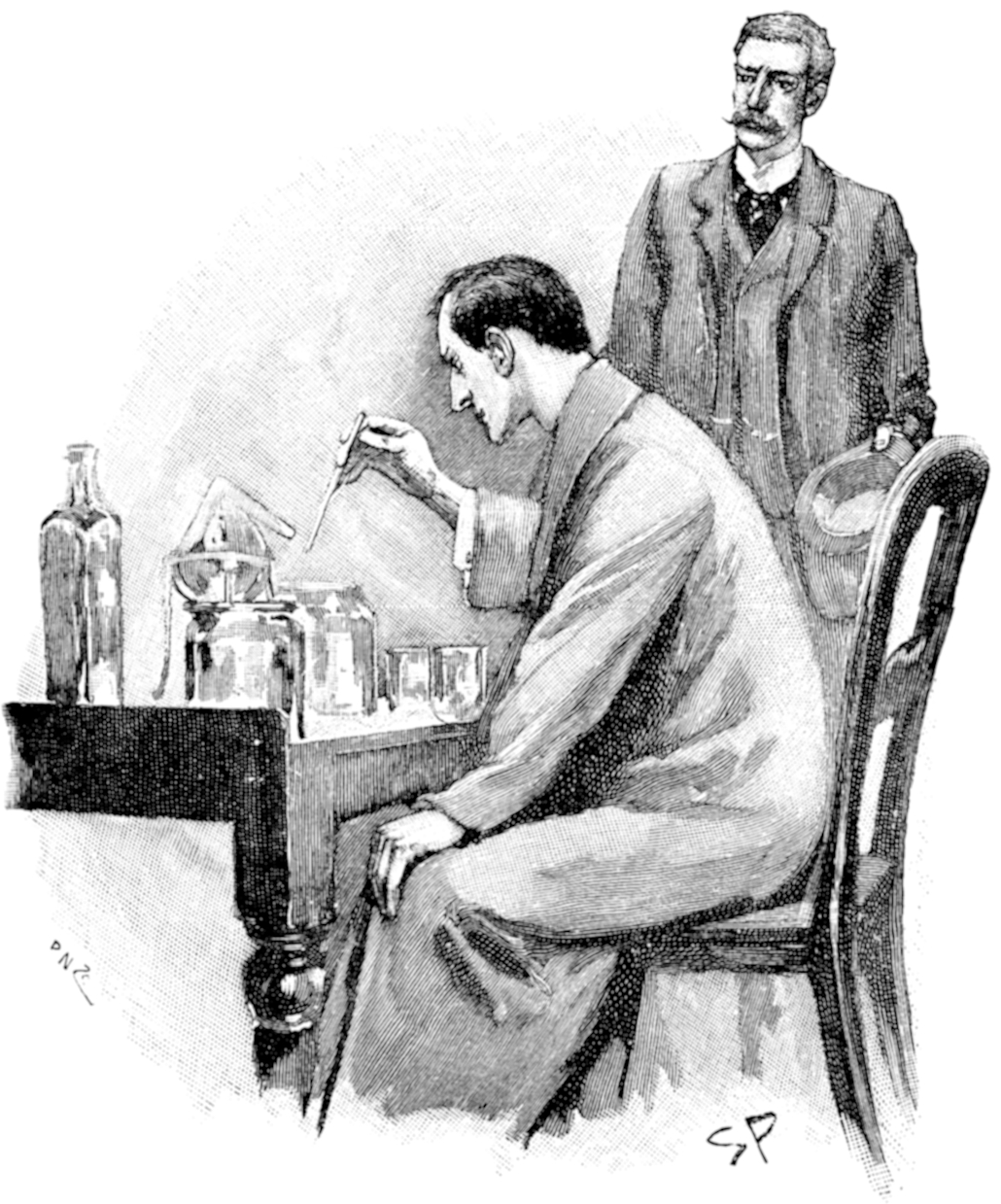
That evening Holmes was bent over his work table mixing reagents and peering into his microscope. ‘Come and look at this, Watson.’
I bent over the eyepiece and, with a sinking heart, had to admit, ‘Yes, as we feared, that is certainly human blood. The form of the cells is unmistakable.’
‘Also,’ he added, ‘I have been working on the fragments of brown paper I retrieved from the fireplace. This was not the thin stuff of a manila envelope, it was stiff brown paper as used for wrapping parcels and, though scorched, the wrting is still partly legible.’ He laid two pieces together and passed me a hand lens. They fitted closely, and it was possible to read:
IF UND
PLEASE RE
P.O. BOX 213
42, VAU
LON
An irregular line was drawn down the left side and across the top. ‘Clearly the return address on the back of a parcel sent to the palace,’ said Holmes. ‘There is a tendency to draw a box around these things. I shall pursue this tomorrow.’
I retired to my bed saddened by our discoveries but eager for the hunt. Wnen I awoke, Holmes had already departed and I did not see him till he returned for our luncheon, a light collation of veal cutlets and cabinet pudding served by the inimitable Mrs Hudson and washed down by a respectable Chambertin.
As we enjoyed our post-prandial brandy and cigars, Holmes told me, ‘The address was, as I suspected, in Vauxhall Bridge Road. It is one of those establishments that maintains boxes where letters can be sent and collected by the addresses. These are, of course, locked, and all the keys are individual. But there is a master key that opens them all.’
He showed me a cake of wax in which there was an impression of a key. ‘I visited this place and hired one of the boxes. I asked to see the size of the box and he used his master key to open it. Affecting clumsiness I knocked into the door so that the key fell out, and as I picked it up I was able to press it into this wax, which I had carried in a trouser pocket to keep it soft. I also have the key he gave me, so that I can be sure that my copy is accurate enough to work on a relatively simple lock. And I have also sent for my friend George, who should be here presently,’
So saying, he set to work on a key blank with his file, and I left him at his task for a couple of hours.
Holmes’s friend George arrived at tea time and happily shared our drop scones and Madeira cake. He was a large and dusky gentleman of African descent with a broad smile and the precise habits of speech of one who has been educated in Britain for most of his youth.
‘George,’ said Holmes, ‘I would be grateful if you would perform a small task for me, for the usual fee. There will be no danger, but I would need you to act the idiot.’
‘Yo mean, Massa,’ said George, ‘I should tok disaway?’
We all laughed. ‘Excellent, but no need to put it on quite so strong,’ said Holmes. But I need you to go to a mail box establishment and retrieve the letters from box number 213 with this key. You should tell them that you have been sent by Dr Esdras Obote to collect his post.’
‘I have heard of him,’ George confided in his usual voice, ‘one of those dubious preachers who prey on my people. It will be a pleasure to thwart his plans.’
While George was on his errand Holmes retired to the tiny darkroom he had improvised inside a wardrobe and left me to my thoughts, which were of some perplexity. He emerged in half an hour with some enlarged prints of the Archbishop’s face, still a little damp, and laid one on the table for my inspection. He kept his hand over the upper part, obscuring the top of the cleric’s head. ‘Watson, what do you see?’
I looked at the face, its small jaw, the absence of any trace of a brow ridge. The clerical collar obscured the neck, but nevertheless one thing was plain. ‘Holmes!’ I said. ‘This is surely a woman.’
‘Indeed,’ he replied. ‘And look further: there is no trace of eyebrows or, as far as we can see from this print, eyelashes.’
‘Alopecia totalis!’ I exclaimed. All the hair falls out, and seldom grows back. Not common, but it can affect people of either sex as early as their teens.’
‘Precisely,’ said Holmes. ‘Having lost the principal ornament of her sex, she took advantage of it to claim the privileges of a man — and the clergy was a wise choice, as no one expects hairy masculinity in such a profession. Yet she can hardly have been a person of mean mind to rise to the primacy of England. Do you remember what we found in her apartment? She would have used a crepe bandage to flatten her bosom, and the blue greasepaint, lightly applied, to suggest a light growth of beard in a clean-shaven man.’
We heard the bell and George returned, grinning from ear to ear and brandishing three letters. ‘So easy,’ he announced. ‘I acted the idiot and the key fitted at once. The man is none the wiser.’
When George had been paid and departed we examined his haul. One letter was a final demand from a supplier of ecclesiastical goods in Weymouth for a special order of candles made to the customer’s request, presumably black. A second was also an invoice, from a butcher in West Bay.
The third was a personal letter, addressed to Dr Esdras Obote in strong masculine handwriting on a blue envelope of high quality. The postmark was from Bridport, only two days old. Holding the envelope at the corner with gloves — for even at that early date he was aware of the new science of fingerprinting — Holmes slit it open with a paperknife and extracted the letter. The message was brief:
‘Dear E,
Trust all is well. Will see you at B.B. Friday. Hoping Stannard’s path is dry, don’t want to get cart stuck again.
Yrs ever, M.’
‘And today is Thursday,’ said Holmes. ‘We must move quickly if we are to catch our prey.’
So saying, he turned to his bookshelves, where there was a full set of one-inch Ordnance Survey maps, and selected the one for south Dorset. After a few minutes’ perusal he turned to me. ‘I believe I have it, Watson.’ His finger was on Burton Bradstock, a small coastal village three miles to the east of Bridport. ‘Tomorrow morning, if I am correct in my assumptions, we shall be on their traces.’ He turned to his well thumbed copy of Bradshaw and consulted it briefly.
* * *
The following morning, after a swift journey from Paddington to Maiden Newton and a slow meandering crawl on the Bridport branch line to West Bay, we were swinging along the coastal path to Burton Bradstock. As usual when he was on the chase, Holmes was in high spirits. The brisk wind from the Channel fluttered his cape.
We took a substantial luncheon at the Three Horseshoes inn. I was always surprised at the way Holmes, who fitted in nowhere, was able to enter the confidences of almost anyone he met, but from a brief conversation with the barmaid he soon elicited the information that Stannard’s was the name of a farm on the outskirts of the village. Well fortified by roast partridges and suet pudding, we set off to reconnoitre.
The lane leading to the farm bore the imprint of hooves and the wheels of a farm cart. ‘Recent,’ observed Holmes, as we followed the tracks to an outlying barn. Here the cart. partly laden with straw, could be seen outside its door while the horse, freed from its harness, grazed in the corner of a field. No one was visible outside, so we approached cautiously.
The barn was a massive thatched structure of Purbeck limestone, with a few narrow slits in the walls to admit light. A wooden platform. perhaps intended to accommodate milk churns for collection, allowed us to reach up to one of them and survey the interior. A tall, bulky Negro was hauling stone blocks, evidently brought concealed by straw on the cart. to create a makeshift platform in the middle of the floor, which was otherwise empty though straw had been swept out and heaped against the walls. This was certainly the mysterious Esdras Obote, but he was entirely alone.
‘Evidently some devilry is afoot,’ remarked Holmes, ‘and without a doubt it will be carried on under cover of darkness. We must wait for the participants to assemble.’ We retired to the cover of a nearby thicket to wait.
As the sun set a small procession straggled along the lane. One of them was a small, slight woman under whose wig I could discern the naked features of the missing Archbishop. ‘What do we do now?’ I said.
‘We can only watch for the present,’ replied Holmes. They have done nothing wrong here so far, and besides we have no means of thwarting them.’
‘Oh, how I wish we could have the police at our side now, for all their failings.’ Holmes nodded sadly.
By now it was almost dark and, since no one else had arrived for some time, we felt it safe to approach the barn, from which a faint muurmur could now be heard. All at once there was a thin wail, suddenly extinguished. We rushed to the platform and looked in.
‘Too late!’ exclaimed Holmes in a harsh whisper as a terrible sight met our eyes. Obote, with the Archbishop at his side, was holding aloft a tiny body from which blood dripped on to his vestments, while the worshippers clustered around baying like hounds.
‘What could we have done?’ I lamented.
‘Nothing, Watson. But we can surely exact retribution now!’
We ran down to the barn and heaved the cart across the double doors to block them. Holmes seized an armful of straw and motioned me to do the same. We climbed on to the platform and Holmes drew out a packet of vestas. ‘We shall burn the villains in their den.’
I expostulated in horror, but Holmes urged, ‘Forget your Hippocratic oath, Watson: you swore not to do harm, but here we are doing nothing but good.’ So saying, he set fire to a bundle of straw and, as the baying of the worshippers rose to an exultant shriek, tossed it in through the slit. I joined him as we threw in more and more blazing straw.
Within minutes the straw lying inside the barn was properly alight, and the cries of those inside changed to screams of panic as they vainly battered the blocked doors. We retired to a safe distance and watched as the thatch caught fire.
‘A case closed,’ commented Holmes grimly as we trudged back to West Bay to take the morning train.
‘But what shall we tell the Home Secretary?’
‘Oh, I shall think of something. All he wants is an easy time and no loose ends. And Archbishops are easily procured.’
© Tachybaptus 2026