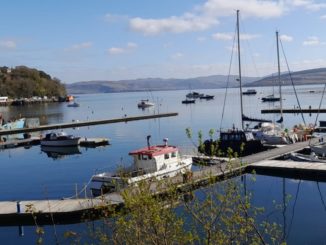
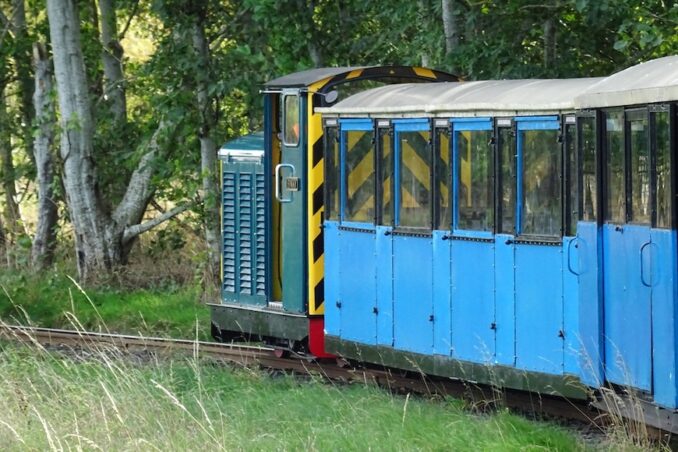
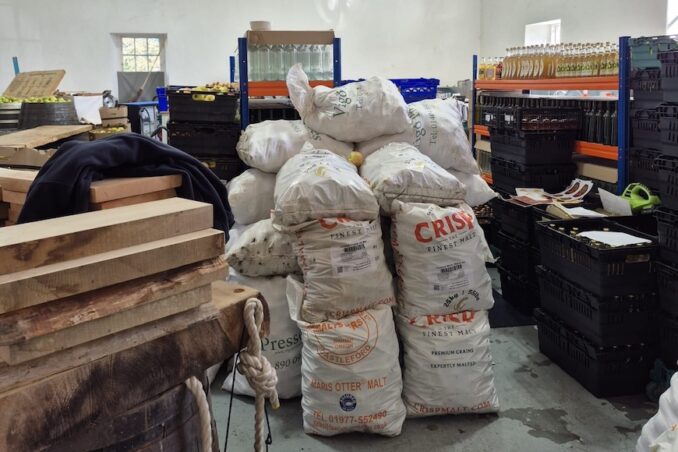
The second half of our trip into Northumberland started with a drive into the countryside to the village of Heatherslaw which is the home of the furthest north narrow-gauge steam railway in England. The Heatherslaw Light Railway starts at their depot and then trundles along slowly for 2 miles as it follows the bank of the River Till to Etal. Wonderful views of the river, farmland and local flora and fauna. Etal has both the ruins of Etal Castle and an active Cider Mill in what was the chapel of the castle.
© John Tull 2025, Going Postal
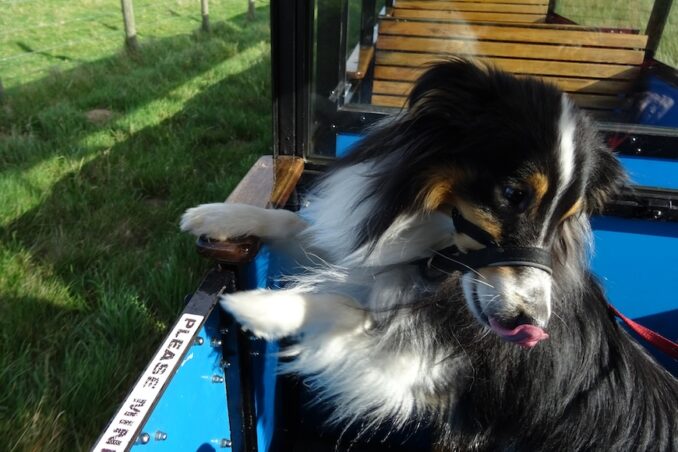
This also happened to be the Sheepdog’s first trip on a train and he became an instant fan. The small carriages have windows only on the side of the prevailing wind so he enjoyed hanging his head out over the open side and catching new smells on the passing breeze.
© John Tull 2025, Going Postal
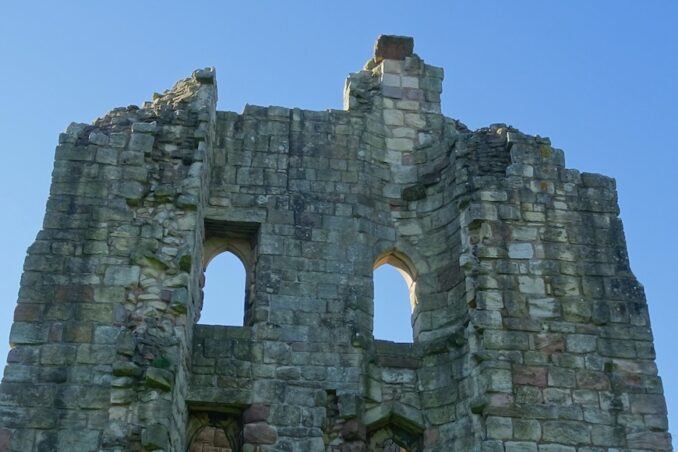
Etal Castle was a key fortress against the Scots and Border Reivers until the Act of Union. After that, it fell into disrepair, the owning family having built themselves a new manor house on the other side of Etal. The castle was “quarried” but enough remains to give the impression of how it was in the past, complete with haunting flocks of crows.
© John Tull 2025, Going Postal
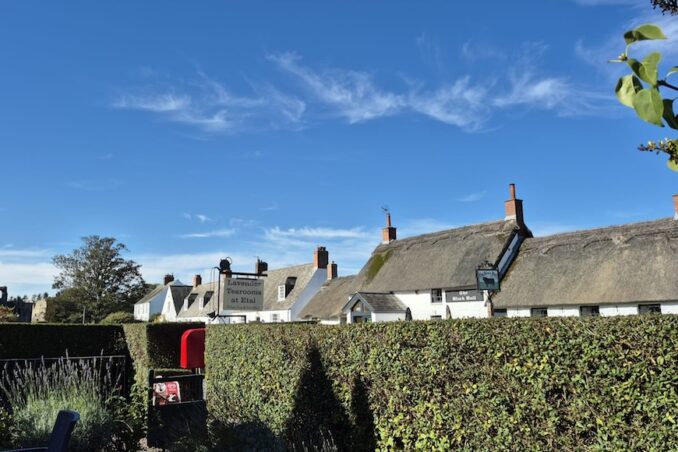
After that a visit to the adjacent Old Chapel Cidery, we went on to Etal Village for a ploughman’s lunch at, surprise, the Post Office/Teashop opposite the 1830s Black Bull, supposedly the only thatched pub in Northumberland. After returning on the light railway back to Heatherslaw, we then drove on to Ford.
© John Tull 2025, Going Postal
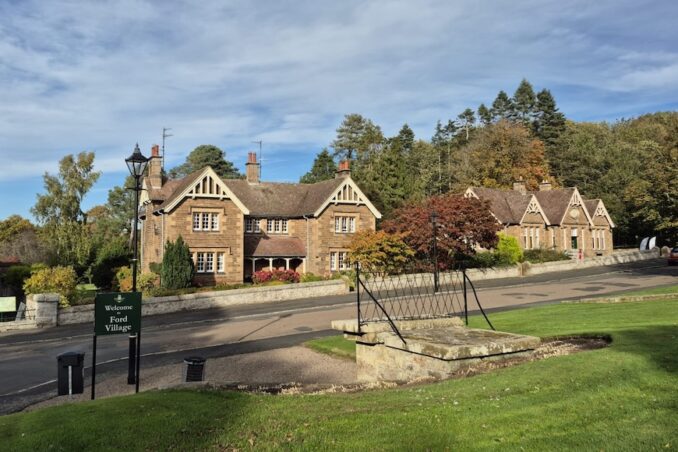
Etal and Ford are both “model villages” created by the Victorians to supposedly improve the lot of the peasants as well as “improving” the view, so similar to modern Poundbury. Both are well maintained and give off a 1970s vibe where you expect an Austin Cambridge or Morris Oxford to appear around each corner. Both villages and the surrounding area belong to the Ford and Etal Estate so all the houses are leasehold and the residents have rules and restrictions to follow, again like Poundbury.
© John Tull 2025, Going Postal
Ford village has the Lady Waterford Hall, an old school with Pre-Raphaelite murals on the walls painted by the former Lady of the Manor. Interesting that this now genteel village was constructed to replace the peasants’ hovels and to introduce sanitation but there appear to be far fewer houses than you would expect needed given the large numbers of labourers on the land that would then have been required. Where did the peasants who didn’t make the grade go?
© John Tull 2025, Going Postal
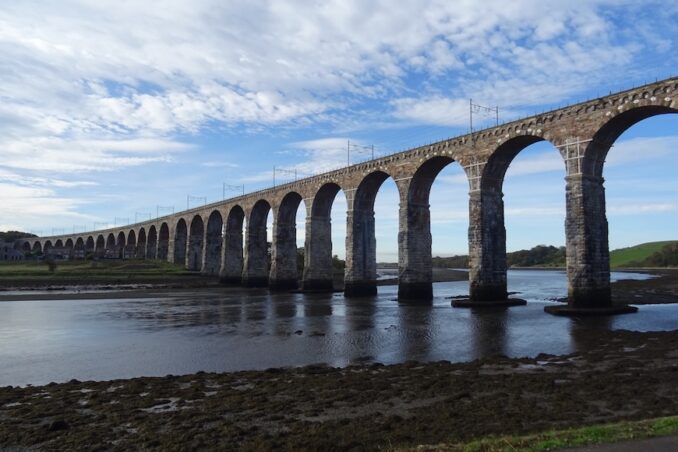
The following day, by mutual agreement including the Sheepdog, was a return trip to Berwick-upon-Tweed to walk from the walls to the station, down to the river and along the bank to view the three bridges from below. First is the impressive multi-arched, curving railway viaduct that was a joy to behold both visually and for its Victorian engineering completed in 1850.
© John Tull 2025, Going Postal
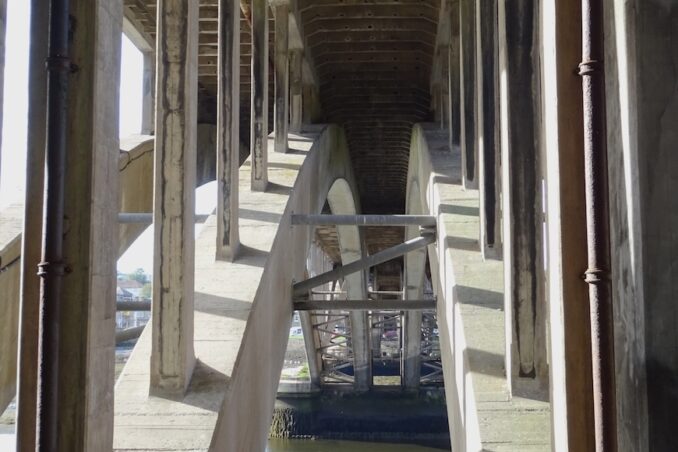
Next is the “new” road bridge built in 1927. A series of arches, the longest being the two nearest the town, with internally supporting pillars, is itself quite an impressive concrete engineering feat for the time.
© John Tull 2025, Going Postal
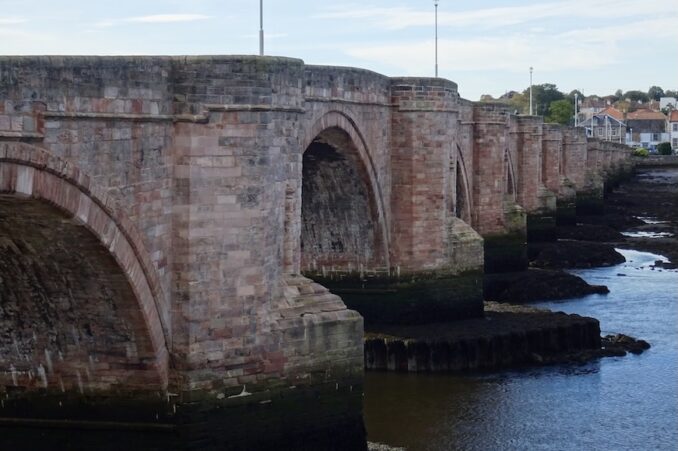
This replaced the “old” road bridge that dates from 1634 and which now appears to be used by pedestrians only.
© John Tull 2025, Going Postal
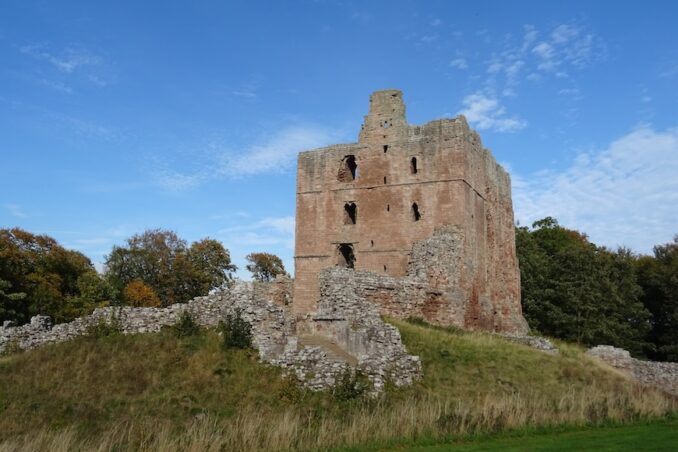
Following our walk and a brief lunch in the town, not in a Post Office for a change, we took a drive out again into the Scottish borders. First stop being Norham Castle standing above the bridge over the Tweed which forms the boundary. Again a castle with a history of fierce battles and sieges that became redundant after the Act of Union. Unfortunately, like Etal, it was also “quarried” with all the exterior dressed stone lost leaving the decaying rubble cores of the walls. You can only access the grounds, as the castle itself is now deemed unstable, but the National Trust have at least started to restore the outer perimeter walls.
© John Tull 2025, Going Postal
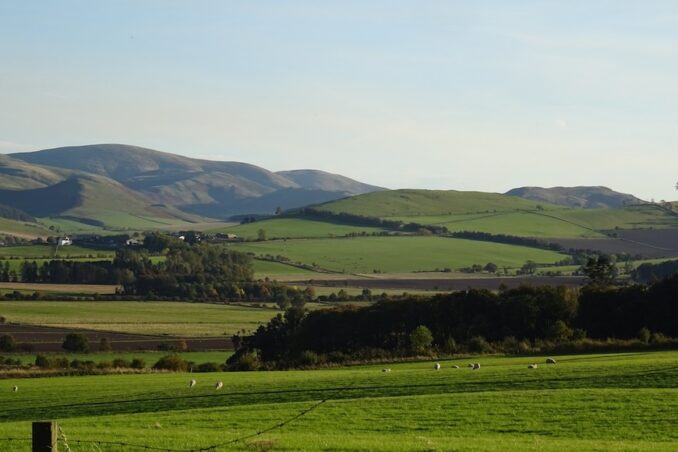
From a pleasant walk around Norham, as no one else was visiting, we drove over the border to Coldstream stopping for tea at the Hirsel Estate park and gardens, a place to return to and spend more time at in the future, and then on to Kelso. We did not have time to stop in Kelso but also a definite place for a future return. It does have a somewhat confusing one way system so although getting into Kelso was no problem, getting out was – which I blame on the Sheepdog’s navigation ability and not my driving skills! The return was across the Kelso Bridge and going via Linton and Midrum affording superb views of the Cheviots, only briefly spoiled by a windfarm en route which typically was not generating despite the stiff onshore breeze.
© John Tull 2025, Going Postal
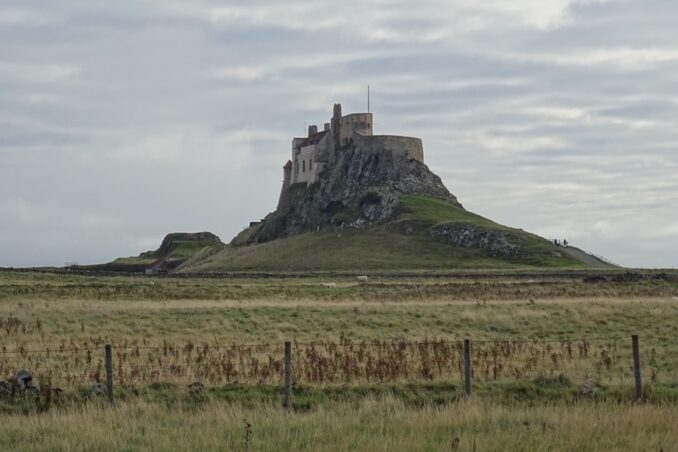
Penultimate day was a trip out to Lindisfarne across the tidal causeway which had opened just as we arrived. A bit of a disappointment to me as it is a large windswept flat island apart from the promontory upon which sits the castle. Lindisfarne Castle itself, although appearing impressive from a distance, close to was not so. The ruined priory was interesting but not that much of it remains. Lindisfarne village now appears to primarily be an outlet for local commercially made mead and only has one, overcrowded pub. Disappointed because my expectation was that it would have literally been a Holy Island but that aspect has gone and it is now just a crowded global tourist destination.
© John Tull 2025, Going Postal
Last day was the run back down the A1/M1 and so on. No issues with the Landy, in fact the exercise seemed to make the engine run smoother although that may have been down more to the diesel particulate filter at last getting a regeneration as normal wanderings around Herefordshire never seem to induce this.
Best day? The trip to Ford and Etal villages, the Heatherslaw Railway and Etal Castle, like stepping back into an England as it was in my childhood, with pristine countryside unspoilt by litter and unnecessary street furniture. Favourite place? Berwick-upon-Tweed.
The only downside was developing a cough later in the holiday which by the time we got home had developed into yet another chest infection so more antibiotics and tests to come…
Would we go again to Northumberland? Despite the long journey, a definite “yes” although in a different holiday let perhaps closer to the border. Also, to make a stop on the way up at a good, dog friendly hotel somewhere near Hadrian’s Wall for an exploration of our Roman past.
Postscript: Ended up in hospital with pneumonia but that’s another story…
© John Tull 2025