John Martin from Haydon Bridge made his name painting the end of the world, so convincingly that one London gallery had to put a railing round his picture to hold the crowds back. He also found time to design London’s sewers. One of his brothers set fire to York Minster and another walked round Newcastle in a tortoiseshell hat calling himself the Philosophical Conqueror of All Nations. All in all a perfectly normal Northumbrian family.
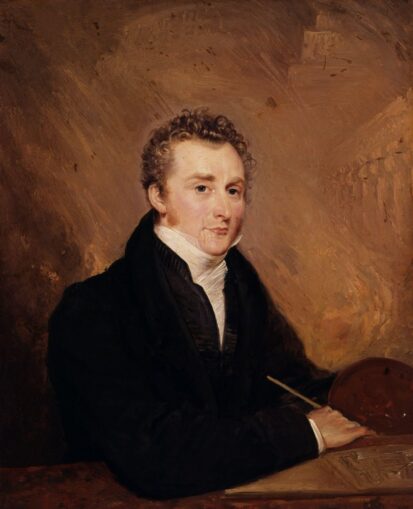
Henry Warren, Public domain, via Wikimedia Commons
In February 1821 the British Institution had to put a railing around one of John Martin’s paintings. The crowds were pressing too close to the canvas. The picture was Belshazzar’s Feast, a vast scene of biblical disaster, and its 31-year-old painter had just become the most talked-about artist in London.
He grew up in a humble cottage in Northumberland. He left school at 14. And he ended up so deeply embedded in the visual language of cinema that Hollywood directors were copying him before they fully realised it.
A humble cottage near Hexham
John Martin was born on 19 July 1789 at Haydon Bridge, about 7 miles from Hexham. His father Fenwick was a former fencing master who boasted he was “not afraid to face any man in the world as a fencer or pugilist”. There were four Martin sons, and all four turned out distinctly odd.
William, the eldest, became an inventor who decided in his spare time to reject Newton’s law of gravity. Richard spent 29 years in the army, by some accounts fought in the Peninsular War and at Waterloo, and rose to Quartermaster Sergeant in the Grenadier Guards. Jonathan was a religious obsessive (more on that in a bit).
John, the youngest, was the most conventional of the four… but this is relatively speaking.
At 14 he was apprenticed to a coachbuilder in Newcastle, painting heraldic crests on carriage doors. The apprenticeship soured over a wage dispute. He switched to studying under a local Italian artist named Boniface Musso, and in 1806, aged 17, followed Musso down to London (getting robbed on the ship on the way). For the next few years Martin painted glass and china to pay the rent while trying to break into the Royal Academy.
His first oil painting submission in 1810 was rejected. He sent the same canvas back in 1811 and got it hung.
The painting that needed a railing
John Martin, Public domain, via Wikimedia Commons
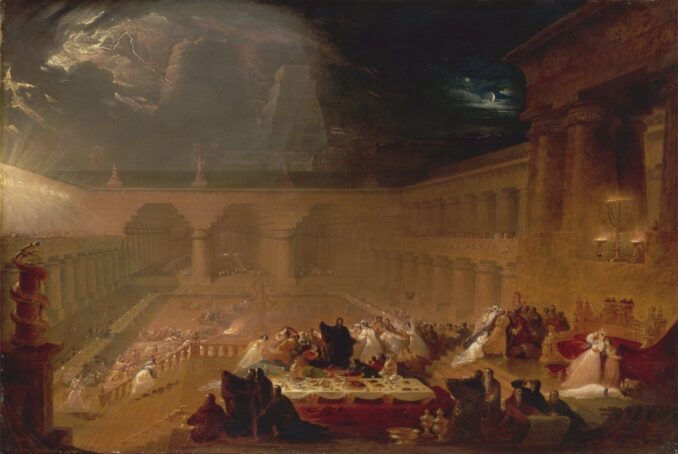
Martin’s big moment came in February 1821 at the British Institution with Belshazzar’s Feast. The scene is from the Book of Daniel. A Babylonian king throws a banquet. A disembodied hand writes a doom prophecy on the wall. The city outside has hours to live.
Martin captured this doom in many clever ways: Mesopotamian columns receding to the vanishing point, lightning above the tower, a crowd of thousands rendered in miniature, the writing on the wall glowing brighter than the banquet lamps. It won the Institution’s 200-guinea prize. More usefully, it pulled in such crowds that a railing had to be put up to keep people from touching the surface.
Martin was 31. Thirteen years later the Westminster Review called him “the most universally popular painter of the day”, and it did not mean it kindly. He spent the next 30 years painting variations on the same theme: vast architecture, tiny humanity, a sky full of judgement.
The Mad Martin family business
While John was getting wealthy painting apocalypses, his brother Jonathan was busy attempting to bring one about in real life.
Jonathan Martin had been press-ganged into the Royal Navy at 22, been thrown out by the Methodists, become a self-appointed wandering preacher, and gradually convinced himself that the Church of England’s clergy were corrupt agents of damnation [Editorial note – I’m beginning to think he was the normal one]. On the night of 1 February 1829 he hid inside York Minster after evensong, piled up cushions and prayer books, and set them alight. The fire destroyed the medieval choir roof and gutted the eastern end of the building.
The jury found him guilty but insane, and the judge had it recorded as not guilty on the grounds of insanity. Jonathan spent the rest of his life in Bethlem Royal Hospital, where he died in 1838.
John, by then famous and with society patrons, was mortified, and paid for his brother’s defence. The press couldn’t resist the symmetry. One Martin brother painted biblical infernos for cash. The other tried to start one in a cathedral. One lady watching the fire was even heard to say “What a subject for Martin!”, without realising which Martin had started it.
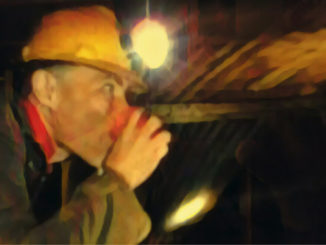
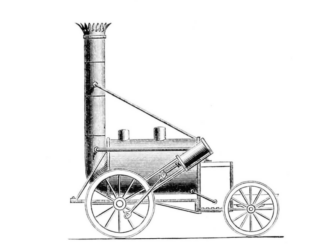
William was possibly the most gifted and maddest of all. He published pamphlets attacking Sir Humphry Davy and Isaac Newton, insisted on perpetual motion, and walked around Newcastle in a tortoiseshell helmet. He also won a silver medal from the Society of Arts for a spring weighing machine, and produced a miner’s safety lamp that some believed superior to Davy’s…. or was it Stephenson’s? If only someone would write an article explaining the differences…
The man who almost designed London’s sewers
This is the part of Martin’s story most people don’t know. While he was painting the destruction of cities, he was also quietly designing one.
From the late 1820s onwards, Martin spent serious time and money publishing engineering proposals for London. He wanted to embank the Thames, run a covered sewer system along both banks, build a ring of railways around central London, and pipe clean water in from outside the city. He published the plans again and again at his own expense, and wrote to ministers and even the Queen.
His 1834 plan, a covered sewer along both banks of the Thames under an embankment with public walks on top, predates Joseph Bazalgette’s Victoria Embankment by a quarter of a century. The big difference was that Martin wanted London’s sewage collected and sold to farmers as manure, while Bazalgette sent it into the river further downstream. In 1836 a committee of noblemen and gentlemen backed Martin’s scheme, but it never got built.
Bazalgette got the credit and a bronze bust on the Victoria Embankment. Martin got nothing. He was a painter who happened to be 25 years ahead of Victorian public health, and the establishment couldn’t quite take him seriously as both.
Pandemonium, and the painting of Hell
John Martin, Public domain, via Wikimedia Commons
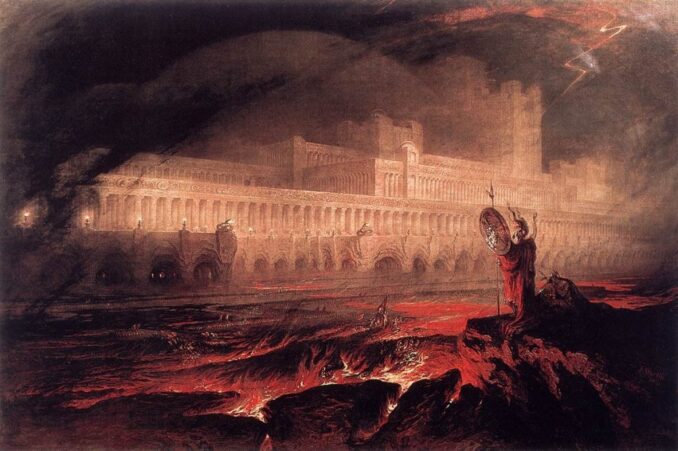
Martin’s other obsession was Milton. He produced a famous series of mezzotint engravings to illustrate Paradise Lost between 1825 and 1827, and returned again and again to the figure of Pandemonium, the capital city of Hell that the fallen angels build in Book One.
The 1841 version, now in the Louvre, is the one most people know. Endless columns of fire stretching to the horizon. A red-orange glare lighting up vast classical colonnades. Blair Satan addressing his armies on a raised plinth. It looks a lot like the inside of an ironworks at full pour. According to his son Leopold, that’s not far off: the idea came from a journey through the Black Country at night, and his father “could not imagine anything more terrible, even in the regions of everlasting punishment”. It seems Dudley was pretty bad even back then.
The apocalyptic trilogy
John Martin, Public domain, via Wikimedia Commons
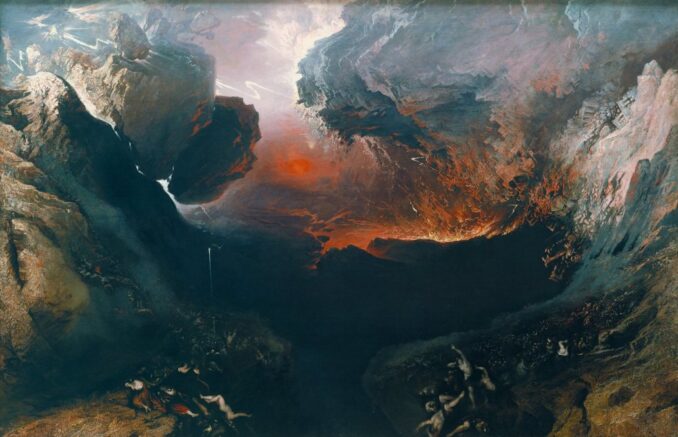
In 1851 Martin began the three canvases that became his final masterpiece. The Great Day of His Wrath, The Plains of Heaven, and The Last Judgement. They were designed as a triptych and shown together.
The three paintings were already on tour when Martin had a stroke in November 1853, and he died on the Isle of Man in February 1854. The tour carried on without him, and over the next 25 years the paintings travelled around Britain, Ireland, New York, and eventually Australia. By 1861 Martin’s promoters were claiming the paintings had already been seen by 8 million people. For most working-class Victorians, this was the closest thing to a cinema they would ever experience, and they paid sixpence for the privilege.
Hollywood’s forgotten storyboard artist
Three of his engravings hang in the Brontë Parsonage at Haworth. The Victorian appetite for cosmic disaster on a grand scale was largely fed by Martin’s prints, which sat on parlour walls across middle-class Britain.
Then came cinema.
D.W. Griffith’s 1916 epic Intolerance includes a recreation of Babylon, and Belshazzar’s Feast was the main inspiration for the set; Griffith kept reproductions of Martin’s pictures in his scrapbook. Ray Harryhausen, the stop-motion man behind the sword-fighting skeletons in Jason and the Argonauts, said of him: “I think he’s one of the first art directors of motion picture.” And Peter Jackson’s Mordor, with its dwarfed figures lit by orange fires beneath an angry sky, looks a lot like a Martin painting given motion.
He more or less invented the look of the disaster film 80 years before anyone could film it.
The fall, and the comeback
Martin’s reputation faded after he died. John Ruskin, the most influential critic in Britain at the time, had already been rude about him in print, sneering at one picture’s sea-foam, painted “with the assistance of an acre of canvas”. The art establishment took the cue and dropped him.
In 1935 the three Last Judgement canvases reportedly sold at auction for £7 the lot. The Tate bought The Great Day of His Wrath ten years later.
Rediscovery began slowly in the 1940s, and the Laing in Newcastle gave him a retrospective in 1970. In 2011 the Laing and then Tate Britain put on major exhibitions of his work, 190 years after Belshazzar’s Feast first drew the crowds.
The coach painter from the cottage at Haydon Bridge is still in there somewhere, still pulling paying audiences into a darkened room to watch the world end.
© Paranoid Android 2026