Genealogy
noun:
a line of descent traced continuously from an ancestor.
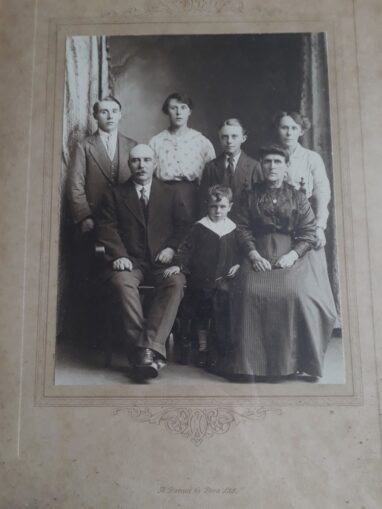
My interest in genealogy began with an old family photograph of my maternal great-grandparents and their family at the time.
My maternal grandfather was born in February 1912 and is the little boy in the front.
There’s no date on the picture but I think it was taken around 1917 – they had another daughter in Jan 1918.
I knew nothing of my g-grandparents apart from having ‘inherited’ a number of Evan’s Bisley participation patches & medals dated between 1898 and 1927, and a silver-plated goblet awarded to him in 1912; he was a member of the Welsh team on 8 occasions in various international shooting competitions.
Researching Mam’s family
Beginning in 2018; I signed up to Ancestry.com; started a tree with what information I had and waited; the site very helpfully went off and searched its database for any references it could find relating to the names/dates on the profiles I had created.
These references are taken from census records, birth, marriage and death records and electoral registers. Other users family trees, where there was any crossover, were also flagged up.
This made it rather straightforward, although there was the inevitable cross-referencing to do; my g-grandparents had a very common Welsh surname and weren’t the only ‘Evan & Margaret’ in the Rhondda at that time.
As a ‘sometime’ hobby the researching was interesting enough with the occasional surprise along the way – my g-grandparents had 7 children (I only knew of 5 of them); an infant death (not uncommon an event as I would find out) and another daughter in 1918.
Both Evan, Margaret and their children were born in Ystradyfodwg (renamed to Rhondda from 1897) – Evan and his eldest Ewan were both [rather inevitably!] employed as miners. Richard joined the army in 1920 and later appeared in the 1939 register1 as a shoe shop manager in Aberystwyth.
Grandad was also listed in the 1939 register as a builder’s carpenter and living in Oxford.
Both Margaret and Catherine married and lived in the Rhondda.
1The 1939 register, although ‘census-like’ in format, was unofficial; it was more of a snapshot of the population used mainly to find who lived where for the issuing of identity cards, ration books etc.
The 1931 census records were lost in a fire in 1942 and the 1941 census was cancelled for obvious reasons, meaning the next census wasn’t carried out until 1951.
Under the 100-year rule for data protection, this will not be released to the general public until 2052 and with genealogy becoming increasingly popular, this is rather frustrating.
A few petitions have been started to try to have it released earlier, around 2031 – but we all know what governments think of petitions, don’t we….
(The 100-yr rule doesn’t apply to the 1939 register, which was released to the public around 10 yrs ago).
Dad’s family
Researching dad’s family was going to be a lot less straightforward.
Born in Dec 1936, he was adopted at 4 months old.
I had made a tentative offer to do some research on his behalf, but he wasn’t all interested in finding his birth parents – all he would tell me was that he born in Abergavenny and ‘came from farming stock’.
(He had applied for his first passport in 1983, and as I later found out he knew a little more than he was telling me..)
However, with his passing away in 2024, I felt that there would now be no harm in looking.
Of course, there was always the risk that I might uncover something unpleasant, or that any existing family may not be too pleased to hear from me, but I went ahead with it anyway.
The GRO (General Register Office) couldn’t provide a copy of his birth certificate through their website – there was a ‘missing window’ of birth dates between 1931-1985, so I had to contact them by phone.
They were very helpful and put me in touch with local Social Services and I was assigned someone to deal with my enquiry. As I was a ‘proscribed person’ (i.e. a child of an adoptee), there were some small official hoops to go through and some ££s to be given away.
It took a few months – Government offices work v..e..r..y….s..l..o..w..l..y… but eventually I obtained a copy of Dad’s birth certificate – it gave his mother’s name (Nancy H.), her home address (a farm!) and his place of birth – Nanty-derry House, Goytre, which is not far from Abergavenny and which rather intriguingly, between the years 1925-1948, served as a maternity ward for unmarried women.
There was no father’s name listed.
The 1939 register showed Nancy was born in 1910 and still living at the farm. Her marital status was listed as ‘single’ – which explained the need for Nanty-derry House.
I researched the farm and found it was still in the H. family and so I wrote an introductory email to the current owner Clare (nhrn) who I guessed was probably a niece of Nancy and therefore my dad’s cousin.
A few days later I received a reply – She was overjoyed at my making contact.
She adored her Aunty Nancy, and knew that she had had a child and she – Clare – had hoped that one day the child would be traced and was sad to hear of his passing.
She had lots of pictures of my Gran (I found it a little strange using that term… my maternal GM had died when I was two years old) and would be only too happy to share them and wanted to find out about my dad.
So, in late October, Mrs ABS and I made the 40-minute drive from ABS Towers to the farm and spent a couple of hours there learning of my grandmother.
There was one real jaw dropper of a moment in her rather non-standard life.
My Gran didn’t marry until she was 41 – his name was P.G. – her cousin (yes, I know…) and she went to live on his farm in Kenya in 1951.
In May 1935 P.G. had left the UK (which ruled him out as a potential ‘grandad’!) to be a tea farmer in [then] Ceylon, now Sri Lanka). He signed up to the British Army during the war and after the war he came home, married my Gran and they moved out to his rather remote farm in Kenya.
Now, some of you may well thinking (as I was) .. Kenya, early 1950’s… Didn’t the Mau Mau Rebellion start around then?
Yes, it did, in 1952.
.. and in 1954 around 50 Mau Mau attacked their farm.
Thankfully they had a loyal workforce and a noisy dog (gud boi!), so they had enough of a warning and could put their ‘defence plan’ into action – the workers, on P.G.’s instructions, fled away into the jungle and Gran telephoned for help just minutes before the line was cut.
The farm was 9 miles from the nearest help, so reinforcements would not be arriving quickly and it would be just the two of them until then.
P.G. owned a rifle and, as he had been a Major in both the Chindits and the OSS Dep 101, (and a ‘Bisley man’) he knew how to use it, despatching 2 of the attackers and injuring several more.
In the meantime, Gran (all 5’1” of her!) armed with their shotgun and, dodging bullets and grenades, blasted away through the windows at anything outside that moved!
The Mau Mau were armed with automatic rifles and grenades and a few attackers climbed onto on the metal roof of the farmhouse and, using axes, tried to chop their way inside.
Just as their ammunition was starting to run low, help arrived in the form of some well-armed police and the attackers fled; P.G. then left the farmhouse and ‘took the fight to the fleeing Mau Mau’ despatching another of them in the action.
I was listening to all this (slightly open mouthed it should be said) while sitting in a warm farmhouse on a slightly chilly and damp October day.
This was almost Boy’s Own Stuff, but they would have fighting for their lives – those Mau Mau weren’t making a social call for tea and cake.
The gun fire, grenade explosions and the ones on the roof – it must have been terrifying.
Perhaps not unsurprisingly they returned the UK not long after. For their actions P.G. was awarded an MBE2 and Gran received a Commendation of Brave Conduct from the Queen.
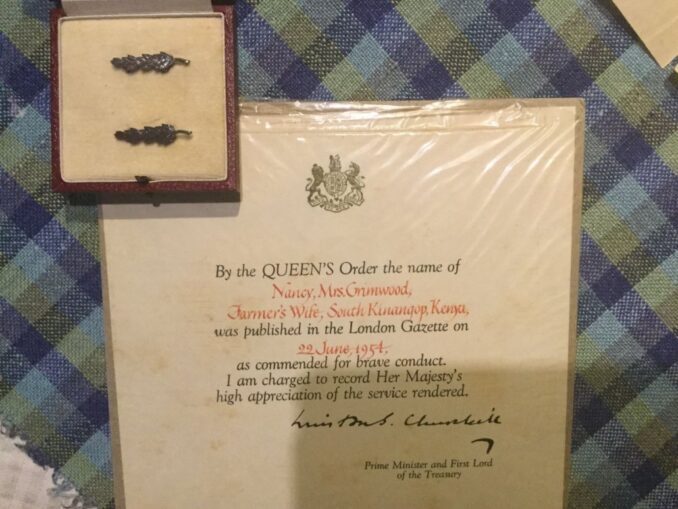
This picture was emailed to us by one of the family a few weeks after our visit; we couldn’t immediately identify the signature of the Prime Minister, and not being able to think who it would have been (I know, I know!), we needed to look it up.
As I was still reading some of the newspaper articles about the attack that were also attached to the email, Mrs ABS did so:
“F*****g hell! That’s Winston bloody Churchill!!”
Mrs ABS doesn’t use expletives all that often, so it certainly brightened up a dreary Sunday morning…
2 P.G. was described to me as a ‘feisty tempered man’ and so it was no surprise to the families, that when the Beatles were awarded their MBEs in 1965, so disgusted was he that he returned his.
Gran had no further children and passed away in 1999 making my brother and I her only surviving immediate family, so her existing nieces and nephews are ecstatic that I’ve made contact with them.
One other thing came out of the visit: I was given my grandfather’s name.
He was described as a “local farmer and married”, which would explain the lack of his name on dad’s birth certificate.
“Nancy would never have destroyed a marriage.”
I was also told that there is a farm ‘in the area’ and the current owners have my grandfather’s surname. However, I’ve decided not to pursue this. Even if it is the same family (and it’s likely it is, the name isn’t a common one and farms do tend to stay in families), I don’t think anything positive would be gained by doing so.
‘Let sleeping dogs lie’
The research into my more recent past has had its uplifting moments – making contact with my dad’s birth family has been an amazing experience – Gran had 5 siblings so suddenly I now have six [2nd] cousins who all until recently none of us had any idea we existed.
… and rather importantly to the family (and my own research of course), that ‘gap’ in their family tree surrounding Nancy can now be updated.
On a separate issue: in 2020, I was contacted via the website, by a lady from Utah who is my 4th cousin 1 x removed; her 3rd g-grandfather and my 4th is our common ancestor.
One of his daughters along with her family, emigrated to the US (unsure exactly when):
1871 – she was living in Ystradyfodwg (there’s that word again…!)
1898 – she remarried in Utah (not only did she lose her 1st husband there in 1896, but also three of her sons, killed in the Utah mining disaster of 1900).
Because of most of what I have found has been recent history, and therefore reliable, the researching has kept me interested.
However, there is only so far back I can go before the records become a bit questionable and ‘anonymous’; I can be confident I have names for my [maternal] 6x G-Grandparents, however I have no idea what they looked like, and probably never will.
Plus, the older the records are, the more difficult they can become to decipher – handwritten 400 yr old parish records can even defeat modern digitialising – I have a name for my 13x G-Grandfather: the records seem to suggest he was the father of 4 children although according to the birth and death dates I have for him, 3 of his children were born after he died, at the age of 9!
While he may well be in my bloodline, that line is distinctly wobbly…
© text & images Afghanistan Banana Stand 2026