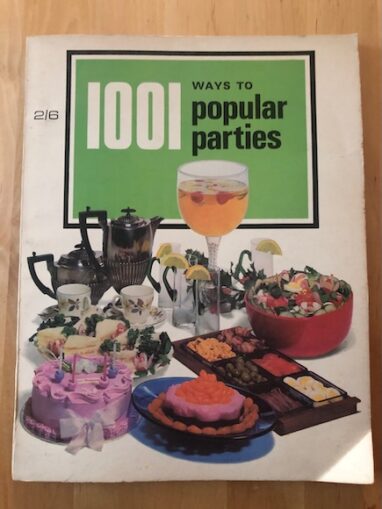
1001 Ways To Popular Parties,
Unknown photographer – Fair use, illustrative of book review
The nights have drawn in and once more we are approaching that strange time of year when apparently everyone is going to parties, or in my case not. So, if any of you are going to be faced with the torment of actually hosting a party and are desperate for ideas, I have once more delved into the world of 1001 Ways to Popular Parties to see how things used to be done in the 60s. While I was around then, my idea of an exciting party involved Pass the Parcel and lemonade, more innocent times.
Not quite innocent (hopefully) is the glamorous¹ world of the cocktail party. It is a phrase that can create all sorts of images; sophisticated ones of a James Bond world of martinis, a blonde in a LBD and a rakishly undone bow tie, or alternatively, a crowd of 18–30s gulping down lurid, over-sweet concoctions with suggestive innuendos for names (now I think of it, a Suggestive Innuendo would be good name for a cocktail!).
First, what is a cocktail, and where do they originate from? There are all sorts of stories about Prohibition and cocktails being created to hide the taste of poorly made hooch, which no doubt did happen. But their history goes back much further, much, much further…
According to that archive of all knowledge, both true and false, Wikipedia, there is mention of an ancient Greek “cocktail” named Kykeon; this appears to have been a term for mixed drinks with wine, water, herbs, flowers and sometimes cheese! (One of Al’s ancestors perhaps?)
Anyway, moving on rapidly from that idea, there are mentions of cocktails as beverages in the early nineteenth century. Originally the term meant a drink with ingredients such as spirits, sugar, water and bitters. Over the years the term expanded to cover all sorts of mixed drinks. Finally, in 1917 the term cocktail party was coined by Julius S. Walsh in St. Louis, Missouri.
As an aside, according to Wikipedia, the first definition of a cocktail appeared in The Balance and Columbian Repository, 13th May 1803, where the editor, Harry Croswell, answered the question “What is a cocktail?”
“Cock-tail is a stimulating liquor, composed of spirits of any kind, sugar, water, and bitters— it is vulgarly called bittered sling, and is supposed to be an excellent electioneering potion, inasmuch as it renders the heart stout and bold, at the same time that it fuddles the head. It is said, also, to be of great use to a democratic candidate: because a person, having swallowed a glass of it, is ready to swallow anything else.”
Meanwhile, back to the subject. 1001 Ways to Popular Parties says that a cocktail party can be held in a fairly limited space and without involving the hostess in too much work (times have changed).
It suggests that time and effort can be saved by buying ready-made savouries; however, I don’t think the quick dash to M&S, Tesco or another purveyor of fine foods was what the authors had in mind.
They suggest tiny vol-au-vents cases can be brought ready to be put in the oven. These could then be filled with such savouries as tinned asparagus in cheese sauce, buttered shrimps, curried beans, minced chicken or turkey². Delicious cheese wafers or cheese-filled sticks could also be brought to add to the savoury bites.
They say that the food should be as attractive as possible, with an emphasis on small savouries that are easy to eat without a plate. This is still good advice today.
They have some suggestions for canapés using pieces of toast, savoury biscuits, potato crisps and hot fried bread as a base. Their garnishes include:
- Strip of smoked salmon and pickled onion
- Sliced hard-boiled egg and tomato
- Chopped walnut and cheese
- Cold ham and chutney
- Beetroot and chopped egg
- Parmesan cheese and chutney
- Stuffed olives and sliced egg
- Chopped chicken, tomato and cress
- Grated cheese and cucumber
- Shredded lettuce and tomato
While some of these don’t sound bad as a sandwich filling, I’m not convinced they really add to the glamour of the evening. However, there are some more exotic suggestions using ingredients such as caviar and smoked salmon (that sounds much more sophisticated).
Caviar Canapés: Spread toast with mayonnaise and then caviar and garnish with small pickled onions and parsley.
Salmon Canapés: Flake and mash salmon with tomato sauce (alternatively mayonnaise). Spread and garnish with cucumber twists.
Smoked Salmon Canapés: Spread toast with savoury butter and arrange strips of smoked salmon across the top. Garnish with savoury butter flowers and parsley.
Pâté Circles: Cut bread in circles with a scone cutter. Spread generously with liver pâté and garnish with one stuffed olive.
Tongue Triangles: Cut bread and tongue in triangles and place one upon the other. Garnish with cucumber and horseradish. (While I would happily try this one, I’m not convinced it would be a crowd pleaser today.)
Cheese Titbits: Spread toast thickly with grated cheese and place under the grill until hot and bubbly. Garnish with tomato and heat quickly again. Serve at once.
Mushroom Toast: Spread toast with creamed mushrooms and heat gently under the grill. Garnish with grated egg yolk.
Bacon Toast: Spread toast with cheese and place a strip of bacon across the top. Cook under the grill and garnish with a pickled onion.
Egg Toast: Place cooked warm scrambled egg on toast and garnish with pieces of anchovy. (If you spread the toast first with Gentleman’s Relish you would have mini Scottish Woodcock, which would be an interesting variation.)
Sardine Toast: Mash sardines well and spread on toast. Heat under the grill and garnish with savoury butter and parsley.
Asparagus Toast: Spread toast with savoury butter and arrange asparagus on the top. Garnish with mustard and cress.
While some of these or variations on them are still popular as a canapé, not all have lasted. Also, why the obsession with pickled onions? Didn’t they have cornichons back then, probably not. I just hope they meant silver-skin onions, not something more rustic.
And now we reach the item you all knew was coming.
Hedgehogs. Place halved grapefruits or oranges on small plates to hold cocktail sticks with sausages and savouries in position. Make six or eight of these with different ingredients and place around the room. Suggested ingredients include:
Oyster Sticks (Angels on horseback): Wrap small pieces of bacon around oysters (presumably tinned smoked oysters, but they do not specify) and secure with cocktail stick. Grill until the bacon is cooked.
Bacon Sticks (Devils on horseback): Wrap pieces of bacon around cheese, chutney, pineapple or olives, grill until bacon is cooked.
Pineapple and Cheese: You have all seen this before, so I won’t bother describing it.
Banana and Date: Cut banana into rounds and spear with pieces of date and cheese.
Sausage Sticks: Cook cocktail sausages and spear with a pickled onion. (Was George involved with pickled onions back in the 60s?)
Sausage and Banana (Now this one is seriously weird): Cut cooked sausages into rings and spear with banana and a walnut. Alternatively, use pickled cauliflower and carrot.
Again, we have some classics, and some probably best forgotten.
Nearly 1200 words and we haven’t yet got on to the booze! To be fair, the book does go into more detail about the food than the drinks. They give a list of a few classic cocktails with brief notes on making them. These include classics such as:
Champagne. Actually, quite a good choice for a party, doesn’t involve excessive mixing or shaking over ice. If you prepare the glasses and use a good Cava or Crémant it need not take long to make or break the bank.
Martini and variants.
Daiquiri. Basically rum and lime juice shaken. Can have different fruit added and blended to give a longer frozen drink. It always seems more of a summertime drink to me.
I’m going to finish with a couple of older cocktails which maybe aren’t as well known today as they used to be:
French 75: This dates back to World War 1 and was first made at the New York Bar in Paris, which later became Harry’s New York Bar by Harry MacElhone. The cocktail was described as having a kick like the French 75mm field gun. It is a variation on a Champagne cocktail with gin, champagne, lemon juice and sugar. It is mentioned in the film Casablanca.
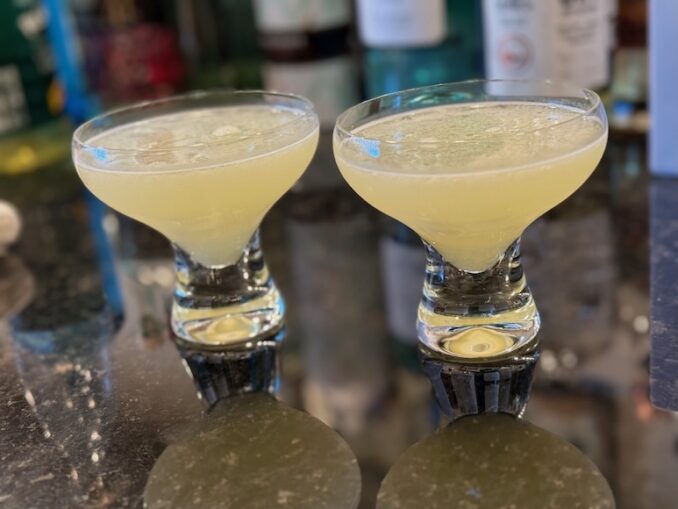
And finally, the Gimlet. This is basically gin and lime and is described as such in 1928. I first came across it in the Raymond Chandler novel The Long Goodbye, where it is described as “half gin and half Rose’s lime juice and nothing else”. I personally prefer half gin and half lime, with the lime made up from 2/3 fresh lime juice and 1/3 Rose’s, shaken with ice.
© Notanumber! 2025, Going Postal
[1] If you know what was originally described as a glamour, then you know how accurately the terms glamour and glamorous are used unintentionally.
[2] The worst vol-au-vent I ever encountered came from the staff canteen in a lunch for a training course and consisted of a vol-au-vent with a wedge of cold corned beef stuck in the top.
© Notanumber! 2025